

On this page
If you have memorised "Br2 adds anti" but cannot say why, one exam question that switches cyclohexene for cis-2-butene will catch you out. The reason is one intermediate, and once you can picture it you can work out the product when bromine adds to a simple alkene.
What is a bromonium ion?
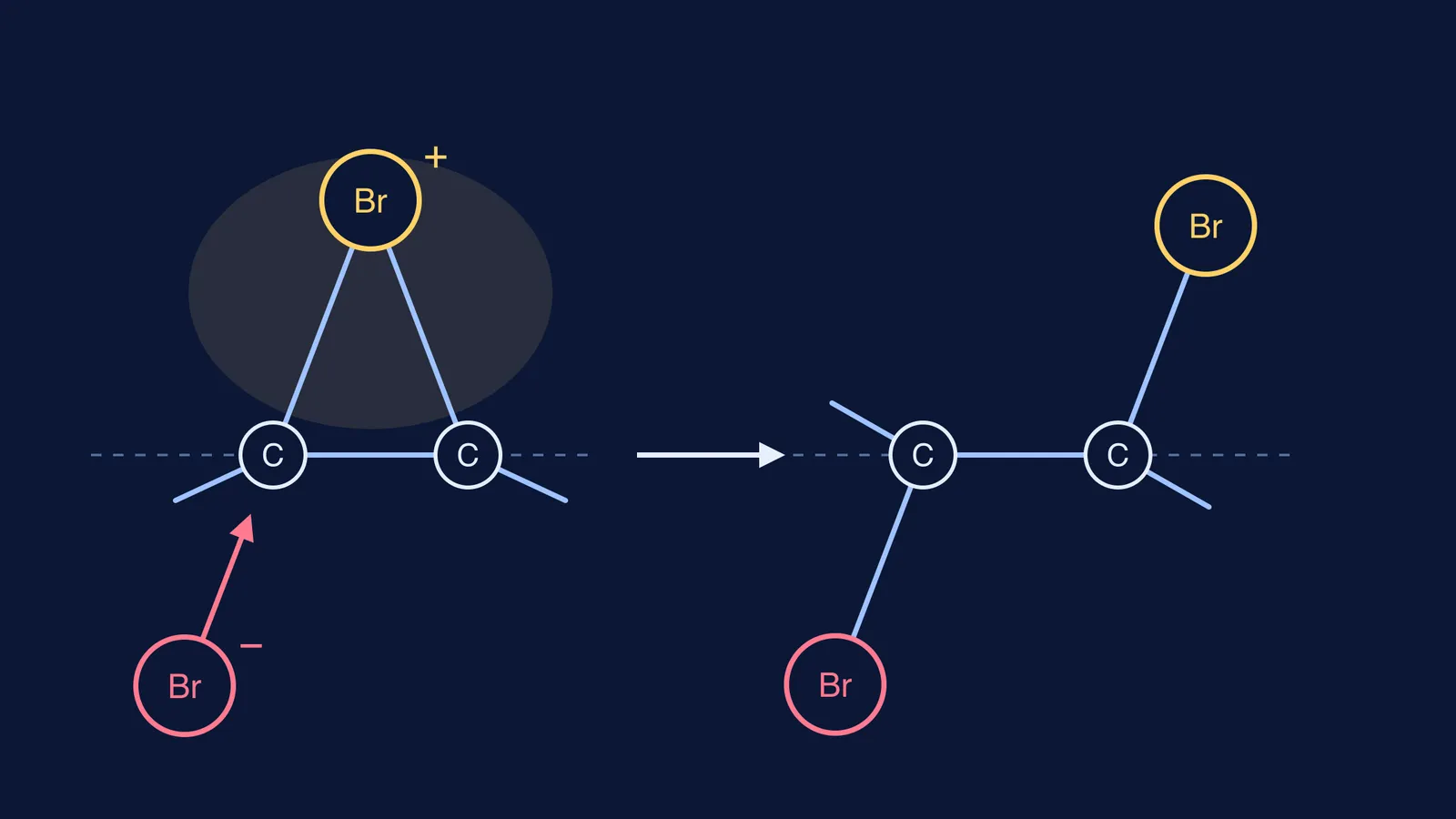
A bromonium ion is a three-membered ring in which one bromine atom bridges both carbons of the former double bond and carries a positive charge. The OpenStax organic chemistry chapter on halogenation/08%3A_Alkenes-_Reactions_and_Synthesis/8.02%3A_Halogenation_of_Alkenes_-_Addition_of_X) describes it as R2Br+, formed in a single step as the alkene interacts with a bromine molecule and bromide ion, Br-, is lost.
The idea is old. Irving Roberts and George Kimball proposed the cyclic intermediate in 1937 in a short paper, The Halogenation of Ethylenes, to explain stereochemistry that a simple open carbocation could not. The same OpenStax chapter notes that George Olah later prepared stable solutions of cyclic bromonium ions in liquid SO2. In 1985 R. Stan Brown's group reported the crystal and molecular structure of the bromonium ion of adamantylideneadamantane, so the ring has been seen directly, not just inferred.
Why does bromine add anti to alkenes?
The bromine atom sits on one face of the molecule, the face the Br2 came from. That face is now crowded and occupied. The bromide ion released in step one is a nucleophile, and it can only reach a ring carbon from the other side.
It attacks one carbon from directly behind the C-Br bond, much like an SN2 reaction. That carbon-bromine bond breaks, the ring opens, and the two bromines end up on opposite faces. Master Organic Chemistry's walk-through of the mechanism puts it simply: the halide attacks the carbon from the backside of the C-halogen bond.
The same source gives the evidence against a free carbocation. Even bulky alkenes such as cis-di-t-butylethylene brominate stereospecifically, with no hydride or alkyl shifts, which you would expect if a flat carbocation formed and could rotate or rearrange.
Worked example: cyclopentene plus bromine
Work through it in four steps, the way you would in an exam answer.
Draw the alkene flat, with the ring in the plane of the page.
Put Br+ above the double bond, bridging both carbons. Br- is left over.
Send Br- in from below, to either carbon. Open the ring at that carbon.
Read the result: one Br on a wedge, one on a dash. That is trans-1,2-dibromocyclopentane.
The OpenStax chapter/08%3A_Alkenes-_Reactions_and_Synthesis/8.02%3A_Halogenation_of_Alkenes_-_Addition_of_X) states that only the trans product forms, with no cis isomer. Because Br2 could have approached from the top or the bottom face to begin with, you get both trans enantiomers in equal amounts. Cyclohexene behaves the same way: Master Organic Chemistry notes that it gives trans-1,2-dibromocyclohexane as a racemic mixture, with no cis isomer.
What happens with cis- and trans-2-butene?
Open-chain alkenes are where students slip, because "trans product" no longer makes sense. Use the word anti instead and follow the geometry. According to Master Organic Chemistry:
cis-2-butene gives a racemic mixture of (R,R)- and (S,S)-2,3-dibromobutane.
trans-2-butene gives meso-2,3-dibromobutane, which is optically inactive.
This is what stereospecific means: each alkene isomer gives its own product, with no crossover. A quick check is to draw the product in a sawhorse with the two bromines anti. If you can find a mirror plane through the middle, it is meso.
If you get these two mixed up, try the 2-butene case again in the Fermi Problem Library. It has worked problems with a step-by-step solver that explains the reasoning rather than printing an answer.
Does the solvent change the product?
Yes, and examiners like this twist. In water the same bromonium ion forms, but water vastly outnumbers bromide, so water opens the ring instead. You get a bromohydrin, still with anti stereochemistry, as Master Organic Chemistry explains. The opening step follows the same backside rule. You can compare it with ring opening in epoxidation and anti dihydroxylation, and contrast it with the syn addition in cold dilute versus hot KMnO4 with alkenes.
The decolourisation you see when bromine water meets an alkene, covered in our post on tests for unsaturation with bromine water and Baeyer's reagent, runs on this same intermediate. If the wedge-and-dash picture still feels shaky, the Fermi Concept Library covers every concept in physics, chemistry, biology, mathematics and computing, each with its own lesson and its place in the map.


