

On this page
Organic chemistry exams often test the same reagent under different conditions, and potassium permanganate (KMnO4) is a classic example. The temperature and concentration of the reagent completely change how it attacks a carbon-carbon double bond. Whether you are adding groups to a molecule or breaking it apart entirely, understanding these conditions is critical for synthesis questions.
What is the reaction of alkene with cold dilute KMnO4?
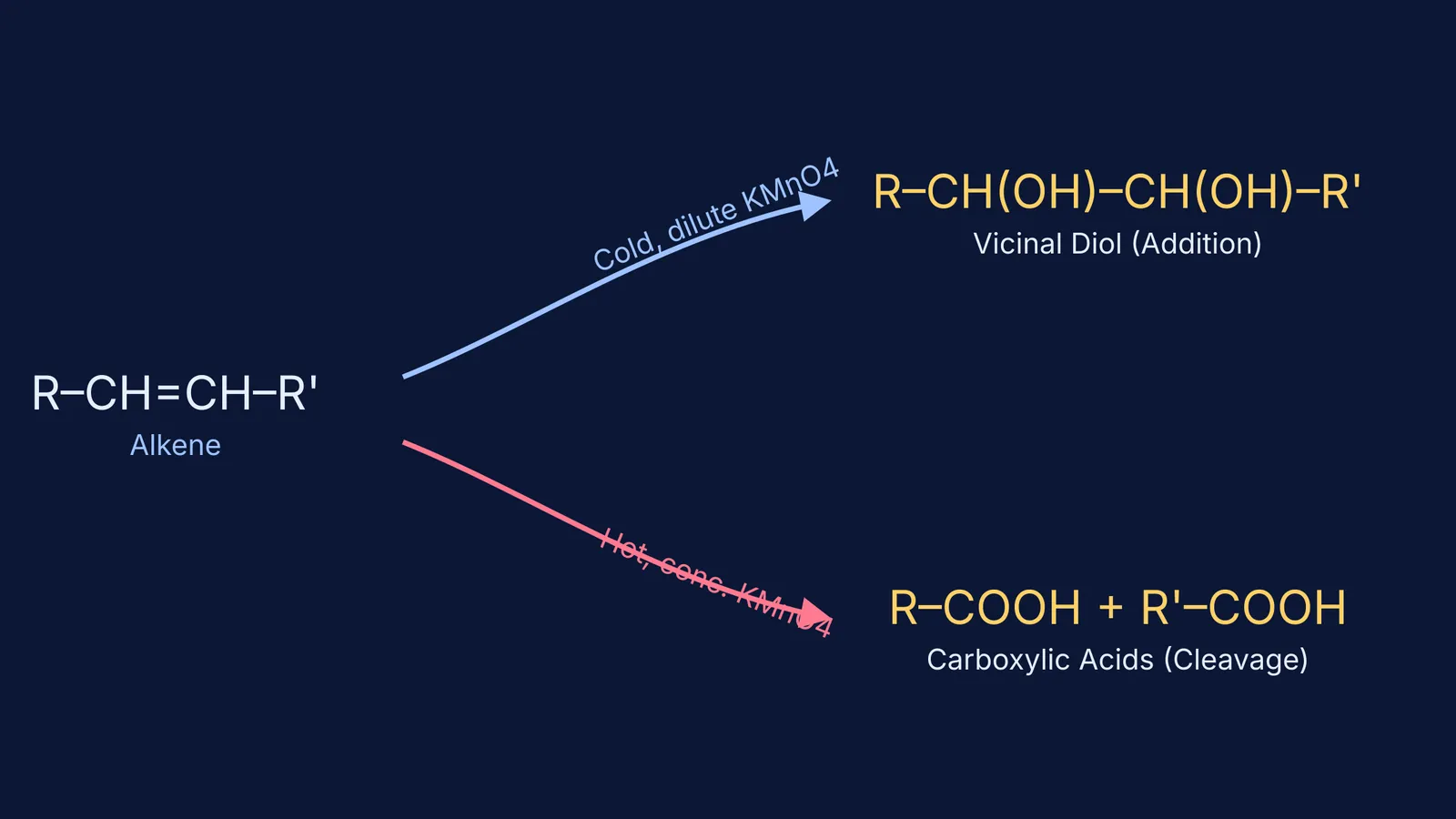
When you treat an alkene with cold, dilute, alkaline KMnO4 (often called Baeyer's reagent), the double bond is not broken completely. Instead, the reaction adds two hydroxyl (–OH) groups to the adjacent carbons.
Cold dilute alkaline KMnO4 adds two adjacent hydroxyl groups to an alkene to form a vicinal diol. This syn-hydroxylation means both –OH groups attach to the same side of the molecule. The mechanism passes through a cyclic manganate ester intermediate. Both oxygen atoms are delivered from the same permanganate ion, ensuring they lock onto the same face of the alkene before the intermediate breaks down in water.
In the laboratory, this serves as a visual test for unsaturation. The deep purple colour of the permanganate solution fades rapidly, and a brown precipitate of manganese dioxide (MnO2) appears. This colour change tells you immediately that a carbon-carbon double or triple bond was present. If you are instead looking to add a single –OH group without breaking the carbon skeleton, you might use hydroboration-oxidation for anti-Markovnikov addition.
What happens when an alkene reacts with hot KMnO4?
If you heat the mixture or use concentrated, acidic KMnO4, it acts as a much more violent oxidising agent. Rather than just adding groups, hot KMnO4 slices straight through both the σ (sigma) and π (pi) bonds of the alkene.
This process is called oxidative cleavage. The original molecule splits into two distinct fragments. Whether you get a ketone, an acid, or a gas depends entirely on what was attached to the vinylic carbons before the split. The reaction actually starts the same way—forming a diol—but the high temperature and acidity force the diol to oxidise further, breaking the carbon-carbon bond entirely.
If you have gaps in your understanding of how these bonds break and rearrange, the Fermi Concept Library offers a clear lesson on alkene oxidation and its place in the chemistry map.
How do you predict the products of hot KMnO4 cleavage?
When tackling exam questions, you can predict the cleavage products by looking at each carbon of the original double bond. Treat the left and right halves separately. Imagine drawing a line straight through the double bond, and look at the substituents on each side. Here is the framework for predicting the pieces:
Unsubstituted carbon (=CH2): The terminal carbon fully oxidises. It first forms formaldehyde, which oxidises to formic acid, and finally breaks down completely to form carbon dioxide (CO2) and water.
Monosubstituted carbon (=CHR): A carbon with one alkyl group attached initially forms an aldehyde. Because hot KMnO4 is a strong oxidant, it immediately pushes the reaction forward, so the fragment becomes a carboxylic acid (RCOOH).
Disubstituted carbon (=CR2): A carbon with two alkyl groups attached forms a ketone (R2C=O). Ketones strongly resist further oxidation, so the reaction stops there for this fragment.
How does hot KMnO4 compare to ozonolysis?
Students often confuse hot KMnO4 cleavage with ozonolysis. While both break the carbon-carbon double bond, their products differ on monosubstituted carbons. The key difference lies in the strength of the oxidation.
If you use reductive ozonolysis (using O3 followed by Zn and H2O or dimethyl sulfide), a =CHR group stops at an aldehyde. The reducing agent prevents further oxidation. Because hot KMnO4 acts similarly to oxidative ozonolysis (using O3 followed by hydrogen peroxide), it pushes that aldehyde one step further into a carboxylic acid.
Once you have formed these ketones or carboxylic acids, you might need to convert them back to alkanes for a synthesis question. In that case, you would look at Clemmensen vs Wolff-Kishner reductions to remove the oxygen.
Practising with cyclic and straight-chain alkenes
Try applying the rules to 2-methylbut-2-ene. The double bond splits down the middle. The left side is a disubstituted carbon (attached to two methyl groups), so it becomes propanone (a ketone). The right side is a monosubstituted carbon (=CHCH3), so it becomes ethanoic acid.
Cyclic alkenes offer another great way to test your understanding. If you treat cyclohexene with hot concentrated KMnO4, the ring breaks open. Because both carbons of the double bond are monosubstituted (=CHR), both ends of the resulting chain oxidise to carboxylic acids. You end up with a single straight-chain molecule: hexanedioic acid (adipic acid).
When you are ready to test your organic conversions, the Fermi Problem Library has worked problems with a step-by-step solver that explains the reasoning rather than printing an answer.


