On this page
A wedge-dash drawing squeezes a 3D carbon onto flat paper. It shows two bonds in the plane of the page, one wedge coming towards you and one dash going away. To give that carbon an R or S label, you need two skills: ranking the four groups, and knowing which way you are looking. If wedges and dashes still feel slippery, start with our guide on how to read and draw wedge and dash representations.
How do you rank groups by the CIP rules?
The ranking system was set out by R. S. Cahn, Christopher Ingold and Vladimir Prelog in their 1966 paper Specification of Molecular Chirality, which refined and extended a system they had applied to organic configurations in and before 1956. IUPAC's current recommendations state the first sequence rule plainly: "higher atomic number precedes lower" (IUPAC Blue Book, P-92).
Look only at the atoms directly attached to the stereocentre. Higher atomic number wins: Br > Cl > O > N > C > H.
If two attached atoms tie, list the three atoms on each, highest first, and compare at the first point of difference. An ethyl carbon carries (C, H, H) and a methyl carbon carries (H, H, H), so ethyl ranks higher.
Count double bonds twice. IUPAC's rule is that "double and triple bonds are split into two or three bonds respectively" (IUPAC Blue Book, P-92). So a CHO carbon reads as (O, O, H) and beats a CH2OH carbon at (O, H, H).
The same ranking drives E and Z for alkenes, so if you have practised assigning E and Z configuration, you already know this step.
Why should the lowest-priority group be on the dash?
IUPAC's recommendations give the chirality rule in Vladimir Prelog and Günther Helmchen's words: the path of the top-ranked groups is followed "from the preferred side of the model, that is, the side remote from the group of lowest precedence" (IUPAC Blue Book, P-92). Clockwise gives R; anticlockwise gives S.
A dash points behind the page, so when group 4 is on the dash you are already standing on the correct side. You can trace 1 to 2 to 3 straight off the paper and ignore group 4.
Worked example: butan-2-ol with H on the dash
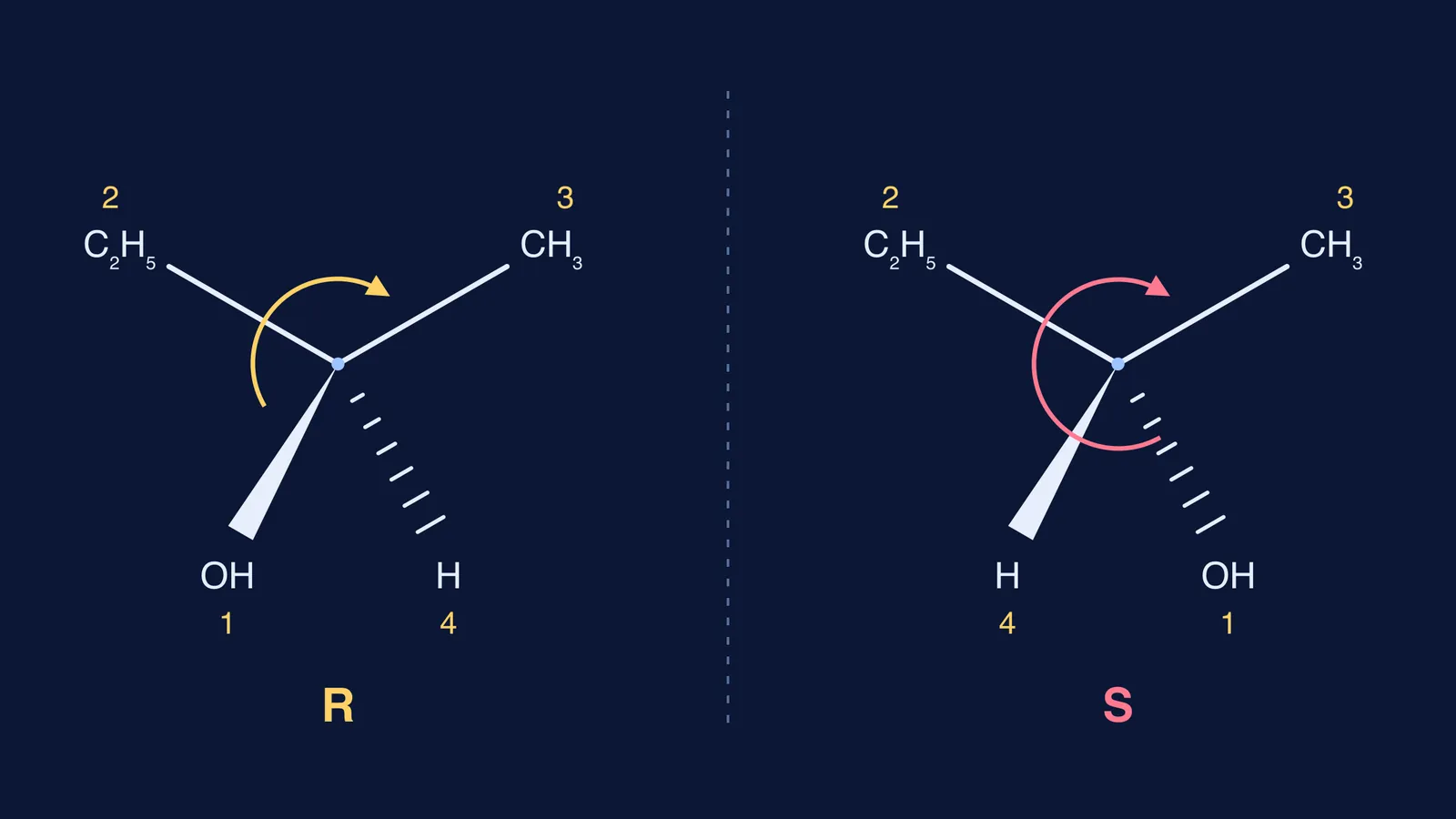
Draw C2 of butan-2-ol with ethyl going up-left, methyl going up-right, OH on a wedge going down-left and H on a dash going down-right.
Rank: OH is 1 (oxygen), ethyl is 2, methyl is 3, H is 4.
H is on the dash, so read directly.
Trace OH (down-left) to ethyl (up-left) to methyl (up-right). Your finger moves clockwise.
Answer: R.
What if the lowest-priority group is on a wedge?
Now group 4 points at you, so you are looking from the wrong side. Every turn you see is the mirror of the true one. The fix is the reversal trick: read the direction as drawn, then flip the letter.
Take the same molecule but swap H and OH: H on the wedge going down-left, OH on the dash going down-right. Trace OH (down-right) to ethyl (up-left) to methyl (up-right). It looks clockwise, which would be R, but H is on the wedge, so the answer is S.
You can check that answer another way. Swapping any two groups on a stereocentre inverts it, and this drawing is the R molecule with H and OH swapped, so S agrees.
If group 4 is in the plane of the page, swap it with whatever group is on the dash. Group 4 is now on the dash, so read the turn directly, then reverse the letter, because you made one swap.
A 30-second checklist for exam questions
Number all four groups before you look at the direction. Ranking and reading are separate steps.
Rank by the first atom, not the size of the group. CH2OH beats C(CH3)3, because at the first point of difference O beats C.
Find group 4. On the dash: read. On a wedge: read, then reverse. In the plane: swap with the dash group, read, then reverse.
Trace only 1 to 2 to 3. Do not loop through group 4.
Write the letter with a one-word reason in the margin ("dash" or "reversed") so you can recheck quickly.
Most wrong answers come from step order: students trace before ranking, or forget to reverse for a wedge. If you get the ranking right but the letter wrong, work a few drawings in the Fermi Problem Library, where the step-by-step solver explains the reasoning rather than printing an answer, so you can spot which step flipped. For the ideas underneath, such as chirality and stereoisomers, the Fermi Concept Library gives each concept its own lesson.
Once wedge-dash drawings feel routine, try the same task on a flat cross: R and S in a Fischer projection uses the same reversal idea for horizontal lines.