

On this page
What do solid and dashed wedges actually mean?
When you study organic chemistry for CBSE Class 11, JEE, or NEET, representing three-dimensional molecules on a flat notebook page is one of the first major hurdles you face. Carbon atoms with sp³ hybridization adopt a tetrahedral geometry with bond angles of approximately 109.5°, yet paper has only two dimensions. To bridge this gap, chemists use wedge-and-dash notation. According to William B. Jensen's historical analysis in the *Journal of Chemical Education*, this convention became standard after Donald Cram and George Hammond popularized it in their 1959 textbook *Organic Chemistry*.
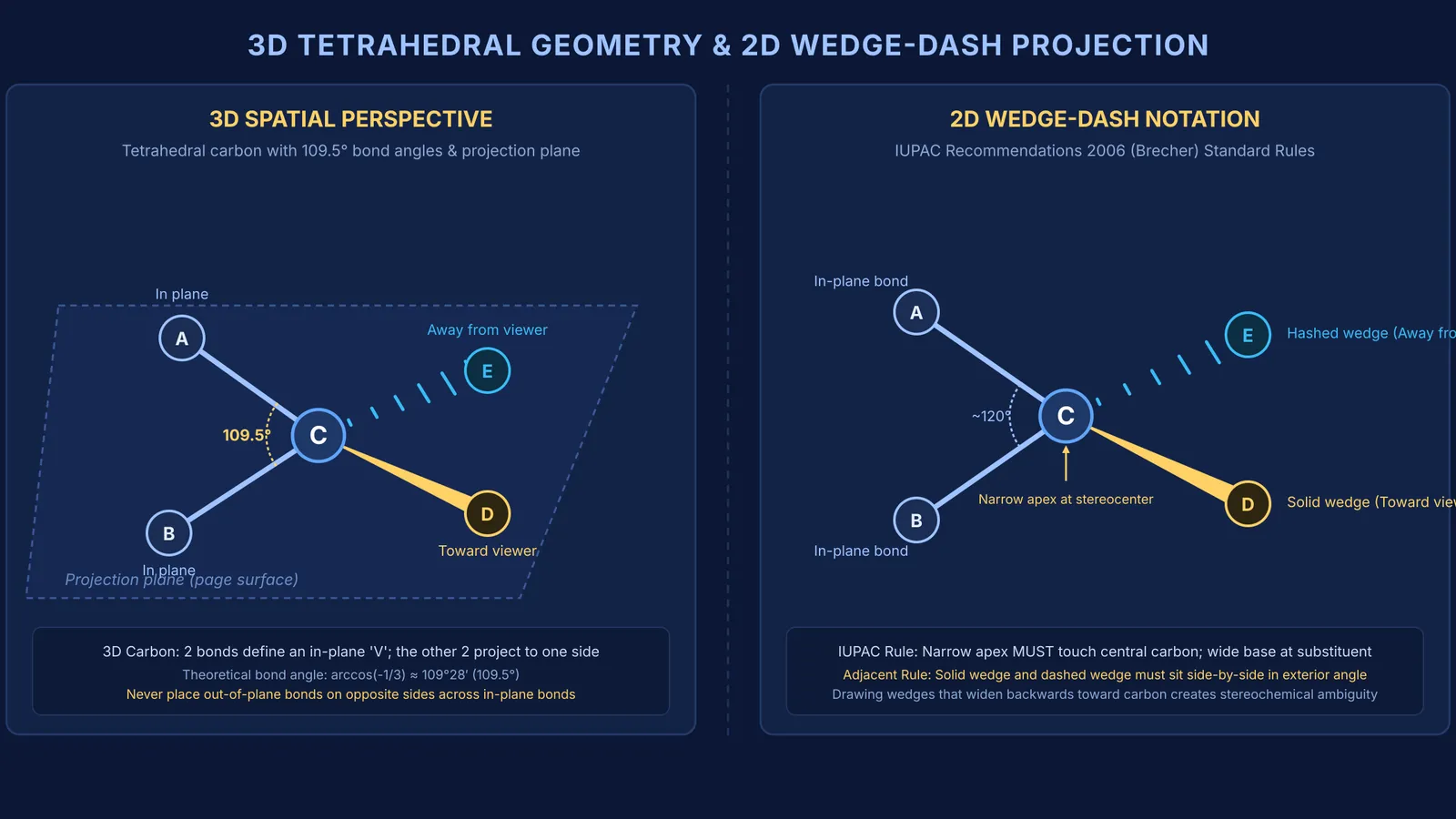
The notation uses three distinct bond types:
Normal solid line (—): Indicates a covalent bond that lies entirely in the plane of the paper or screen.
Solid wedge (▲): Represents a bond projecting out of the plane, pointing straight towards the viewer.
Dashed or hashed wedge (⫵): Represents a bond pointing into the page, projecting away from the viewer.
The formal graphical standards are defined by IUPAC Recommendations 2006, authored by Jonathan Brecher in *Pure and Applied Chemistry*. Brecher emphasizes a critical rule that students frequently break: both solid and dashed wedges must be drawn with their narrow apex attached to the central stereogenic carbon and their wide base pointing toward the peripheral atom or group. Drawing a wedge that widens backward toward the central carbon creates visual ambiguity, particularly in molecules with consecutive chiral centres.
How do you draw tetrahedral carbons without geometric errors?
According to IUPAC graphical recommendations, representing a tetrahedral carbon on a 2D surface requires drawing two bonds in the plane of the page and two bonds out of the plane. The two in-plane bonds form an open angle typically drawn between 105° and 120° to project the true 109.5° tetrahedral geometry.
The most common geometric mistake is scattering the solid wedge and dashed wedge randomly. The wedge and dash must always be drawn adjacent to each other on the exterior, obtuse side of the 'V' formed by the two in-plane bonds. If your two in-plane bonds point up and to the sides, your wedge and dash must point downwards. Placing a solid wedge on one side of an in-plane bond and a dashed wedge on the opposite side across a straight line creates an impossible geometry that obscures the true spatial arrangement.
In a study published in the *Journal of Research in Science Teaching*, Pribyl and Bodner's 1987 study analyzed spatial problem-solving across four organic chemistry courses. They found that students who routinely sketched accurate preliminary diagrams scored significantly higher on spatial chemistry tasks. In contrast, students who struggled with spatial tasks often produced distorted sketches that violated tetrahedral symmetry. Tracing why molecules adopt three-dimensional geometry goes back to Jacobus van 't Hoff's discovery of the tetrahedral carbon in 1874. To strengthen your structural foundation before tackling reaction mechanisms, you can explore core bonding models in the Fermi Concept Library.
How do you determine R and S configurations from wedge-dash drawings?
Reading stereocentres requires assigning absolute configuration using the Cahn-Ingold-Prelog (CIP) priority rules, first codified in Cahn, Ingold, and Prelog's 1966 paper in *Angewandte Chemie International Edition*. Once you identify a carbon atom bonded to four different groups, follow this three-step framework:
Assign priorities (1 to 4): Rank the four attached atoms by atomic number (higher atomic number gets higher priority). If there is a tie, move outward along the bond path until a point of difference is found.
Locate priority 4: Check whether the lowest-priority substituent (frequently hydrogen) is on a dashed wedge, a solid wedge, or an in-plane line.
Trace the priority arc (1 → 2 → 3):
Case A (Priority 4 on a dash): You are looking down the C–4 bond. Trace from priority 1 to 2 to 3. Clockwise indicates *(R)* configuration, while counter-clockwise indicates *(S)* configuration.
Case B (Priority 4 on a wedge): The lowest-priority group points toward you. Trace 1 → 2 → 3 as drawn, then reverse the outcome: clockwise is *(S)*, and counter-clockwise is *(R)*.
Case C (Priority 4 in the plane): Swap priority 4 with the group on the dash, then swap the remaining two groups to preserve stereochemistry. Determine the configuration from this equivalent view.
Consider lactic acid: the central carbon bonds to –OH (priority 1), –COOH (priority 2), –CH₃ (priority 3), and –H (priority 4). If –H is on the dashed wedge, tracing from –OH to –COOH to –CH₃ reveals the absolute stereochemistry instantly. For a broader overview of how optical isomers relate, read our guide to stereoisomerism step by step and our breakdown of counting stereoisomers from chiral centres.
Why should you avoid 3D mental rotation in exam conditions?
During timed exams such as JEE Advanced or NEET, students often try to mentally rotate three-dimensional molecules in their head. Cognitive research shows this strategy frequently backfires under stress. An empirical study led by Mike Stieff and colleagues in 2012 in the *Journal of Chemical Education* investigated spatial problem-solving strategies in organic chemistry. They demonstrated that high-performing students and professional chemists do not rely on exhaustive mental rotation; instead, they convert spatial tasks into algorithmic rules, such as CIP priority tracing and inversion shortcuts.
Using analytical rules reduces working-memory load, eliminating the visual illusions that occur when rotating complex ring systems or multi-centre chains.
Developing speed and accuracy in stereochemistry comes from deliberate practice on varied molecules rather than guessing spatial views. You can practice worked stereochemistry problems with a step-by-step solver that explains the reasoning in the Fermi Problem Library.


