

On this page
Fischer projections save time in exams, but they trap students who read the rotation correctly and still write the wrong letter. The fix comes down to one question: where is the lowest-priority group? Below are the rule, a worked example checked against a textbook, the swap trick, and a safe way to turn a Fischer cross into a wedge-dash drawing.
What do the lines in a Fischer projection mean?
In a Fischer projection, "the horizontal lines represent bonds coming out of the page, and the vertical lines represent bonds going into the page", as OpenStax Organic Chemistry puts it. The chiral carbon sits where the two lines cross and is not drawn.
The same OpenStax section gives two allowed moves. You may rotate the whole drawing 180° on the page, but a 90° rotation swaps the groups going into the page with those coming out, so it gives the other enantiomer. You may also hold one group still and rotate the other three, clockwise or anticlockwise.
How do you assign R and S in a Fischer projection?
First rank the groups. The Cahn-Ingold-Prelog rules in OpenStax section 5.5 rank the four directly attached atoms by atomic number. If two atoms tie, you move outward to the first point of difference. A double bond counts as two single bonds to the same atom. In ordinary 3D drawings, R means the path 1 to 2 to 3 runs clockwise while group 4 points away from you.
Then use the shortcut set out in Xin Liu's Organic Chemistry I on LibreTexts/05:_Stereochemistry/5.05:_Fisher_Projection):
Number the four groups 1 to 4.
Trace 1 to 2 to 3 on the page, ignoring group 4.
If group 4 is on the vertical line, clockwise is R and anticlockwise is S.
If group 4 is on the horizontal line, reverse what you read.
Why the reversal? A vertical group 4 already points away from you, which is the standard view. A horizontal group 4 points at you, so you are viewing the molecule from the wrong side and every rotation looks backwards.
Liu's quick check is 2-chlorobutane drawn with H at the top, Cl on the right, ethyl at the bottom and methyl on the left. Here H is vertical, Cl to ethyl to methyl runs clockwise, and the answer is R.
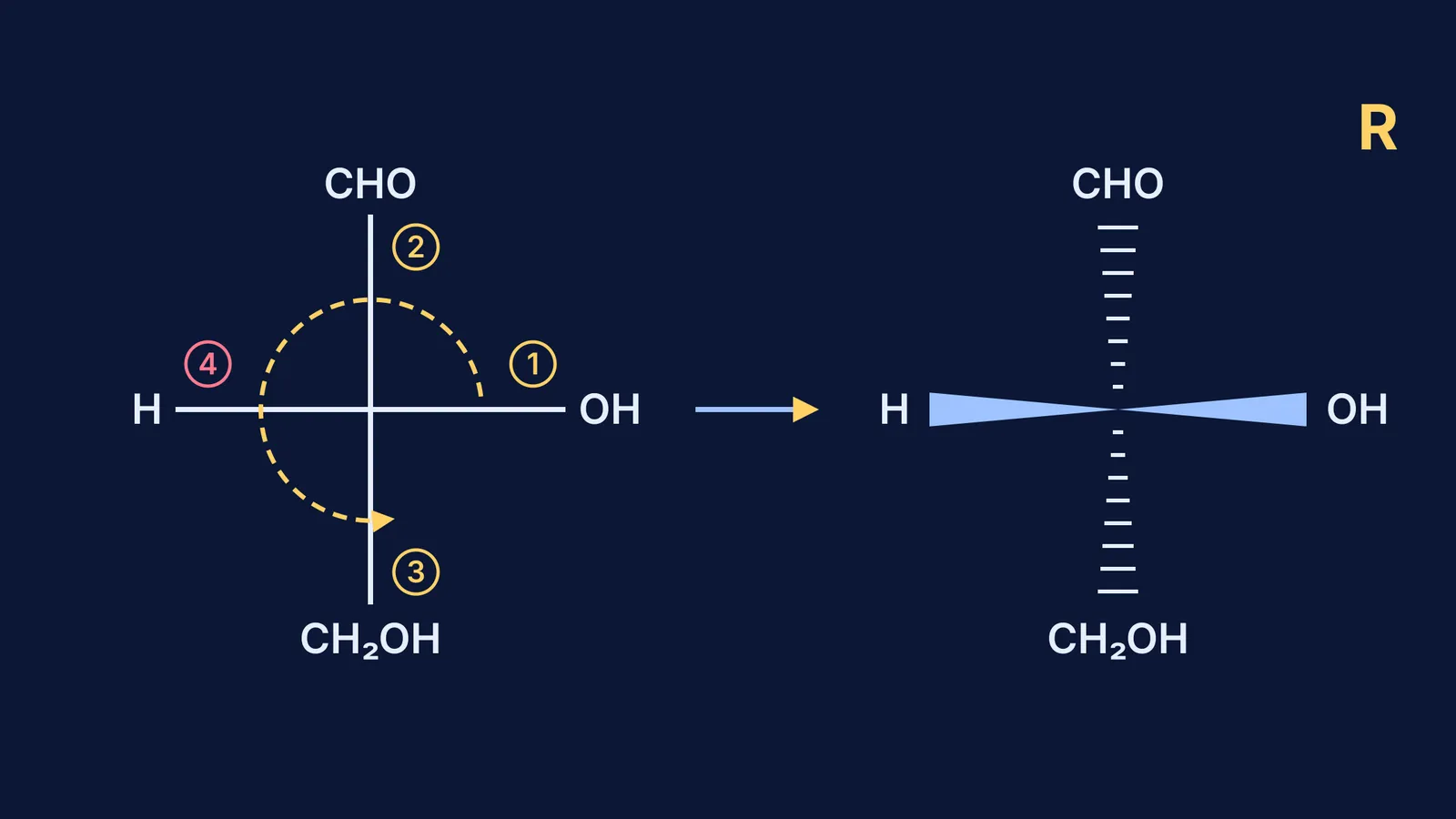
Worked example: is this glyceraldehyde R or S?
Take the Fischer projection with CHO at the top, CH2OH at the bottom, H on the left and OH on the right.
OH ranks 1, because oxygen has the highest atomic number.
CHO ranks 2 and CH2OH ranks 3. Both carbons carry one oxygen, but the C=O counts as a second oxygen on the CHO carbon.
H ranks 4, and it sits on the horizontal line.
Right to top to bottom runs anticlockwise, which reads as S.
H is horizontal, so reverse it: the answer is R.
This matches OpenStax, whose section 25.2 draws (R)-glyceraldehyde exactly this way, with the OH on the right. OpenStax section 25.3 adds that (R)-glyceraldehyde is also called D-glyceraldehyde.
What is the swap rule, and when does it help?
In a Fischer projection, "interchanging any two groups inverts the configuration", as University of Texas notes on Fischer projections state. That gives you a second method that does not rely on remembering the reversal.
In the glyceraldehyde example, swap H with the CH2OH at the bottom. H is now vertical. Right to top to left runs anticlockwise, so the swapped molecule is S. One swap inverted it, so the original is R. When both methods give the same letter, move on.
How do you convert a Fischer projection to wedge-dash safely?
Most mistakes here come from redrawing everything at once. Change one thing at a time:
Assign R or S on the Fischer projection first and write the letter down.
Draw a bow-tie: the carbon in the centre, the left and right groups on wedges, and the top and bottom groups on dashes. This is the Fischer projection itself, just drawn in 3D.
If you need a different orientation, redraw it.
Assign R or S again on the new drawing. If the letter changed, swap any two groups on your new drawing to fix it.
If you keep losing marks at step 2 of the worked example, the problem is usually priority ranking, not the projection. The Fermi Concept Library has a lesson for every concept in physics, chemistry, biology, mathematics and computing. The Fermi Problem Library has worked problems with a step-by-step solver that explains the reasoning rather than printing an answer.
For the bigger picture, see our guide to stereoisomerism step by step, from chirality and meso compounds to R/S and E/Z, and counting stereoisomers from the number of chiral centres. For where the cross came from, read about Emil Fischer and his work on sugar structures.
Next time you see a Fischer cross, find group 4 before you trace a single arrow.


