

On this page
If you open up a pair of headphones or a large concert speaker, you will find the same basic physics at work. They both rely on a principle you learn in high school electromagnetism: a current-carrying conductor placed in a magnetic field experiences a force.
By controlling that force, a speaker turns an electrical signal from your phone or amplifier into the mechanical vibrations we hear as music or speech. Here is how the parts work together.
How does a speaker turn electricity into sound?
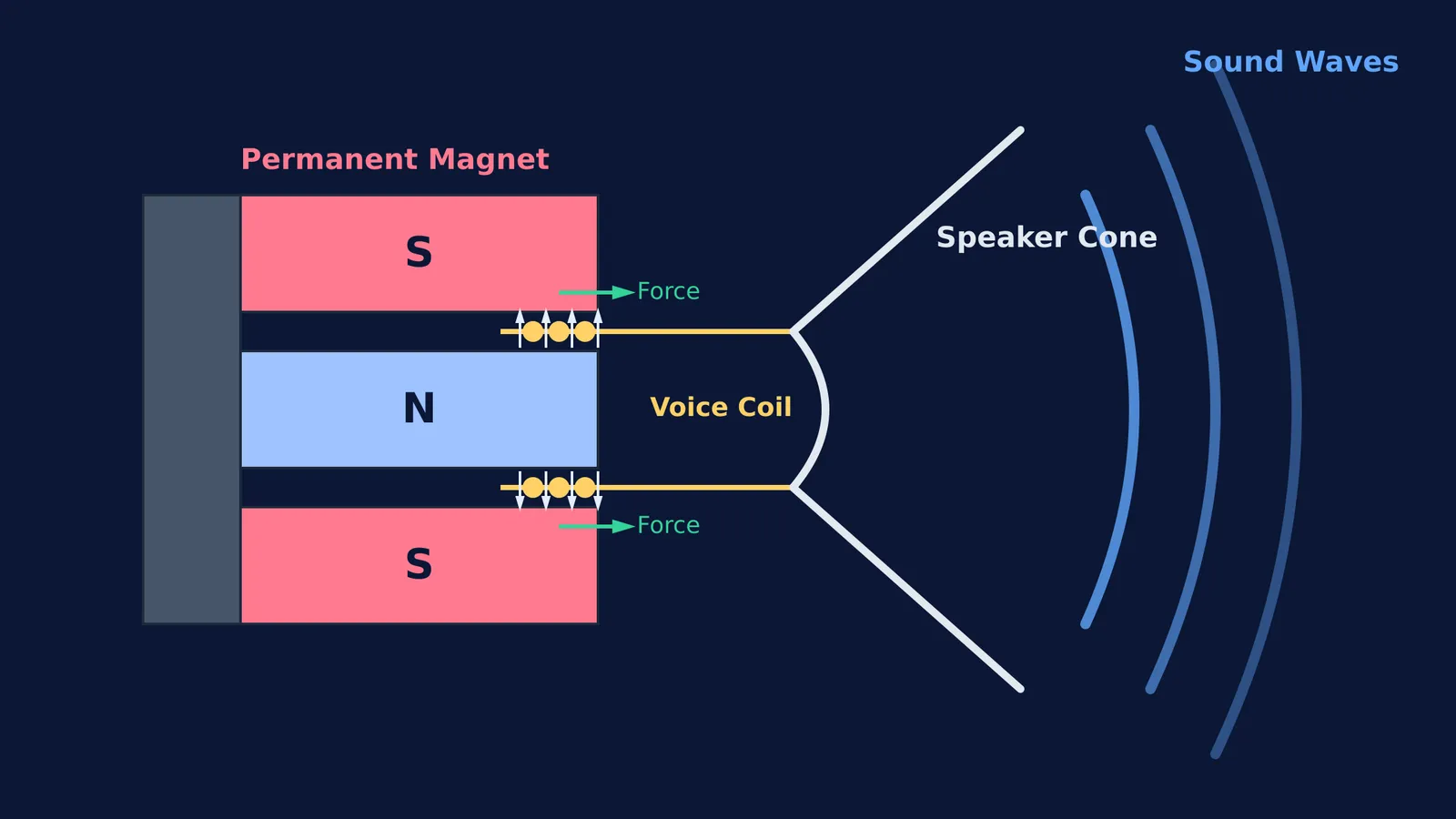
A standard dynamic speaker, which is the most common type, has three main working parts: a permanent magnet, a voice coil and a cone.
The permanent magnet is typically shaped like a cylinder with a central pole and an outer ring, creating a strong radial magnetic field in the gap between them.
The voice coil is a cylinder wrapped in fine copper wire that sits perfectly inside this magnetic gap. According to HyperPhysics, a dynamic loudspeaker operates on the principle that a current-carrying wire in a magnetic field experiences a perpendicular magnetic force.
Finally, the speaker cone (or diaphragm) is made of lightweight paper, plastic or metal. The narrow end of the cone is glued firmly to the voice coil, while the wide end is suspended so it can move freely.
What is the motor effect?
When you play a song, the amplifier sends an alternating current (AC) through the voice coil. Because the coil sits within the field of the permanent magnet, the current and the magnetic field interact to produce a force.
This phenomenon is known as the motor effect, and it follows Fleming's left-hand rule. Because the current is alternating, it constantly reverses direction. When the current flows one way, the magnetic force pushes the voice coil outward. When the current reverses, the force pulls the coil inward.
This rapid switching means the voice coil vibrates back and forth in exact time with the electrical audio signal. It can be difficult to picture how changing the current direction immediately flips the force. The Fermi Simulation Lab lets you adjust the current and the magnetic field to see exactly how the resulting force vector changes on a conductor.
Problem-solving checklist for the motor effect
When tackling exam questions about speakers or the motor effect, check these three things:
Identify the field direction: Permanent magnetic field lines run from North to South.
Identify the current direction: Determine whether the current is flowing clockwise or counter-clockwise through the coil at that instant.
Apply the left-hand rule: Align your index finger with the field and middle finger with the current. Your thumb will point in the direction of the resulting force (and thus, the cone's movement).
How do vibrations create sound waves?
The voice coil is attached to the speaker cone, so as the coil vibrates, it drags the cone with it.
When the cone pushes forward, it squashes the air molecules in front of it together, creating a region of high pressure called a compression. When it pulls backward, it leaves a region of low pressure called a rarefaction. These alternating bands of high and low pressure travel outward through the room as longitudinal sound waves.
There are two properties that control the sound you hear:
Pitch: The frequency of the alternating current determines how fast the cone vibrates. A higher frequency signal makes the cone vibrate faster, producing a higher-pitched sound.
Volume: A larger current creates a stronger magnetic force. This makes the cone move further back and forth, pushing the air harder and creating a louder sound.
The microphone in reverse
It helps to remember that a speaker is essentially a dynamic microphone working in reverse. When you speak into a microphone, the sound waves hit a diaphragm, which pushes a coil back and forth in a magnetic field. This motion induces an alternating current through the coil (thanks to Faraday's law of electromagnetic induction).
When that same recorded current is sent to a speaker, the motor effect takes over. The electrical signal forces the speaker cone to move in exactly the same pattern, recreating the original sound waves. This symmetry makes electromagnetism one of the most elegant topics in high school physics.


