On this page
Hang a weight from two springs joined by a short string. Add two longer "safety" strings that hang slack. Now cut the short string. Almost everyone expects the weight to drop. It goes up. Joel Cohen and Paul Horowitz described this network in Nature in 1991: cutting a string that supports a weight makes the weight settle higher. The reason is plain Hooke's law. Cutting one string changes the springs from series to parallel.
You already know the rules for springs in series and parallel. This post uses them on a set-up where the answer surprises you, and works the numbers in full.
How is the spring and string network set up?
Build it from the ceiling down.
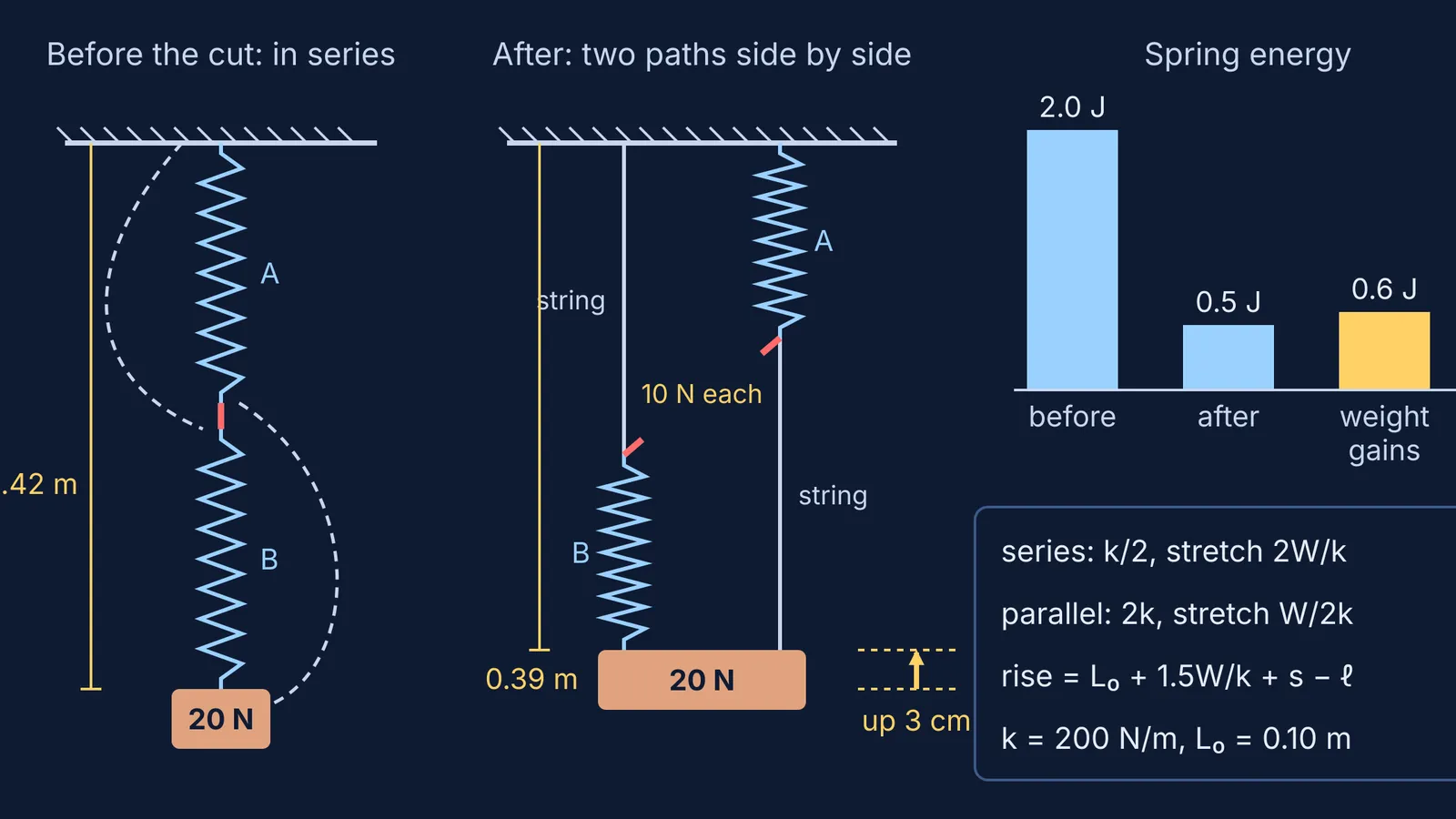
Spring A hangs from the ceiling.
A short string joins the bottom of A to the top of spring B.
The weight hangs from the bottom of B.
Safety string 1 runs from the ceiling to the top of B.
Safety string 2 runs from the bottom of A to the weight.
While the short string is intact, the two safety strings are longer than the gaps they span, so they hang loose and carry nothing. The springs are in series, and each one carries the full weight W.
In Cohen and Horowitz's paper, the springs have zero natural length and k = 1 N/m, the weight is 0.5 N, the short string is 0.375 m and the safety strings are 1 m. The weight hangs 1.375 m below the support before the cut and 1.25 m after it. Below we use springs with a real natural length and everyday numbers.
What happens when you cut the string?
Once the short string is gone, the only way down from the ceiling to the weight is through the safety strings. There are now two routes, side by side:
Route 1: ceiling, safety string 1, spring B, weight.
Route 2: ceiling, spring A, safety string 2, weight.
Each route has one spring and one string. By symmetry each route carries W/2. So each spring now stretches W/(2k) instead of W/k. Each spring carries half the force, and each route has one spring instead of two in a row. The safety strings add some length back, but if they are not too long, the weight still ends up higher.
Worked example: how far does a 20 N weight rise?
Take two identical springs with natural length L₀ = 0.10 m and k = 200 N/m, a weight W = 20 N, a short string s = 0.02 m and safety strings ℓ = 0.24 m. Treat the springs and strings as light, and the strings as inextensible.
Before the cut (series).
Each spring carries 20 N, so each stretches W/k = 20/200 = 0.10 m and is 0.20 m long.
Distance from ceiling to weight = 0.20 + 0.02 + 0.20 = 0.42 m.
Check the safety strings. The ceiling to the top of B is 0.20 + 0.02 = 0.22 m. The bottom of A to the weight is also 0.02 + 0.20 = 0.22 m. Each safety string is 0.24 m, longer than 0.22 m, so both are slack. Good.
After the cut (parallel).
Each route carries 10 N, so each spring stretches 10/200 = 0.05 m and is 0.15 m long.
Route 1: 0.24 m of string plus 0.15 m of spring = 0.39 m. Route 2 gives the same.
Distance from ceiling to weight = 0.39 m.
The weight has risen 0.42 − 0.39 = 0.03 m, or 3 cm.
Effective stiffness. Measured by stretch, the network went from k/2 = 100 N/m (series) to 2k = 400 N/m (parallel). It became four times stiffer.
When does the weight go up, and by how much?
Write the general result. Before the cut the distance is 2L₀ + 2W/k + s. After the cut it is ℓ + L₀ + W/(2k). Subtract:
Rise = L₀ + 1.5W/k + s − ℓ
Two conditions must both hold:
The safety strings must be slack before the cut, so ℓ > L₀ + W/k + s = 0.22 m here.
The rise must be positive, so ℓ < L₀ + 1.5W/k + s = 0.27 m here.
So for these springs, any safety string between 0.22 m and 0.27 m makes the weight rise. The rise is largest when the safety strings are only just slack. Then it equals W/(2k) = 0.05 m, half of one spring's original stretch. With safety strings longer than 0.27 m, the weight drops, as your intuition expected.
Where does the energy go?
Spring energy is ½kx².
Before: 2 × ½ × 200 × (0.10)² = 2.0 J.
After: 2 × ½ × 200 × (0.05)² = 0.5 J.
Gain in the weight's potential energy: 20 N × 0.03 m = 0.6 J.
The springs released 1.5 J. Of that, 0.6 J lifted the weight. The other 0.9 J goes into the bounce that follows the cut, and air drag and internal friction in the springs turn it into heat. The final state has less total potential energy than the first, which is why the network settles there. Nothing breaks energy conservation.
To find the accelerations at the instant of a cut, rather than the new rest position, see cutting a string in a spring system. For a related series puzzle, see why two spring balances in series read the same.
What does this have to do with traffic jams?
Cohen and Horowitz built this network as a mechanical copy of a traffic result. In 1968 Dietrich Braess showed that adding a road to a network can make every driver's trip slower once drivers choose their own routes. An English translation of his paper appeared in Transportation Science in 2005. The short string plays the part of the extra road: removing it lets the load split evenly into two paths, and the whole system does better.
Treat this as an analogy only. Cars choosing routes are not springs, and the maths is different in detail.
Can you try it at home?
Yes, with two identical soft springs from a lab kit, thread and a small weight. Tie the safety threads a little longer than the gaps they span, mark the weight's height, then snip the short thread. Keep your face away from the springs when you cut, since they will jump.
The Fermi Problem Library has spring-combination problems with a step-by-step solver that explains the reasoning. If you are preparing for JEE Main & Advanced, Fermi Test Prep offers personalised preparation with an AI tutor, live classes, adaptive mocks, mentorship and a study plan that updates based on mastery.
Quick checklist
Before the cut, the springs are in series: each carries W and stretches W/k.
After the cut, two routes share the load: each spring carries W/2 and stretches W/(2k).
Rise = L₀ + 1.5W/k + s − ℓ. Here 3 cm.
It works only if the safety strings are slack before and short enough after: 0.22 m to 0.27 m here.
Spring energy falls from 2.0 J to 0.5 J; 0.6 J lifts the weight, 0.9 J is lost in the bounce.
The traffic link (Braess's paradox) is an analogy, not the same physics.