On this page
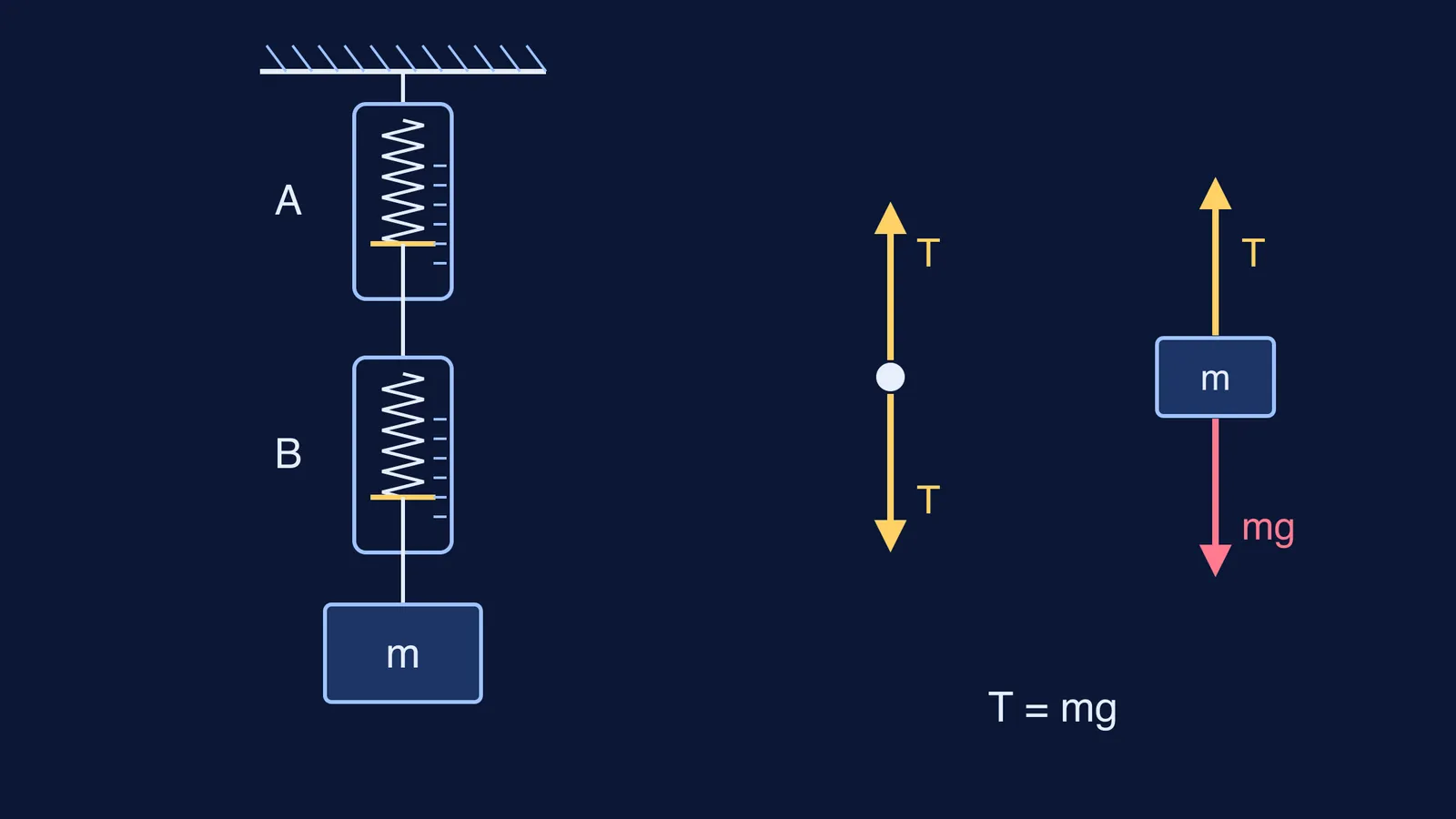
Hang one spring balance from a hook, hang a second balance from the first, and hang a 5 kg block from the bottom one. It is tempting to expect each balance to read 2.5 kg, as if the two were sharing the load. They don't. If the balances are light, both read 5 kg. It is a classic laws-of-motion question, and the idea behind it, that a connector passes the whole force along, comes back in pulleys, ropes and springs.
What does each spring balance read in series?
A spring balance reads the force pulling on its hook. Inside, a spring stretches in proportion to that pull: OpenStax University Physics gives Hooke's law as F = −kx, where k measures the spring's stiffness (OpenStax, Common Forces). The scale is marked so that the pointer's position tells you the force.
Now follow the force upward. The block hangs at rest, so the upward pull of balance B on it equals its weight. For a massless connector holding a stationary mass, the tension equals the weight of the supported mass, T = mg (OpenStax). So B reads mg.
Next, look at the point where B hangs from A. B pulls that point down with force T. Nothing there is accelerating, so A must pull it up with the same force. As the University of Illinois physics Q&A service explains, the joint between the two balances feels no net force, so the force from one balance pulling one way must equal the force from the other pulling the opposite way (Illinois Physics, Ask the Van). So A also reads mg.
Why don't the two balances split the weight?
Splitting only happens when two supports share the load side by side, as with two springs in parallel or two ropes holding one beam. In series, there is only one path for the force. Every link in the chain has to hold up everything below it, so no link carries less than the full load.
The same logic works sideways. If you and a friend each hold one end of a pair of hooked-together balances and pull, both balances read the same pull, not double and not half. It is the same reason tension is constant along a light string, which we unpack in is tension the same throughout a string. The pull of A on B and of B on A also form an action-reaction pair; our guide on how to identify action-reaction pairs shows how to spot them.
What if the spring balances are not light?
Real balances have weight, and the rule still holds: each one reads what hangs below it. Wikipedia's spring scale entry says balances in series read approximately the same, with the full weight of the body on the lowest scale and the upper scale reading slightly more because it also supports the lower scales (Spring scale, Wikipedia).
Here is a worked example with numbers you can check:
Block: 5 kg. Each balance: 0.2 kg. Take g = 9.8 m/s².
Balance B (bottom) holds only the block. It reads 5 kg, or 49 N.
Balance A (top) holds the block plus the whole of balance B. It reads 5.2 kg, or about 51 N.
Add a third 0.2 kg balance at the top and it reads 5.4 kg.
The extra amount is always the mass of the hardware below, so the gap is small whenever the balances are much lighter than the load. That is why textbooks say "light balances" and then expect equal readings.
How do you solve spring balance problems quickly?
Use this three-step check on any spring balance question, whether it involves hooks, strings or pulleys:
Cut the chain just below the balance you care about. Everything below the cut is what that balance holds up.
Add the masses below the cut, including lower balances and strings, unless the problem calls them light.
If the system is accelerating, use Newton's second law instead of T = mg, as in OpenStax's elevator-scale example (OpenStax, Solving Problems with Newton's Laws). In a lift accelerating upward at 2 m/s², the 5 kg block needs T = 5 × (9.8 + 2) = 59 N, so both light balances read about 6 kg on a kg-marked dial.
The same cut-and-count method answers the classic pulley version, where the balance reads twice the string tension; see why a pulley on a spring balance reads 2T.
If you want to practise the method on more variations, the Fermi Problem Library has worked problems with a step-by-step solver that explains the reasoning rather than printing an answer. If the shaky part is tension or Hooke's law itself, the Fermi Concept Library gives each concept its own lesson.
Next time you see a chain of balances, ask one question of each: what is hanging below me?