On this page
Hang a pulley from a spring balance, pass a string over it and tie a 2 kg block to one end and a 4 kg block to the other. Let go. Most students expect the balance to show 6 kg, because that is what is hanging from it. It shows less. It is a common exam question, and the reason behind it is one idea you can reuse in many pulley problems: the balance feels the string, not the blocks directly.
What does a spring balance read when it holds a pulley?
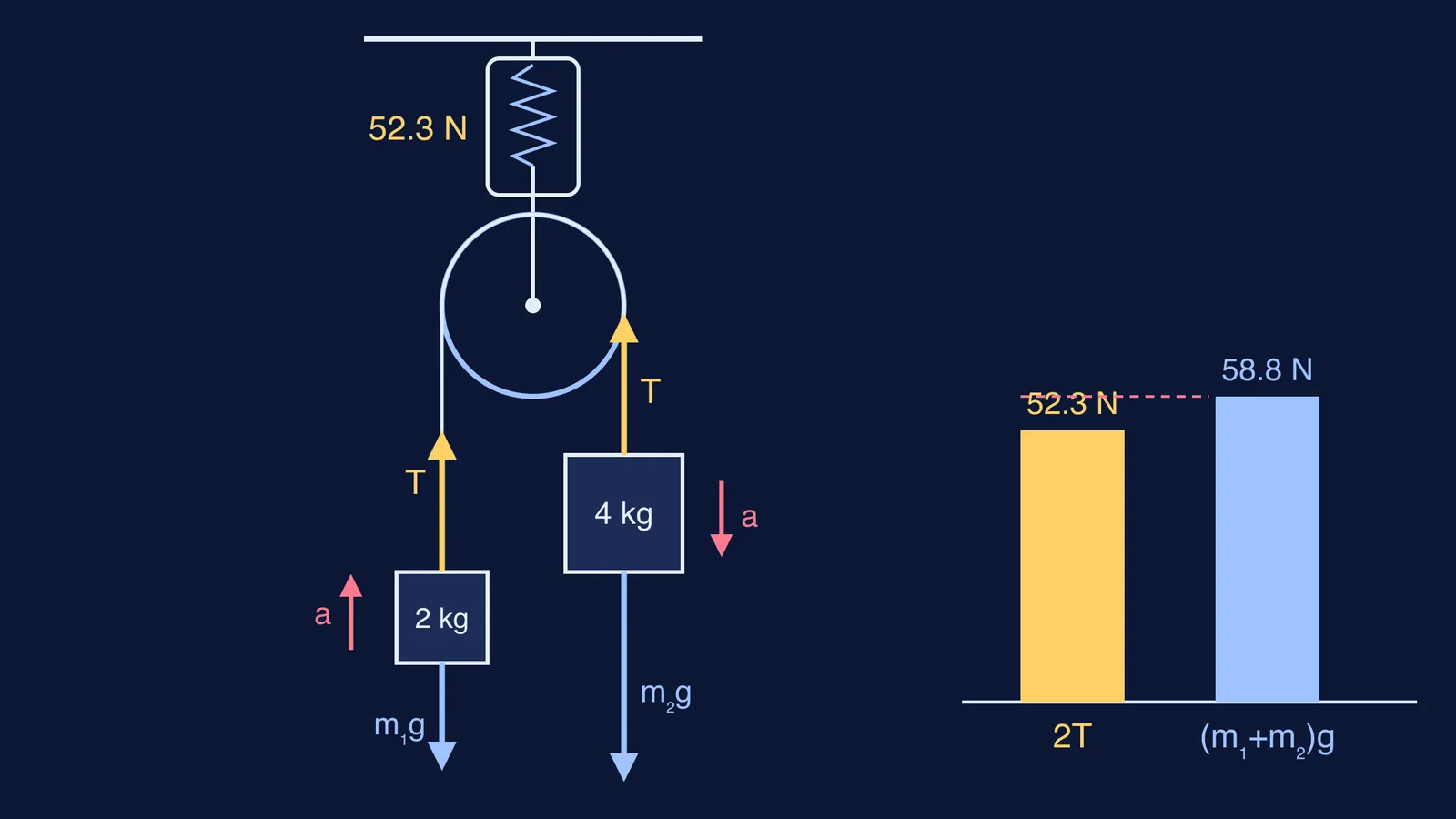
Take the pulley as light and frictionless. The string pulls down on the wheel on both sides, each with tension T, so the balance has to pull up with 2T to hold the pulley in place. The UCSB physics lecture-demonstration notes on the vertical Atwood's machine put it directly: the pulley's support must provide 2T, plus the weight of the pulley.
The tension comes from Newton's second law applied to each block. The OpenStax University Physics Atwood machine example (Example 6.5) derives the acceleration a = (m₂ − m₁)g/(m₁ + m₂), and the same UCSB notes eliminate a to get the tension T = 2m₁m₂g/(m₁ + m₂).
So the balance reading is R = 2T = 4m₁m₂g/(m₁ + m₂).
If you want the full derivation and three common variations, our post on Atwood machine tension and acceleration works through them.
Why is the reading less than the total weight?
Subtract the reading from the total weight:
(m₁ + m₂)g − 4m₁m₂g/(m₁ + m₂) = (m₂ − m₁)²g/(m₁ + m₂)
The right-hand side is a square divided by a positive number, so it is never negative. The reading is therefore never more than the total weight, and it equals the total weight only when m₁ = m₂.
The physical reason is the centre of mass. The heavier block moves down with acceleration a and the lighter one moves up with the same a, so more mass is speeding up downwards than upwards. The centre of mass accelerates downwards, so the net force on the system points down, and the balance (the only upward external force) must be smaller than the weight. If you write weight − R = (m₁ + m₂)a_cm and put in a_cm = (m₂ − m₁)a/(m₁ + m₂), you get the same expression as above. Our post on checking Atwood answers with the centre of mass shows this check in more detail.
Worked example: 2 kg and 4 kg
We use the numbers from the OpenStax example: m₁ = 2.00 kg, m₂ = 4.00 kg and g = 9.8 m/s², which give a = 3.27 m/s² and T = 26.1 N.
Balance reading: R = 2T = 2 × 26.13 N = 52.3 N.
Total weight: (2 + 4) × 9.8 = 58.8 N.
Gap: 58.8 − 52.3 = 6.5 N.
Check with the formula: (4 − 2)² × 9.8/6 = 6.5 N. The two methods agree.
If the balance is marked in kilograms, it shows R/g = 52.3/9.8 ≈ 5.33 kg, not 6 kg.
Now make the masses more unequal: 1 kg and 5 kg with g = 10 m/s². Using the same tension formula, T = 2 × 1 × 5 × 10/6 ≈ 16.7 N, so R ≈ 33.3 N against a total weight of 60 N. A kilogram scale would show about 3.33 kg. The more unequal the masses, the bigger the gap.
How can you check your answer in an exam?
Run these quick tests before you move on:
Equal masses: put m₁ = m₂ and the reading must come out as the total weight.
One mass zero: put m₁ = 0. The other block falls freely, the string goes slack, and R must be 0.
Upper limit: for a light pulley, R can never be more than (m₁ + m₂)g. If yours is, a sign is wrong.
Units: a balance calibrated in kg shows R/g. Read the question to see which one it asks for.
Heavy pulley: add the pulley's own weight. If the pulley has rotational inertia, the two tensions differ and R = T₁ + T₂ + (pulley's weight).
Held, then released: while the blocks are held, R is the full weight. The moment they are released, the reading drops to 2T.
The same habit of asking "what is actually pulling on the balance?" also settles the classic question of what a spring balance reads when pulled from both ends.
What should you practise next?
Try two variations: the same machine inside a lift accelerating upwards, and a pulley with mass. Each time, draw the pulley's free-body diagram first.
If you keep getting pulley problems wrong at a different step each time, the Fermi Problem Library has worked problems with a step-by-step solver that explains the reasoning rather than printing an answer. And if it helps to watch the heavier block pull the lighter one, the Fermi Simulation Lab has interactive simulations for ideas that are easier to see than to read.