

On this page
When you solve a standard Atwood machine problem—two blocks connected by a string over a frictionless pulley—you find the tension and the acceleration of the blocks. But did you know that the acceleration of the system's centre of mass offers a built-in way to check your work? The motion of individual blocks might seem disconnected at first glance, but analyzing them together reveals an elegant physical truth about the system as a whole.
What is the acceleration of the centre of mass of a two block system?
According to OpenStax University Physics, the net external force on a system equals its total mass multiplied by the acceleration of its centre of mass. This fundamental principle, F_ext = M a_cm, applies to any system of particles, no matter how the individual parts are moving relative to one another.
OpenStax notes that while internal forces might cause the parts of a system to vibrate or rotate, they always cancel out in pairs. Only external forces can change the velocity of the centre of mass. We can apply this simple rule to the seemingly complex motion of the blocks to find their combined behaviour.
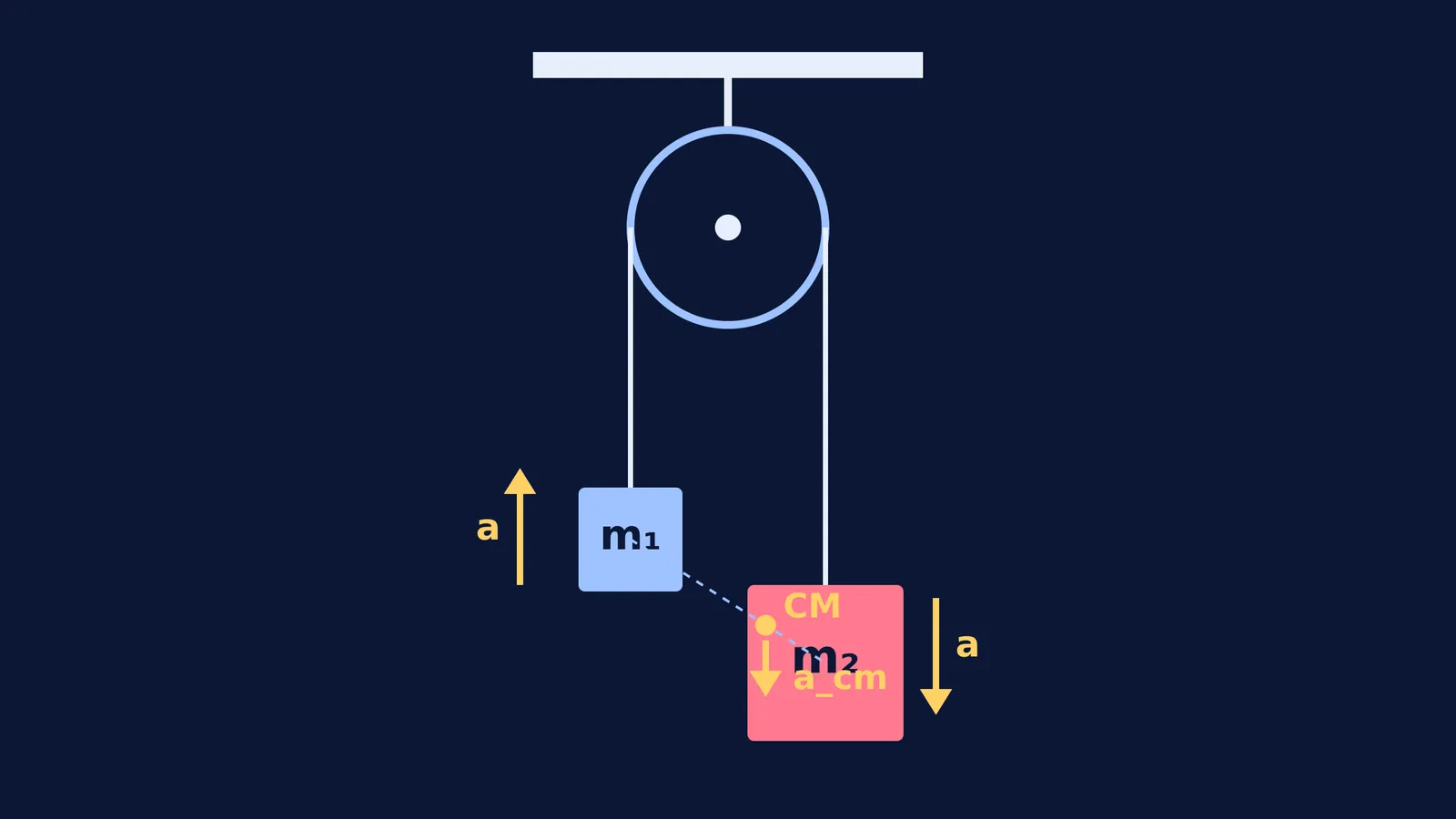
In a two-block Atwood machine where m₁ is lighter than m₂, both blocks accelerate at the same rate but in opposite directions. The heavier block accelerates downwards with magnitude a = g(m₂ - m₁)/(m₁ + m₂), while the lighter one accelerates upwards.
Because they move in opposite directions and have different masses, the acceleration of the system's centre of mass is not zero. We treat downward as positive. The acceleration of the centre of mass is the mass-weighted average of the individual accelerations:
a_cm = (m₂ a - m₁ a) / (m₁ + m₂)
Substitute the value of a into this equation:
a_cm = [(m₂ - m₁) / (m₁ + m₂)] × [g(m₂ - m₁) / (m₁ + m₂)]
a_cm = g(m₂ - m₁)² / (m₁ + m₂)²
Because the mass difference is squared, a_cm is always positive. The centre of mass of an Atwood machine always accelerates downwards, regardless of which block is heavier.
Can you check your answer using net external force?
Yes, finding a_cm from the external forces is a great way to verify that your tension and acceleration formulas are correct. When you have multiple equations, comparing the result to the entire system's centre of mass provides an independent validation.
Look at the two blocks and the string as a single system. What external forces act on it? Gravity pulls downwards on both blocks with a total force of (m₁ + m₂)g. Meanwhile, the pulley pulls upwards on the string with a force of 2T, where T is the tension in the string.
The net external force is:
F_ext = (m₁ + m₂)g - 2T
Using Newton's second law for the system (F_ext = M a_cm), we can set up our check:
a_cm = [(m₁ + m₂)g - 2T] / (m₁ + m₂)
If you have calculated the standard Atwood tension, T = 2m₁m₂g / (m₁ + m₂), you can substitute it here. The algebra perfectly returns our earlier formula:
a_cm = [(m₁ + m₂)g - 4m₁m₂g / (m₁ + m₂)] / (m₁ + m₂)
a_cm = g - 4m₁m₂g / (m₁ + m₂)²
a_cm = [g(m₁ + m₂)² - 4m₁m₂g] / (m₁ + m₂)²
a_cm = g(m₁² + 2m₁m₂ + m₂² - 4m₁m₂) / (m₁ + m₂)²
a_cm = g(m₁ - m₂)² / (m₁ + m₂)²
a_cm = g(m₂ - m₁)² / (m₁ + m₂)²
This confirms that the standard formulas for a and T are consistent with the system's overall motion. Calculating the centre of mass using two completely different methods yields the exact same expression, giving you confidence in your derivation.
How can you use this in exam prep?
When you face complicated mechanics problems involving multiple blocks and pulleys, the external force check is a useful method. It is often faster to look at the whole system than to solve simultaneous equations for each individual block and risk algebra errors.
If you struggle to identify which forces are internal (like the tension within the string) and which are external (like gravity or the pulley's upward pull), you can review these definitions in the Fermi Concept Library. Mastering this distinction is crucial for solving advanced mechanics questions accurately.
For mechanics problems where you keep making sign errors in your free-body diagrams, the Fermi Problem Library has worked problems with a step-by-step solver that explains the reasoning rather than printing an answer. It helps you see where a minus sign was dropped before you carry it through the whole calculation.
Similar principles apply to other linked setups in physics. For example, you can analyze the contact force between blocks pushed together on a smooth floor or the time for a block to slide down a rough incline by defining your system boundaries carefully. If you change the setup entirely, such as a spool pulled by its string, you still track the centre of mass through F_ext = M a_cm.
By mastering the centre of mass view, you gain a reliable safety net for your hardest physics questions.


