

On this page
This is a classic Class 11 mechanics question. The usual wrong answer is "double". The right answer comes from one idea: a spring balance measures tension, not the total of the forces on it.
What does a spring balance read when pulled from both ends?
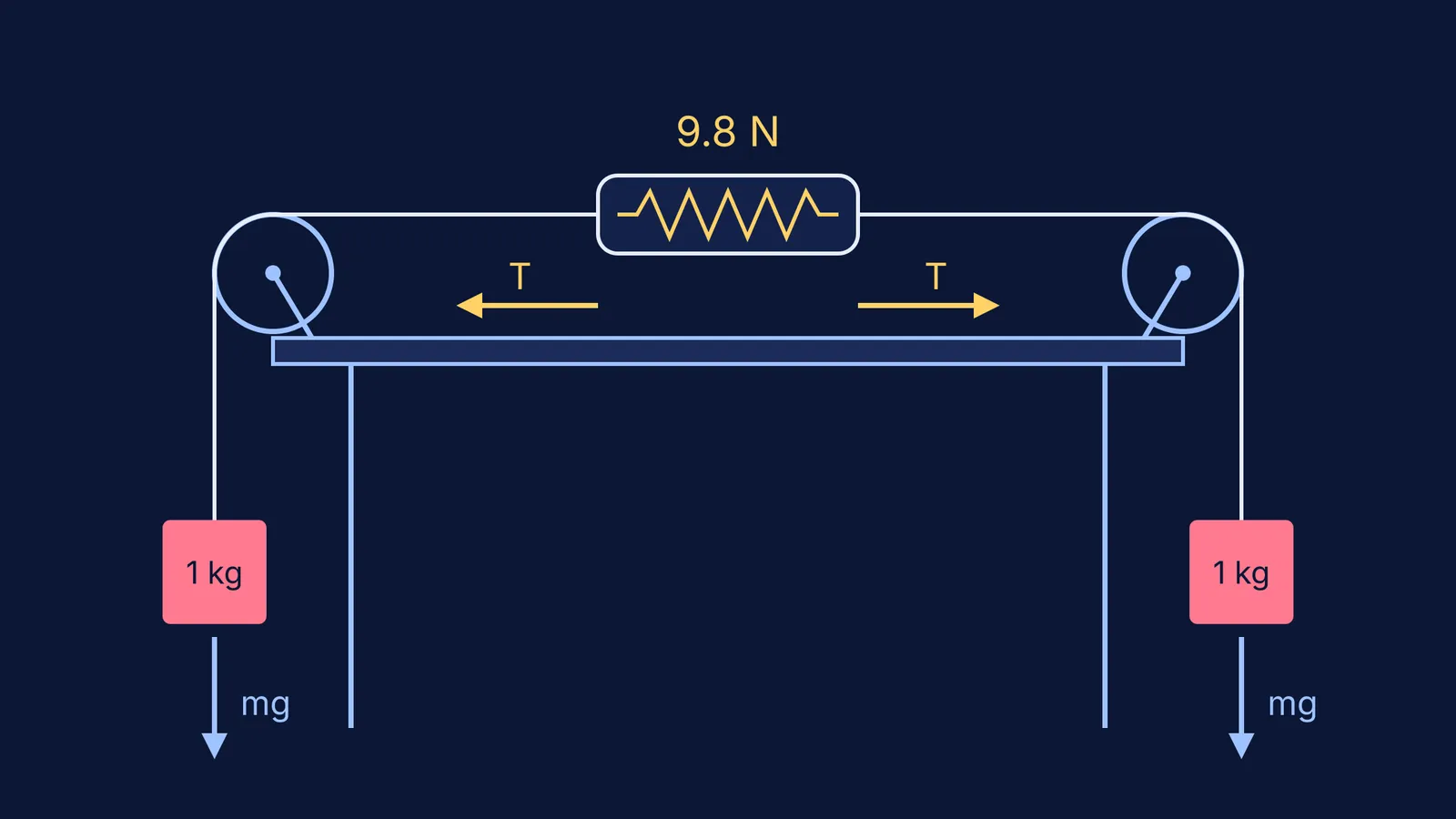
It reads the force applied at one end. If you pull one hook with 10 N and a friend pulls the other hook with 10 N, the balance reads 10 N.
OpenStax University Physics defines tension as "a pulling force that acts along a stretched flexible connector, such as a rope or cable" (OpenStax, Common Forces). The same chapter states that the tension anywhere in a massless rope is equal, so once you know it at one point, you know it everywhere.
A light spring balance is a stretchy piece of that rope with a scale on it. Because it has almost no mass, the pulls on its two hooks must be equal, and the pointer shows that one value.
Purdue University runs this as a lecture demonstration: two equal weights hang from a string over two pulleys, with a scale in the middle. The Purdue demo notes call the idea that the scale should read twice the weight a common misunderstanding; the scale reads the value of only one weight. UC Santa Barbara's version uses two 1 kg masses and gets 9.8 N, the same reading as when one end is tied to a table clamp (UCSB lecture demonstrations).
Why isn't the reading double, like a tug of war?
The tug-of-war picture causes the mistake. It feels as if two teams pulling 500 N each must put 1000 N into the rope. But pull a light balance by one hook only and it barely stretches; it just accelerates along with your hand. To read 10 N, the balance needs 10 N on both ends. The second pull is not extra; it is what lets the first pull register.
In a real tug of war, what decides the winner is the friction between each team's feet and the ground, which we explain in who really wins a tug of war.
What do two spring balances in series read?
Hook two light balances end to end and pull the free ends with 50 N each. Both read 50 N. Each balance has 50 N on its left hook and 50 N on its right hook, so each shows the tension of the one rope they are part of.
Compare two identical balances side by side holding up one 50 N load. Now the load is shared, and each reads 25 N: side by side, the readings add up to the load.
The same idea, tension passed along a chain, runs through tension in a train of blocks.
What does a spring balance read on a pulley with unequal masses?
Tempting guesses are 6 kg (the total) or 4 kg (the heavier mass), and both are wrong. Here is a worked example using the Atwood machine numbers from OpenStax, Example 6.5.
A light string over a frictionless pulley carries 2.00 kg on one side and 4.00 kg on the other. A light spring balance is inserted in the string.
The system accelerates: a = (m2 - m1)g/(m1 + m2) = (2/6)(9.8) = 3.27 m/s², which OpenStax derives.
For the 2 kg mass, T - m1g = m1a, so T = m1(g + a) = 2(9.8 + 3.27) = 26.1 N, the OpenStax result.
The balance reads the tension: 26.1 N, which is about 2.7 kg-wt on a balance marked in kilograms.
The reading sits between the two weights (19.6 N and 39.2 N): the string pulls the light mass up harder than gravity, and the heavy mass up less hard. The general form is T = 2m1m2g/(m1 + m2). With equal masses, a = 0 and T = mg, back to the Purdue demonstration. The pulley itself feels a different force again, worked through in the force on a pulley from its clamp.
How do you check your answer in 30 seconds?
Ask what the balance is measuring: the tension in its own string, never a sum.
Do the wall test: replace one puller with a fixed hook and see if anything changes.
Draw a free-body diagram of the balance alone. Equal pulls on both hooks mean one reading.
For pulleys, check whether the system accelerates. If it does, solve for T with Newton's second law.
Sanity-check: with unequal masses, T lies between the two weights.
If you keep reaching for "double", work a few of these in the Fermi Problem Library, where the step-by-step solver explains the reasoning rather than printing an answer. To revise tension and Newton's third law from the start, open the topic in the Fermi Concept Library.


