

On this page
In a tug of war, most people assume the team that pulls harder on the rope wins. If an adult defeats a child, common sense insists the adult exerted more force on the rope. Yet according to OpenStax University Physics, Newton's third law of motion dictates that forces always occur in matched pairs: whenever body A exerts a force on body B, body B exerts an equal and opposite force on body A.
In a classic analysis in *The Physics Teacher*, educator Paul Hewitt (Hewitt 1998, DOI: 10.1119/1.1523856) demonstrated that the tension throughout a light rope is identical at both ends. If you pull on the rope with 500 N, the rope pulls back on your hands with 500 N and pulls on your opponent with 500 N. You cannot pull on your opponent with any more force than they pull on you. Physics education research, including the Force Concept Inventory on common misconceptions about force (Hestenes et al. 1992, DOI: 10.1119/1.2343497), confirms that this third-law symmetry is one of the most stubborn hurdles for science students.
Does the stronger team pull harder on the rope?
If the rope pulls both teams with identical force, how does anyone win? The answer lies in separating internal forces from external forces. As physics educator Don Hinson emphasized in *Physics Education* (Hinson 1984, DOI: 10.1088/0031-9120/19/4/111), action-reaction pairs act on different bodies, so they never cancel out within an isolated participant.
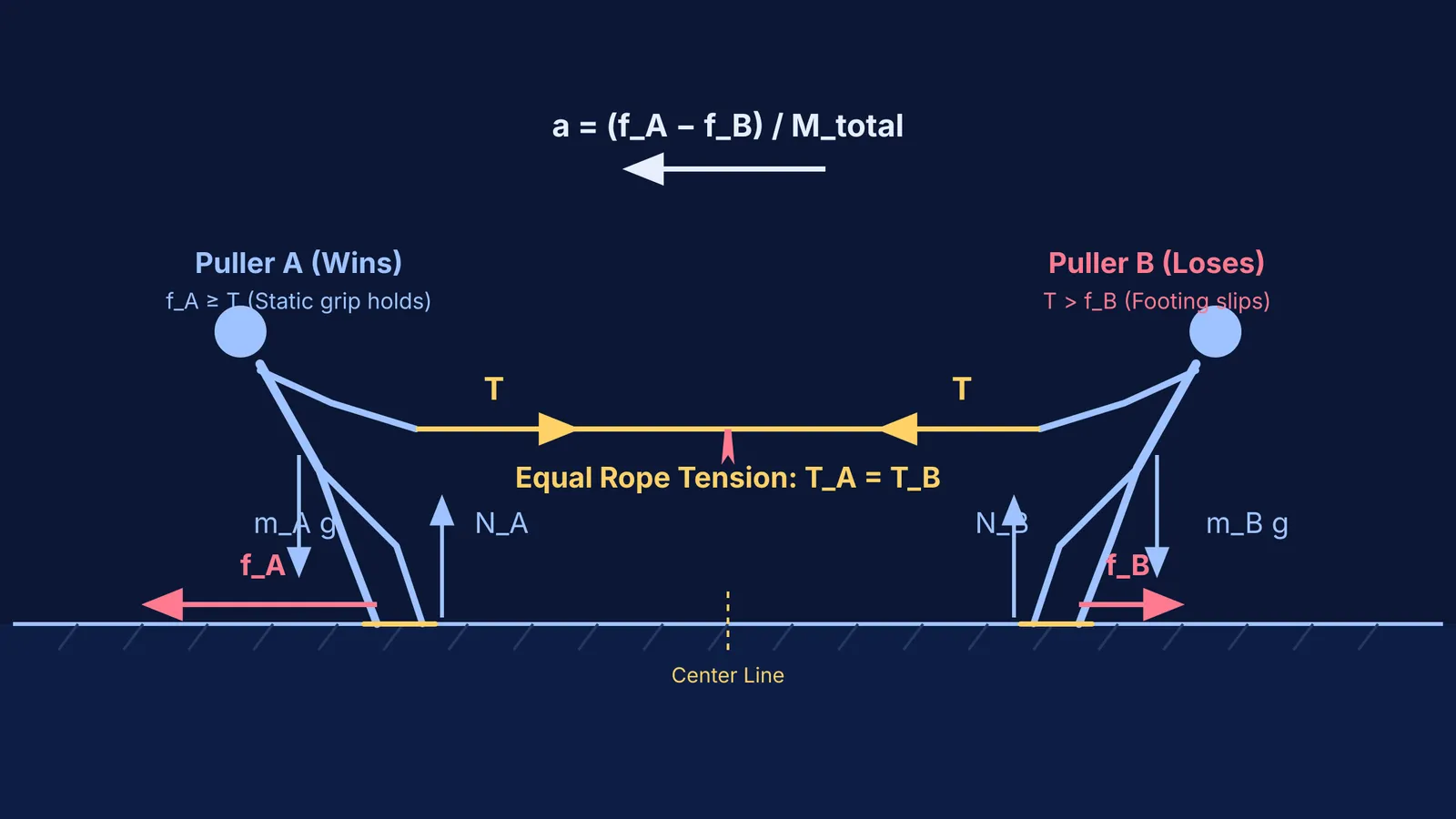
A team does not win by pulling harder on the rope; it wins by pushing harder against the ground. Your arms act only as a clamp. In *Sports Biomechanics*, Wen-Tzu Tang and colleagues (Tang et al. 2018, DOI: 10.1080/14763141.2017.1341545) showed that elite pullers rely on isometric upper-limb activation to hold the rope stationary against their torso. The arms transmit tension, but they generate zero net horizontal acceleration for the combined system.
Why does friction at your feet decide who wins?
To predict the winner, look at the horizontal contact between shoes and earth. When you pull, your legs push backward against the ground. By Newton's third law, the earth pushes forward on your feet with an equal static friction force.
According to OpenStax University Physics, maximum static friction before slipping is f_max = μ_s × N, where μ_s is the static friction coefficient and N is normal force (equal to body weight M × g on level ground). When you treat both teams and the rope as one system, internal rope tensions cancel. The net external horizontal force is simply the difference between the two teams' ground friction:
a = (f_A − f_B) / (M_A + M_B)
Whichever team generates greater ground friction accelerates the entire contest toward their side. This principle is why the Tug of War International Federation enforces strict cumulative weight classes (such as 640 kg and 720 kg divisions). Higher body mass increases normal force and raises the static friction limit before slipping. It also explains why competitive outdoor pullers wear boots with rigid heels that lock into turf.
How do you calculate who wins a tug of war?
Consider a worked numerical example using the friction formulas from OpenStax University Physics. Puller A (mass 80 kg) wears cleated boots on dry turf (μ_s = 0.70). Puller B (mass 90 kg) wears smooth sneakers on slick grass (μ_s = 0.30). Taking g = 9.8 m/s²:
Normal forces: N_A = 80 kg × 9.8 m/s² = 784 N; N_B = 90 kg × 9.8 m/s² = 882 N.
Limiting friction: f_A,max = 0.70 × 784 N = 548.8 N; f_B,max = 0.30 × 882 N = 264.6 N.
When rope tension climbs to 270 N:
Puller A feels T = 270 N, well below their 548.8 N limit. Their feet hold fast.
Puller B feels T = 270 N, exceeding their 264.6 N threshold. Their shoes slip.
Once Puller B slips, kinetic friction takes over (at μ_k = 0.25, f_B,k = 0.25 × 882 N = 220.5 N). The net dragging force on Puller B is F_net = 270 N − 220.5 N = 49.5 N toward Puller A. Despite having 10 kg less body mass, Puller A wins because their footing provides double the ground friction. For students working through friction problems distinguishing static from kinetic friction, this threshold marks the difference between equilibrium and acceleration.
How do you solve multi-body interaction problems?
To analyze two-body contact or tension problems without getting misled:
Separate internal from external forces: Rope tension is internal to the combined system; ground friction is external.
Draw isolated free-body diagrams: Apply Newton's second law with free-body diagrams to each participant separately.
Calculate boundary limits: Compute f_max = μ_s × N at each surface before assuming motion.
Sum external forces: Add the equations to cancel tension and find net acceleration.
To see these force vectors adjust in real time as you alter friction and pull angles, the Fermi Simulation Lab provides interactive simulations for ideas that are easier to see than to read. For guided practice with two-body mechanics, the Fermi Problem Library has worked problems with a step-by-step solver that explains the reasoning rather than printing an answer.


