On this page
A soap film shows colours because two reflected waves interfere. Put two good mirrors face to face instead, and the light bounces back and forth dozens of times. The result is a filter that passes only a comb of very narrow frequency bands, called teeth, and blocks everything between them. This is the Fabry–Pérot etalon. It sits inside lasers, splits closely spaced spectral lines and sorts the colours that carry internet traffic, and the same two-mirror idea makes up each arm of the LIGO gravitational-wave detectors. Two Class 12 ideas explain all of it: the path-difference condition for bright fringes, and a geometric series.
What is a Fabry–Pérot etalon?
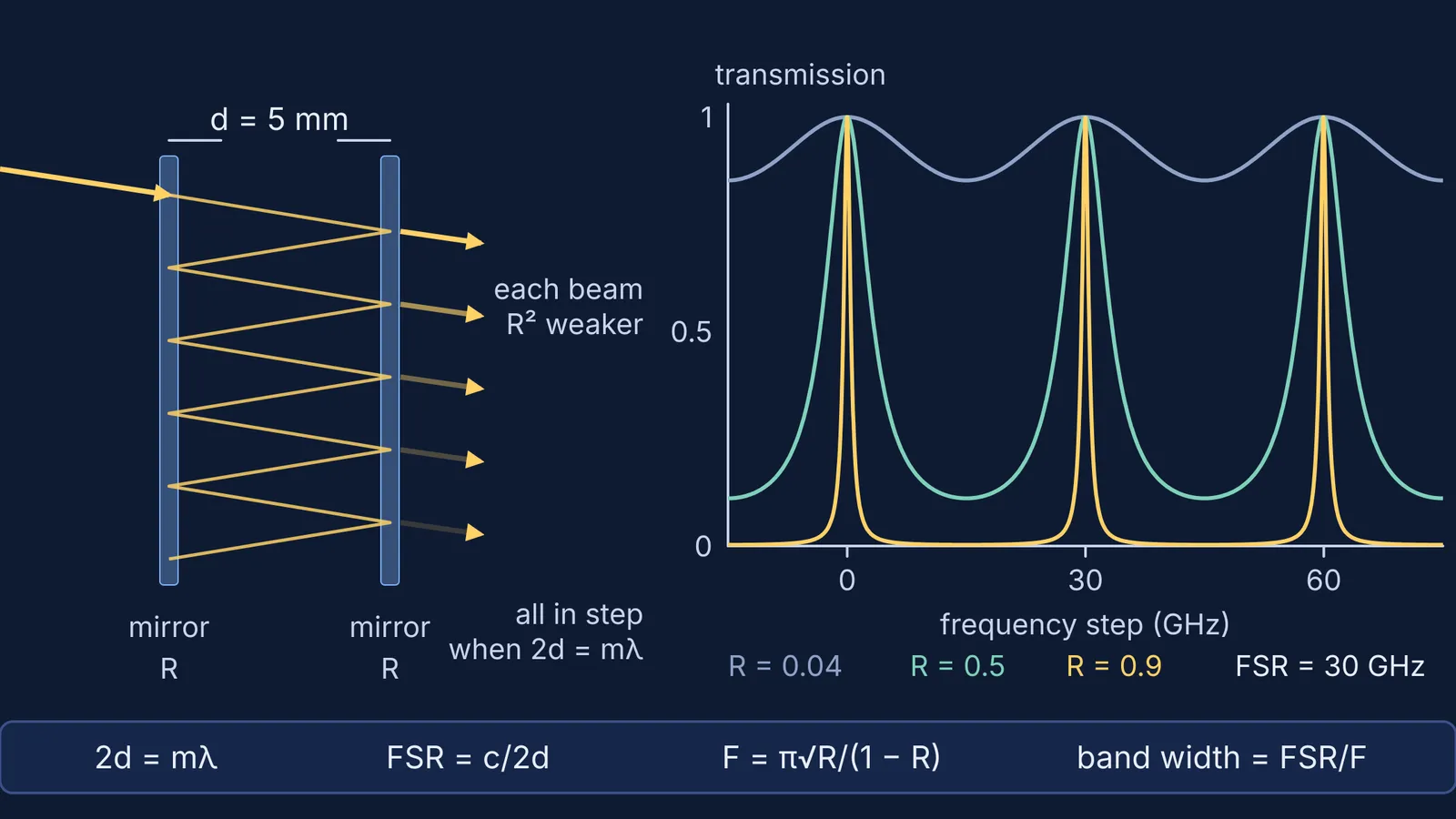
An etalon is two flat, parallel, partly silvered surfaces a fixed distance d apart. The gap can be air between two coated glass plates, or a single glass plate coated on both faces. HyperPhysics describes it as an interferometer that uses multiple reflections between two closely spaced partly silvered surfaces, with part of the light leaking out each time it reaches the far surface.
Each mirror reflects a fraction R of the light and lets the rest through. A beam that enters makes one round trip, and a small part leaks out. The rest goes round again, leaks a little more, and so on. You end up with a whole fan of transmitted beams, each weaker than the one before by a factor R² in intensity.
Our post on soap-film colours covers interference between two reflected beams. The etalon is the same physics with many beams, and many beams make a much sharper result.
When does an etalon let light through?
Each extra round trip adds a path of 2d (air gap, light hitting straight on). If that path is a whole number of wavelengths,
2d = mλ, with m a whole number,
then every transmitted beam leaves in step with the others and they all add up. The etalon is then almost fully transparent, even though each mirror on its own reflects most of the light. Move the wavelength slightly off this condition and the beams drift out of step. With many beams, even a small drift makes them cancel, just as in a grating with many slits.
Two details matter in practice:
Glass gap. If the gap is filled with glass of index n, the round trip becomes 2nd.
Tilted light. A ray at angle θ to the axis sees 2d cos θ. Different angles satisfy the condition for slightly different wavelengths, which is why an etalon viewed with a spread-out source shows bright rings, not a single spot.
What is the free spectral range of an etalon?
Write the condition in frequency. Since λ = c/ν, the pass frequencies are ν = mc/2d. Neighbouring teeth differ by one in m, so they are a fixed distance apart:
free spectral range (FSR) = c/2d
The University of Washington Fabry–Pérot lab notes give this result, and the same spacing in wavelength, Δλ = λ²/2d.
Worked example. An air-spaced etalon has d = 5 mm. Take red helium–neon laser light, λ = 632.8 nm (an illustrative choice).
FSR = c/2d = (3.00 × 10⁸ m/s) / (2 × 0.005 m) = 3.00 × 10¹⁰ Hz = 30.0 GHz.
In wavelength: Δλ = λ²/2d = (632.8 × 10⁻⁹)² / 0.010 = 4.00 × 10⁻¹¹ m = 0.040 nm.
Order of the tooth: m = 2d/λ = 0.010 / (632.8 × 10⁻⁹) ≈ 15,800.
So a 5 mm gap is about 15,800 wavelengths long and passes teeth only 0.040 nm apart.
What is finesse, and why do better mirrors make sharper teeth?
The teeth are 30 GHz apart, but how wide is each tooth? The lab notes define the finesse as the peak separation divided by the peak width. For ideal mirrors (perfectly flat, parallel and loss-free) they show that it depends only on the reflectance:
F = π√R/(1 − R), so the width of each tooth = FSR/F.
You can picture why. With a high R, each beam is only a little weaker than the one before, so many beams take part. A finesse of 60 means, roughly, that some tens of beams add together, like a grating with that many slits (see why more slits make sharper grating lines).
Continue the 5 mm example with different mirrors:
Uncoated glass, R = 0.04: F = 0.65. The transmission only dips to about 85% between teeth, so there are no sharp teeth at all.
R = 0.90: F = π√0.90/0.10 = 29.8. Each tooth is 30.0/29.8 ≈ 1.0 GHz wide.
R = 0.95: F = π√0.95/0.05 = 61.2. Each tooth is 30.0/61.2 = 490 MHz wide, or 0.040 nm/61.2 = 0.65 pm. That is 61 times narrower than the gap between teeth.
R = 0.99: F = 313, and the teeth are under 100 MHz wide.
With R = 0.95 the resolving power λ/δλ is about 632.8 nm / 0.65 pm ≈ 970,000. That is hundreds of times more than a classroom grating, from two mirrors and a 5 mm gap.
The lab notes add that a real instrument has a finesse "typically much lower" than this mirror limit, because the plates are never perfectly flat or parallel. Treat π√R/(1 − R) as an upper limit.
Where are etalons used in real life?
Fibre-optic internet. Long-distance fibres carry many channels, each on its own frequency. The ITU-T G.694.1 standard anchors the grid of channel frequencies at 193.1 THz, with spacings from 12.5 GHz up to 100 GHz and wider. An etalon with a 1.5 mm air gap has FSR = 3.00 × 10⁸ / 0.003 = 100 GHz, so its teeth line up with a 100 GHz grid. At 193.1 THz (λ ≈ 1552.5 nm), 100 GHz is about 0.80 nm in wavelength.
Gravitational-wave detectors. LIGO's arms are 4 km long, and LIGO describes the space between the two mirrors in each arm as a Fabry–Pérot cavity, with the light bouncing about 300 times. Its free spectral range is c/2L = 3.00 × 10⁸ / 8,000 ≈ 37.5 kHz. LIGO-India, planned in Maharashtra as a third LIGO interferometer, uses the same idea; our post on LIGO-India and gravitational waves explains what the arms measure.
Lasers. The two mirrors at the ends of a laser form the same kind of cavity, which is why only certain frequencies can lase. Gordon Gould's notebook already named a Fabry–Pérot resonator in 1957.
If thin-film and multiple-beam interference still feel abstract, the Simulation Lab has interactive simulations for ideas that are easier to see than read, and the Concept Library covers interference and diffraction from the start.
Quick checklist
Pass condition: 2d = mλ (2nd for a glass gap, 2d cos θ for tilted light).
Tooth spacing: FSR = c/2d in frequency, λ²/2d in wavelength.
Tooth width: FSR/F, with F = π√R/(1 − R) for ideal mirrors.
Higher R means more beams take part and sharper teeth; uncoated glass gives almost none.
Real finesse is lower than the mirror formula because of flatness.
Lines more than one FSR apart can overlap in different orders.