

On this page
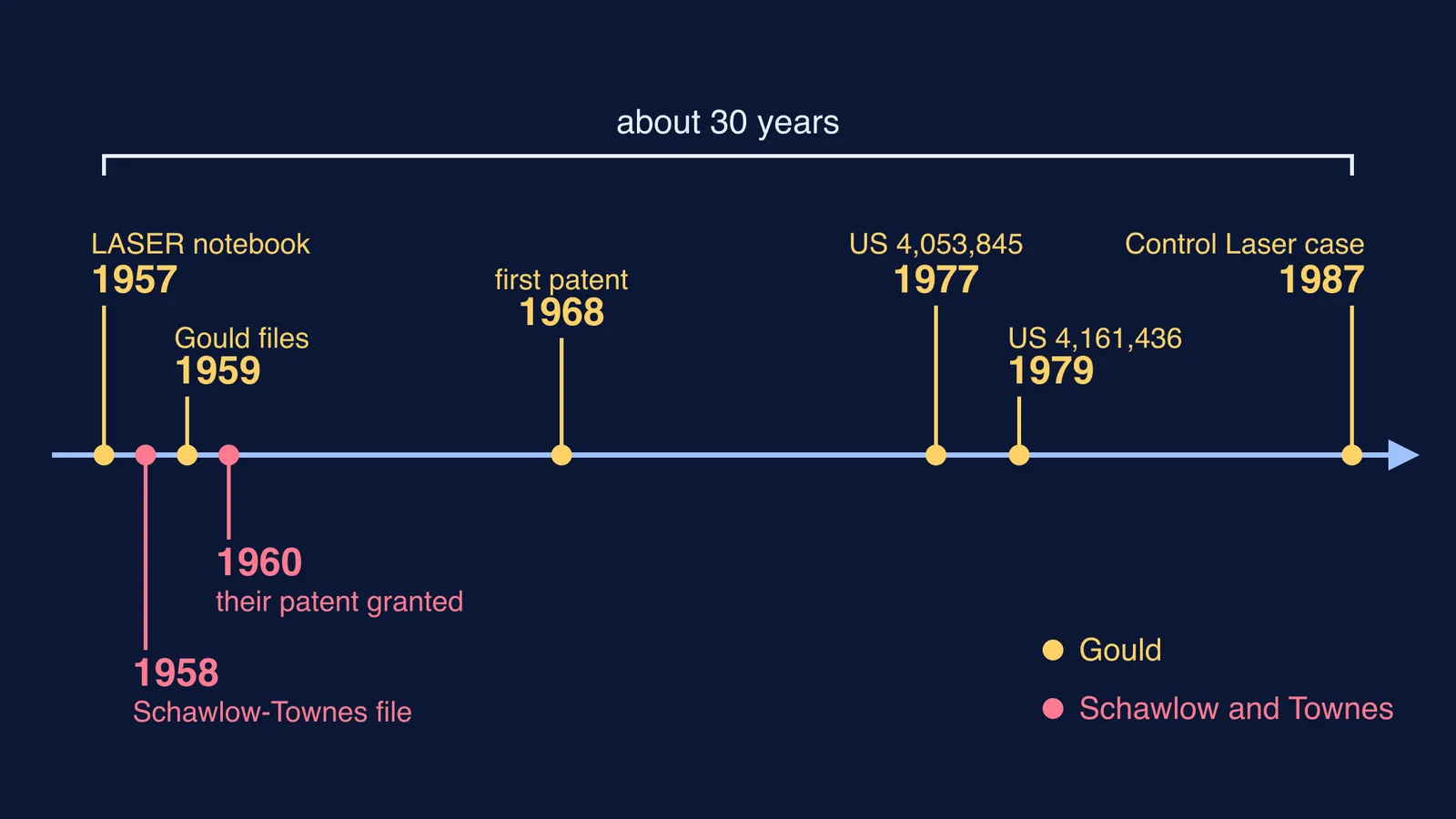
In November 1957, a Columbia University graduate student named Gordon Gould filled nine notebook pages with sketches, equations and a new word: LASER. He had the pages notarised, filed for patents two years later, and then spent about thirty years in court and at the patent office. His story still teaches a lesson about writing ideas down.
Did Gordon Gould coin the word laser?
Yes. The National Inventors Hall of Fame says Gould "coined the word laser" in a notebook headed "Some rough calculations on the feasibility of a LASER: Light Amplification by Stimulated Emission of Radiation." Nicolaas Bloembergen, reviewing Nick Taylor's history of the dispute in Physics Today, wrote that Gould coined the word in November 1957 and "had those ideas witnessed and notarized."
The Science History Institute's Distillations podcast gives the date as 13 November 1957. Gould took the notebook to a candy store in the Bronx whose owner was a notary public. The nine pages were so full that the stamp had to go in the margins.
You can read how that 1917 idea came about in our story on Einstein and stimulated emission.
What was in Gould's 1957 notebook?
Gould had started doctoral work at Columbia in 1949 under Polykarp Kusch, according to his Wikipedia biography, which draws on Taylor's book. The same account says the 1957 notebook described two facing mirrors (a Fabry-Perot resonator) so light could bounce through the material and grow stronger on each pass.
Pumping the atoms with light was an idea he had already raised with Charles Townes in 1956, the Distillations episode says. Townes worked on masers, the microwave version of the same principle; see our profile of Charles Townes and the ammonia maser. Gould then left Columbia without finishing his doctorate and joined a company called TRG (Wikipedia).
Why did Gould lose the race for the laser patent?
He filed later. Arthur Schawlow and Charles Townes filed their patent on 30 July 1958, and it was granted on 22 March 1960, as the record of US patent 2,929,922 shows. Gould's own application was filed on 6 April 1959, according to the text of his later US patent 4,053,845.
His application then went through "five separate interferences" at the Patent Office, the Hall of Fame notes. These are proceedings to decide who invented something first. Gould used the notarised notebook as evidence, but he lost the claim to the basic laser largely because the notebook did not explicitly say the sidewalls of the laser medium should be transparent (Wikipedia). Meanwhile someone else again built the first working laser: Theodore Maiman and his ruby crystal.
How did the long patent battle end?
His first laser patent, granted in 1968, covered an obscure use: making X-rays with a laser (Wikipedia). The big one, US 4,053,845 for optically pumped laser amplifiers, was granted on 11 October 1977. A patent on laser applications such as welding, cutting and drilling followed in 1979, and in 1987 Patlex, the company formed to manage his patents, won its first decisive case against the manufacturer Control Laser.
The Hall of Fame says lasers of the kinds Gould patented are used in 80 percent of industrial, commercial and medical laser applications. To pay for the fight, Gould had signed away 80 percent of his rights (Laser Focus World), but the royalties still made him a multimillionaire. He died on 16 September 2005, aged 85.
What can you learn from Gould's notebook?
A science project or a summer research internship goes better with a notebook someone else can trust. This checklist comes from what helped Gould and what hurt him.
Use a bound notebook with numbered pages, and never tear one out.
Write the date and your name at the top of every entry, in pen.
State the idea in one sentence before the maths, the way Gould's heading did.
Add the rough calculation that shows it could work, even if it is crude.
List what it could be used for.
Spell out the obvious details. Gould's missing line about transparent sidewalls cost him years.
Ask a teacher or guide to read, sign and date important pages.
A worked example for a Class 11 project entry: "28 Oct 2026. Idea: a phone torch through a sugar solution bends more as concentration rises. Rough check: measure the spot's shift on a wall for plain water, then for each spoon of sugar. Possible use: a cheap sugar meter for the school lab. Detail: the container walls must be flat and clear." That last line is the one Gould left out. For a real invention, speak to a registered patent agent; the rules have changed since 1959.
If the physics in Gould's heading is still fuzzy, the Fermi Concept Library has a lesson for every concept in physics, and the Fermi Simulation Lab has interactive simulations for ideas that are easier to see than to read.
Start your own dated notebook this week; the first page costs nothing.


