

On this page
In 1916 Albert Einstein wrote to his friend Michel Besso that "a splendid light has dawned on me about the absorption and emission of radiation", as physicist Virendra Singh of the Tata Institute of Fundamental Research, Mumbai, recounts in his review Einstein and the Quantum. The paper that came out of it, "On the Quantum Theory of Radiation", added a third way for light and atoms to interact. Forty-three years later, that third process became the working principle of the laser.
What did Einstein propose in 1917?
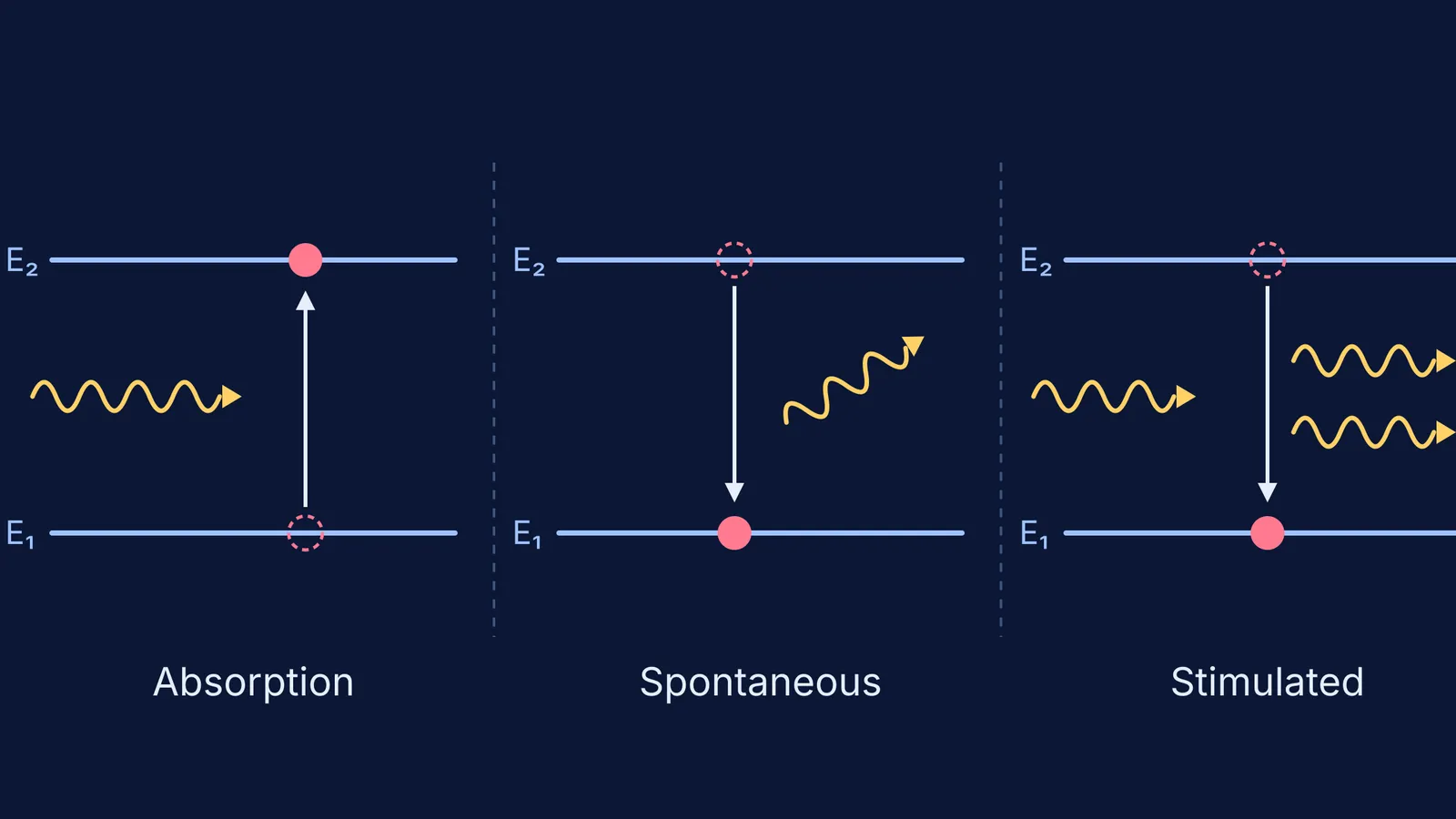
Einstein pictured atoms with two energy levels, E₁ below E₂, in a bath of radiation, and allowed three processes (Singh's review):
Absorption: an atom in E₁ takes in light and jumps to E₂, at a rate B₁₂N₁ρ that grows with the radiation energy density ρ.
Spontaneous emission: an atom in E₂ drops to E₁ on its own, at a rate A₂₁N₂ that does not depend on the light around it.
Stimulated emission: light of the right frequency pushes an excited atom down, at a rate B₂₁N₂ρ.
The A and B numbers are now called the Einstein coefficients. The paper appeared in Zürich in 1916, then in Physikalische Zeitschrift in 1917 (bibliographic record).
A stimulated photon has the same frequency, direction, polarisation and phase as the photon that triggered it (stimulated emission overview). One photon in, two identical photons out: that is amplification.
Why did Einstein need stimulated emission?
In equilibrium, upward jumps must balance downward ones: N₂(A₂₁ + B₂₁ρ) = N₁B₁₂ρ. Using Boltzmann's populations and Bohr's rule E₂ − E₁ = hν, Singh shows that this reproduces Planck's radiation law only if A₂₁/B₂₁ = 8πhν³/c³. Without the stimulated term, Singh writes, the same argument leads to Wien's law, which experiments had already found failing at long wavelengths.
So Einstein did not add the third process to invent a device. He added it because the energy accounts would not balance without it.
There is an Indian chapter to this story. In 1924 Satyendra Nath Bose of Dacca University sent Einstein a new derivation of Planck's law that treated light as a gas of photons, the start of what we now call Bose-Einstein statistics, as the same review describes.
How did stimulated emission lead to the laser?
There was a catch. Einstein's coefficients make absorption and stimulated emission equally likely, so in a simple two-level system no population inversion can be reached (HyperPhysics on Einstein coefficients). Only with a population inversion, more atoms up than down, does incoming light get amplified rather than absorbed (overview). Building that took decades:
1954: James Gordon, Herbert Zeiger and Charles Townes amplified microwaves with ammonia molecules, the maser (Physical Review paper). Read how in Charles Townes, the ammonia maser and the road to the laser.
1958: Arthur Schawlow and Townes published "Infrared and Optical Masers" (Physical Review paper).
16 May 1960: Theodore Maiman, at Hughes Research Laboratories in Malibu, saw red light at 694 nm from a flashlamp-pumped ruby rod (Science News), reported in Nature as Stimulated Optical Radiation in Ruby. The full story is in Theodore Maiman and the ruby crystal that made the first laser.
The word itself, coined by Gordon Gould, spells out Einstein's idea: light amplification by the stimulated emission of radiation (Science News).
Worked example: why is a hot lamp not a laser?
Divide Einstein's spontaneous rate by his stimulated rate and put in Planck's ρ. The ratio is A₂₁/(B₂₁ρ) = e^(hν/kT) − 1, using the relations in Singh's review with equal level weights. Take Boltzmann's constant k = 8.617 × 10⁻⁵ eV/K (NIST).
Ruby's red line, 694 nm: hν = 1240/694 ≈ 1.79 eV, using the 1240/λ photon-energy shortcut.
At 3000 K, kT ≈ 0.259 eV, so hν/kT ≈ 6.9 and e^6.9 − 1 ≈ 1,000. Spontaneous emission wins about 1,000 to 1.
At 300 K, hν/kT ≈ 69 and the ratio is about 10³⁰.
A 24 GHz microwave at 300 K: with h = 4.136 × 10⁻¹⁵ eV/Hz (NIST), hν ≈ 9.9 × 10⁻⁵ eV, hν/kT ≈ 0.0038, and stimulated emission now outnumbers spontaneous by about 260 to 1.
The lesson: heating does not make a visible laser. At 694 nm the two rates only match near 30,000 K, and in equilibrium fewer atoms sit up than down, so absorption still wins. You have to pump atoms into an inverted population, which is what Maiman's flashlamp did.
How should you revise this for JEE and boards?
Draw the three processes from memory, labelling E₁, E₂ and which ones need incoming light.
Write the balance equation and say in words what each term counts.
Explain in two sentences why a two-level system cannot reach population inversion.
Redo the worked example at another wavelength and temperature.
If photons and energy levels stay abstract, the Fermi Simulation Lab has interactive simulations for ideas that are easier to see than to read. The Fermi Problem Library has worked problems with a step-by-step solver that explains the reasoning.
Start with the drawing: if you can sketch the third panel and say why its two photons match, you have Einstein's 1917 idea.


