On this page
The NEET (UG) 2026 syllabus lists plant growth and development under Unit 4, Plant Physiology. Each rule and exception here is drawn from NCERT Class 11 Biology, Chapter 13 (Reprint 2026-27), with its section. The 12 questions are original practice, not predictions or past-paper items.
Which rules in Plant Growth and Development have NCERT exceptions?
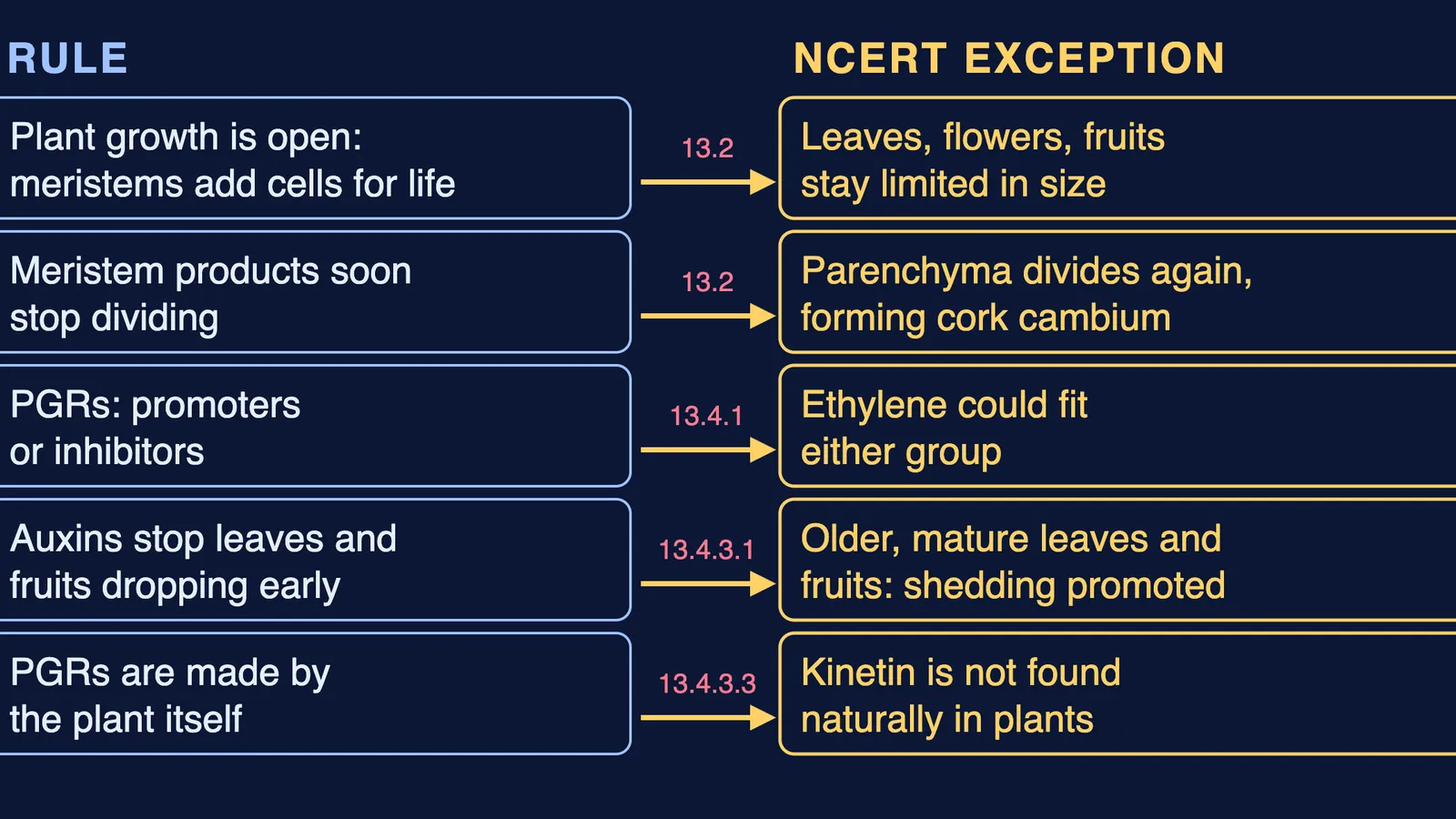
Each line pairs a pattern the chapter sets up with the case it names that breaks it.
Rule: plant growth is generally indeterminate; meristems keep adding cells for the plant's whole life (13.1.1). Exception: a tree's leaves, flowers and fruits have limited dimensions and appear and fall periodically, so NCERT says growth can be determinate too (chapter opening, 13.2).
Rule: cells made by a meristem soon lose the power to divide (13.1.1). Exception: living differentiated parenchyma can regain it, forming interfascicular cambium and cork cambium (13.2).
Rule: in most systems, growth plotted against time gives an S-shaped (sigmoid) curve (13.1.4). Exception: a root lengthening at a constant rate plots as a straight line, Lt = L0 + rt (13.1.4).
Rule: PGRs split into two groups, promoters and inhibitors (13.4.1). Exception: ethylene could fit either group; though largely an inhibitor, it speeds internode elongation in deep-water rice, promotes root hairs and breaks dormancy (13.4.1, 13.4.3.4).
Rule: auxins help prevent leaves and fruits dropping at early stages. Exception: they promote abscission of older, mature leaves and fruits (13.4.3.1).
Rule: auxins belong to the growth promoter group (13.4.1). Exception: they are widely used as herbicides (13.4.3.1).
Rule: 2,4-D is used to kill dicotyledonous weeds. Exception: it does not affect mature monocotyledonous plants, so lawns stay intact (13.4.3.1).
Rule: the plant's own tissues make its PGRs (Summary). Exception: kinetin, the first cytokinin, was obtained from autoclaved herring sperm DNA and is not a natural plant product, while NAA and 2,4-D are made synthetically (13.4.3.1, 13.4.3.3).
How should you tackle odd-one-out and exception items?
Read the basis in the stem first and judge only on it. Then run each option past two or three other features, such as group, source or organ, to make sure no second option also stands apart. For "which is NOT an exception", look for the one option where the rule still works as stated.
Odd-one-out and "NOT an exception" items on plant growth
Q1. Odd one out, by whether NCERT counts it as an intrinsic or extrinsic factor: (a) light (b) temperature (c) oxygen (d) plant growth regulators
Answer: (d). PGRs are intercellular intrinsic factors; the other three are extrinsic (13.3).
Q2. Odd one out, by NCERT's growth pattern on a tree: (a) shoot apex activity (b) root apex activity (c) vascular cambium activity (d) a single leaf
Answer: (d). A leaf has limited dimensions; the three meristems keep adding cells (chapter opening, 13.1.1).
Q3. Odd one out, by the compound each was later shown to be: (a) inhibitor-B (b) abscission II (c) dormin (d) kinetin
Answer: (d). The first three proved chemically identical and were named abscisic acid; kinetin is a cytokinin (13.4.2).
Q4. Odd one out, by the PGR group NCERT credits with the effect: (a) chloroplasts in leaves (b) adventitious shoot formation (c) production of new leaves (d) early seed production in juvenile conifers
Answer: (d). Spraying juvenile conifers with GAs hastens maturity; the other three are cytokinin effects (13.4.3.2, 13.4.3.3).
Q5. Odd one out, by NCERT's split of PGR roles into promoting and inhibiting: (a) dormancy (b) abscission (c) responses to wounds and stresses (d) pattern formation
Answer: (d). Pattern formation is a growth-promoting activity; the other three belong to the inhibitor group's roles (13.4.1).
Q6. Rule: ethylene is largely an inhibitor of growth activities. Which is NOT an exception? (a) inducing flowering in mango (b) breaking bud dormancy (c) initiating germination in peanut seeds (d) promoting senescence and abscission of leaves and flowers
Answer: (d). Senescence and abscission are inhibiting activities, as the rule expects; flowering, ending dormancy and germination are promoting (13.4.1, 13.4.3.4).
Q7. Which pair shows auxins acting against their usual promoter role, as NCERT records? (1) rooting in stem cuttings; parthenocarpy in tomatoes (2) 2,4-D killing dicot weeds; abscission of older, mature fruits (3) flowering in pineapples; xylem differentiation (4) preventing early leaf drop; helping cell division
Answer: (2). Killing weeds and shedding organs are the inhibitory cases; every effect in the other pairs supports growth or keeps organs on (13.4.1, 13.4.3.1).
Two-statement and single-correct items on growth and PGRs
Key for Q8 to Q10: (A) I and II correct (B) neither correct (C) only I correct (D) only II correct.
Q8. I: Growth in plants can be determinate as well as indeterminate. II: A cell becoming a tracheary element keeps its protoplasm and forms a thin cellulose wall.
Answer: (C). Tracheary cells lose their protoplasm and build strong lignocellulosic secondary walls (13.2).
Q9. I: In most situations, ABA works together with GAs. II: Ethylene breaks seed and bud dormancy.
Answer: (D). NCERT says ABA mostly acts as an antagonist to GAs; ethylene does break dormancy (13.4.3.4, 13.4.3.5).
Q10. I: Over 100 gibberellins are known, from fungi and higher plants. II: NCERT says all five major PGR groups were found by accident.
Answer: (A). Both are stated in 13.4.2 and 13.4.3.2.
Q11. In NCERT's example of open differentiation near the root apical meristem, cells pushed to the periphery mature as: (1) root-cap cells (2) epidermis (3) interfascicular cambium (4) tracheary elements
Answer: (2). Position decides fate: cells placed away from the meristem become root cap, those at the periphery become epidermis (13.2).
Q12. NCERT calls one PGR a general plant growth inhibitor, yet gives it an important role in seed development and maturation. Which? (1) ethylene (2) abscisic acid (3) gibberellin (4) cytokinin
Answer: (2). ABA inhibits growth and metabolism but also aids seed development, maturation and dormancy (13.4.3.5).
What should you practise next?
Cover the Exception half of each line and rebuild it from the rule. Then try our two-statement and match-the-list set on plant growth and the plant growth diagram questions, or revise with our chapter guide to growth rates and PGRs.
Which exceptions keep slipping away from you? Fermi's AI tutor works out what you already know and builds a plan for the session.