On this page
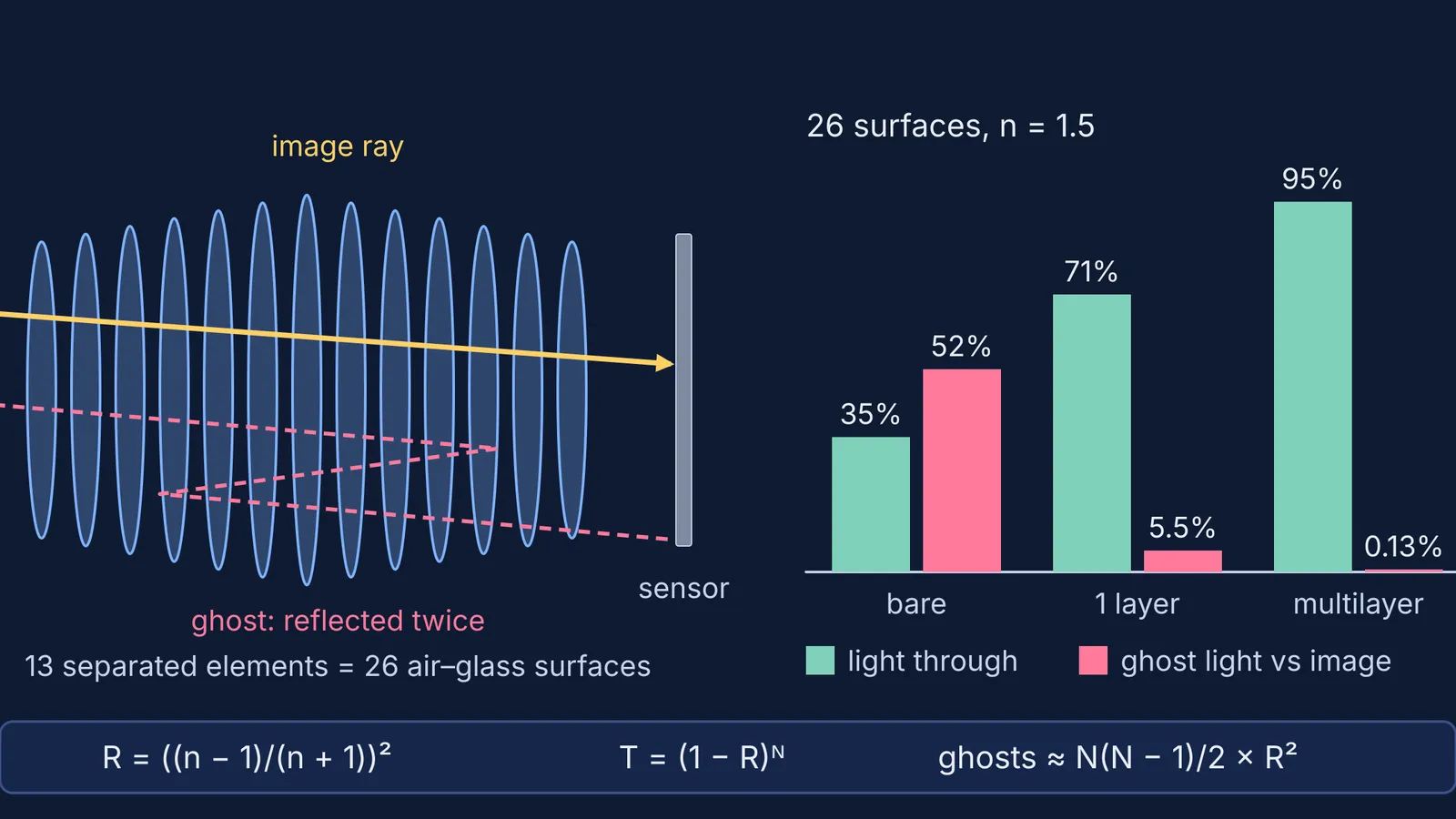
A camera lens is not one piece of glass. ZEISS's technical article on reducing reflections in camera lenses (Blahnik and Voelker, 2016) describes its Distagon 2,8/21 wide-angle lens as having 29 refracting surfaces, 26 of them in contact with air. Every one of those air–glass surfaces reflects a little light. One surface hardly matters. Twenty-six of them, left bare, would throw away about two-thirds of the light and fill the picture with ghost images. That is why every modern camera and phone lens is coated, and the numbers come straight from Class 12 optics.
How much light does one glass surface reflect?
For light hitting a surface straight on, the fraction reflected is R = ((n − 1)/(n + 1))². Our post on why windows show reflections at night works this out: about 4% for glass of index 1.5.
Lens glass is often denser. With n = 1.7, R = (0.7/2.7)² = 6.7%. The ZEISS article notes that most catalogue glasses have indices between 1.48 and 1.93, so the reflectance of visible-light glasses ranges from 4% to 10%, averaging around 7%. In this post we use the gentler 4% so the numbers stay on the safe side.
Only air–glass surfaces count. When two lenses are cemented together, the reflectance is set by the small index step between them. The same article gives about 0.4% for a joint between glasses of index 1.7 and 1.5, so cemented joints are close to harmless.
Why does the loss multiply instead of add?
Each surface passes a fraction (1 − R) of whatever reaches it. The second surface passes (1 − R) of what the first let through, and so on. After N surfaces:
T = (1 − R)ᴺ
Worked example: the 26-surface lens, uncoated, n = 1.5.
One surface: R = 0.04, so it passes 0.96.
Twenty-six surfaces: T = 0.96²⁶. Take logs: 26 × log 0.96 = 26 × (−0.01773) = −0.461.
T = 10⁻⁰·⁴⁶¹ = 0.346, so only about 35% of the light reaches the sensor.
With the average 7% reflectance from the ZEISS article, it is worse: 0.93²⁶ ≈ 0.15, about 15%. For comparison, a simple two-surface lens passes 0.96² = 92%.
Where does the reflected light go?
Light reflected once heads back out of the front of the lens and is lost. The trouble comes from light reflected twice. The ZEISS article points out that only paths with an even number of reflections can reach the image. A ray that bounces back off surface 10 and then forward again off surface 3 arrives at the sensor in the wrong place. That is a ghost.
How many such pairs are there? The same article counts them: a lens with n air–glass surfaces has 1 + 2 + … + (n − 1) = n(n − 1)/2 surface pairs that can send a ghost forward.
Worked example, continued.
Pairs: 26 × 25 / 2 = 325.
Each ghost has been reflected twice, so it carries about R² = 0.04² = 0.0016 of the light (0.16%), compared with the image ray.
Total ghost light ≈ 325 × 0.0016 = 0.52, about half as bright as the image itself.
Treat this as an upper estimate. Most ghosts are far out of focus, so they spread over the frame as a grey veil that lowers contrast, rather than appearing as sharp copies, and some miss the sensor altogether. The ZEISS article also adds n more reflections between the sensor itself and the lens surfaces. Either way, the picture is washed out.
How much do anti-reflection coatings help?
A thin coating makes the light reflected from its top and bottom faces cancel. Our post on the minimum thickness of an anti-reflection coating derives the quarter-wave condition t = λ/4n, so here we only use the results.
Single magnesium fluoride layer. The ZEISS article gives a residual reflectance of about 1.3% on BK7 glass. An optics designer writing in Laser Focus World calculates about 1.26% for the same pair.
Triple-layer coatings reach under 0.4% across the visible spectrum, and coatings of seven or more layers reach about 0.1 to 0.2% over much of it, according to the ZEISS article.
Worked example, coated. Same 26 surfaces, same 325 pairs:
Single layer, R = 1.3%: T = 0.987²⁶ = 71%. Ghosts ≈ 325 × 0.013² = 5.5% of the image.
Multilayer, R = 0.2%: T = 0.998²⁶ = 95%. Ghosts ≈ 325 × 0.002² = 0.13% of the image.
Going from bare glass to a modern multilayer coating almost triples the light that arrives (35% to 95%) and cuts ghost light by a factor of 0.04²/0.002² = 400. Because ghost light goes as R², each small cut in R pays back twice.
Why did many-element lenses need coatings first?
ZEISS lists 1935 as the launch of a coating technique developed by Alexander Smakula to reduce lens reflection. The technical article adds that by 1950 all ZEISS lenses were coated, and that multilayer coatings were first used in the 1950s on wide-angle lenses that often had 18 or more optical surfaces.
The arithmetic shows why. With bare glass at 4%:
18 surfaces: 0.96¹⁸ = 48% through, 153 ghost pairs, ghosts ≈ 25% of the image.
24 surfaces (an illustrative count, for example 12 separated groups with two air surfaces each): 0.96²⁴ = 37% through, 276 pairs, ghosts ≈ 44%.
Long telephoto lenses are just as crowded. The 400 mm telephoto lens in our earlier post has 18 elements in 12 groups. Zoom lenses and phone camera modules, which stack several elements in a few millimetres, depend on the same coatings.
If you want to see interference cancel a reflection rather than read about it, the Simulation Lab has interactive simulations for ideas that are easier to see than read, and the Concept Library covers reflection and thin films from the basics.
Quick checklist
One surface: R = ((n − 1)/(n + 1))², about 4% at n = 1.5 and 6.7% at n = 1.7.
Many surfaces: T = (1 − R)ᴺ. Multiply, never add.
Count only air–glass surfaces; cemented joints reflect very little.
Ghost pairs: N(N − 1)/2, each about R². This is an upper estimate.
Coatings cut R from 4% to about 1.3% (one layer) or 0.1 to 0.4% (multilayer), and ghosts fall as R².