

On this page
A 400 mm camera lens is not 400 mm long. Put a converging lens a few centimetres in front of a diverging lens and the pair bends light as if one lens sat 40 cm in front of the image, though the glass fits in half that length. That is the telephoto design. The physics is the two-lens formula from ray optics, with one lens negative.
What makes a lens a telephoto lens?
For a distant object of angular size α (in radians), the image is f × α across, so a longer focal length gives a bigger image. A single lens with f = 400 mm needs its image 400 mm behind it, which makes a very long tube.
A telephoto lens is a design that is physically shorter than its focal length. Designers describe it by the telephoto ratio: overall length divided by focal length. A plain long-focus lens has a ratio near 1. A telephoto has a ratio below 1.
So "telephoto" names a layout, not just any long lens: a positive (converging) group at the front and a negative (diverging) group behind it.
A real example: Canon lists its EF400mm f/4 DO IS II USM as 232.7 mm long with 18 elements in 12 groups. The barrel is only about 58% of the 400 mm focal length.
How do a converging and a diverging lens give a long focal length?
For two thin lenses on the same axis, a distance d apart, the combined focal length is
1/f = 1/f₁ + 1/f₂ − d/(f₁f₂)
If you have met this formula with two convex lenses, as in how separating two lenses changes their combined power, the only change here is the sign: f₂ is negative for the diverging lens, and d stays positive.
The front lens alone would focus parallel rays at F₁, 100 mm behind it. The diverging lens sits before that point, so to it the converging cone is a virtual object just behind it. It spreads the cone a little, the rays meet farther back, and the image is magnified. The overall focal length is f₁ times that magnification, the same idea as a Barlow lens on a telescope.
The image distance from the second lens is called the back focal distance:
back focus = f(1 − d/f₁)
The lens length, front glass to image, is d plus the back focus.
Worked example: how long is a 400 mm telephoto?
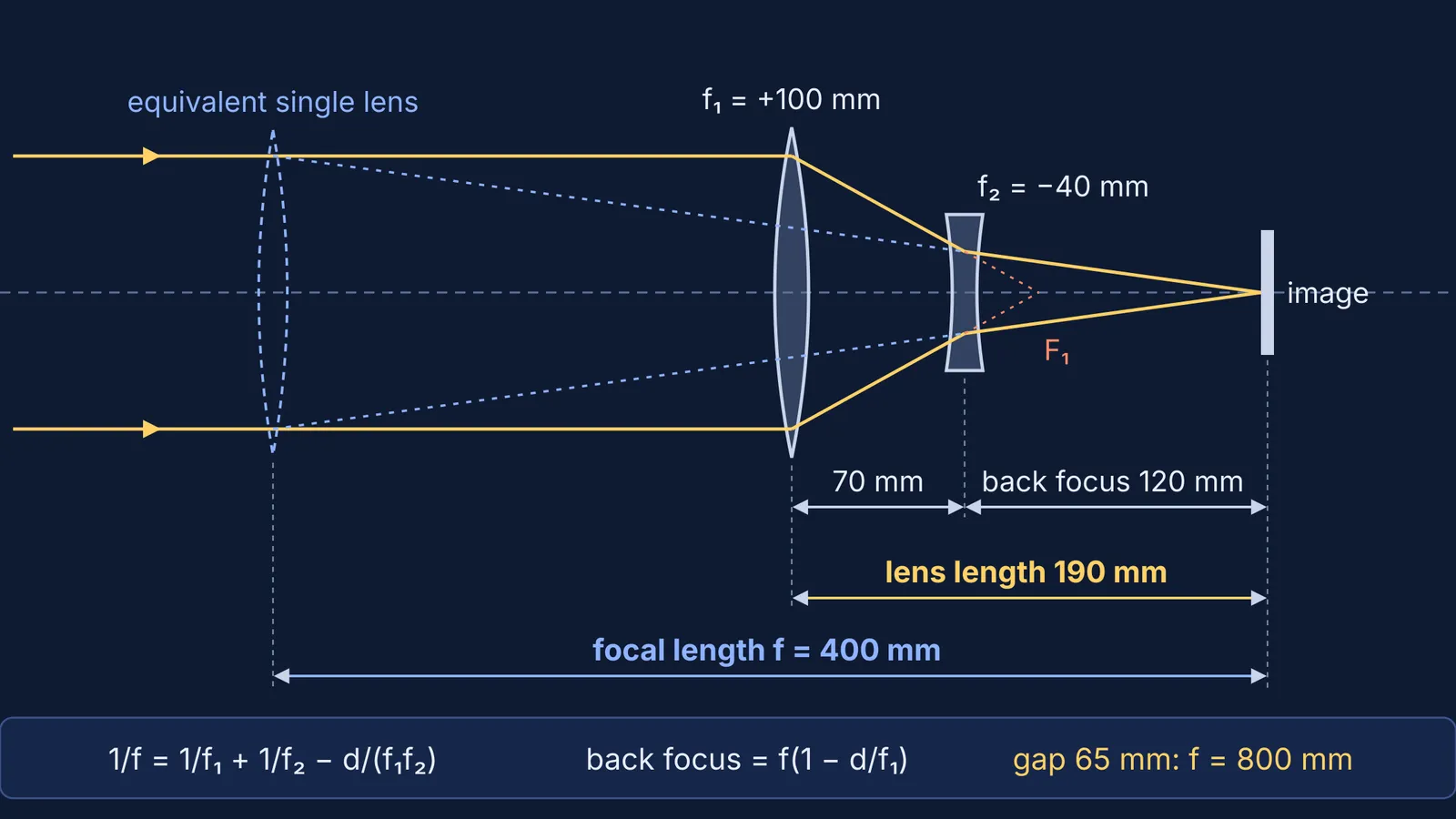
Take a simple two-lens model with round numbers: f₁ = +100 mm (converging), f₂ = −40 mm (diverging), d = 70 mm. Real lenses use many elements per group, so this is a model.
Combined power. 1/f = 1/100 − 1/40 − 70/(100 × (−40)) = 0.0100 − 0.0250 + 0.0175 = 0.0025 mm⁻¹.
Focal length. f = 1/0.0025 = 400 mm. Positive, so the pair is converging overall.
Back focus. 400 × (1 − 70/100) = 400 × 0.3 = 120 mm behind the diverging lens.
Check with the virtual-object method. The front lens alone would focus 100 mm behind it, which is 100 − 70 = 30 mm behind the second lens. Using 1/v − 1/u = 1/f with u = +30 mm and f = −40 mm gives 1/v = 1/30 − 1/40 = 1/120, so v = 120 mm. The magnification is v/u = 4, and f = 100 × 4 = 400 mm. Both methods agree.
Length. 70 + 120 = 190 mm from the front lens to the image.
Telephoto ratio. 190/400 = 0.475. The lens is less than half its focal length.
Units. Every term in step 1 is in mm⁻¹, so f is in mm.
How big is the Moon on the sensor? NASA's Moon fact sheet gives its mean apparent diameter as 1,896 seconds of arc, about 0.53°. In radians that is 0.00919, so the image is 400 × 0.00919 = 3.7 mm across. A 50 mm lens would give only 0.46 mm. The method is the same one used in the size of the Sun's image formed by a convex lens.
Where is the 400 mm lens actually?
Draw the final rays backwards from the image until they reach the height at which they entered. They get there 400 mm in front of the image, which is 400 − 190 = 210 mm in front of the front lens, out in the air. That point is the rear principal plane. A single thin lens placed there would do exactly what the pair does. The telephoto pair has moved its effective lens out in front of the glass, and that is the whole reason it can be short.
Why does moving the lenses 5 mm closer double the focal length?
Run the same sums for a few gaps (f₁ = +100 mm, f₂ = −40 mm):
d = 75 mm: f = 267 mm, back focus 67 mm, length 142 mm.
d = 70 mm: f = 400 mm, back focus 120 mm, length 190 mm.
d = 65 mm: f = 800 mm, back focus 280 mm, length 345 mm.
d = 60 mm: 1/f = 0. The rays leave parallel and there is no focal length at all.
The magnification of the second lens explains it. The virtual object sits u = 100 − d behind the diverging lens, and the magnification is 40/(40 − u). At d = 70 mm, u = 30 mm and m = 4. At d = 65 mm, u = 35 mm and m = 8. As u approaches 40 mm, which is |f₂|, the rays leave almost parallel and m grows without limit.
So a telephoto needs precise spacing, and this sensitivity is how a zoom lens works: sliding one group a few millimetres changes f a lot. The image moves too (back focus from 67 mm to 280 mm), so a real zoom also moves a second group to keep the picture sharp.
Why a phone carries a separate camera for zoom is covered in why phones have two or three camera lenses. Some phones also fold the light sideways with a prism, a different trick from the telephoto layout.
If you want to try more two-lens problems like this one, the Fermi Problem Library has a step-by-step solver that explains the reasoning, including where the sign of each focal length goes.
What mistakes cost marks on two-lens problems?
Taking f₂ as +40 mm for a concave lens. It is −40 mm.
Adding powers directly (1/f₁ + 1/f₂) when the lenses are separated. That only works when they touch.
Measuring the focal length from the front lens or the back lens. It is measured from the principal plane, which here lies outside the glass.
Quick checklist
Telephoto: converging group in front, diverging group behind.
1/f = 1/f₁ + 1/f₂ − d/(f₁f₂), with f₂ negative.
Back focus = f(1 − d/f₁); length = d + back focus.
Telephoto ratio = length/f, below 1 for a telephoto.
The diverging lens magnifies the front lens's image by v/u, so f = f₁ × m.
f changes fast with d near the point where the powers cancel, which is how zoom lenses work.


