

On this page
Lens combinations are commonly used in designing cameras, microscopes and telescopes, as the NCERT Class 12 Physics chapter on Ray Optics and Optical Instruments notes. Here is the rule, a worked example to predict, and the moment the rule changes.
What happens when you put two lenses together?
The power of a lens is the reciprocal of its focal length, P = 1/f, and its SI unit is the dioptre, where 1 D = 1 m⁻¹ (NCERT Class 12 Physics, Ray Optics). Power is positive for a converging (convex) lens and negative for a diverging (concave) lens.
For thin lenses in contact, the same chapter derives 1/f = 1/f1 + 1/f2, which in terms of power is P = P1 + P2 + P3 + … It stresses that this is an algebraic sum, so a concave lens subtracts. Wikipedia's optical power article notes the rule is approximate for thin lenses placed close together.
The usual trap is units. Convert focal lengths to metres first, or use P = 100/f with f in centimetres; we explain that shortcut in power of a lens when focal length is in centimetres.
How do you predict the combined focal length in a simulation?
Set up a ray-optics simulation or an optical bench with a beam of parallel rays and two convex lenses: lens A with f = 20 cm and lens B with f = 25 cm.
Convert to powers: PA = 1/0.20 m = +5 D, and PB = 1/0.25 m = +4 D.
Add them, as for thin lenses in contact: P = +9 D.
Invert: f = 1/9 m, about 11.1 cm.
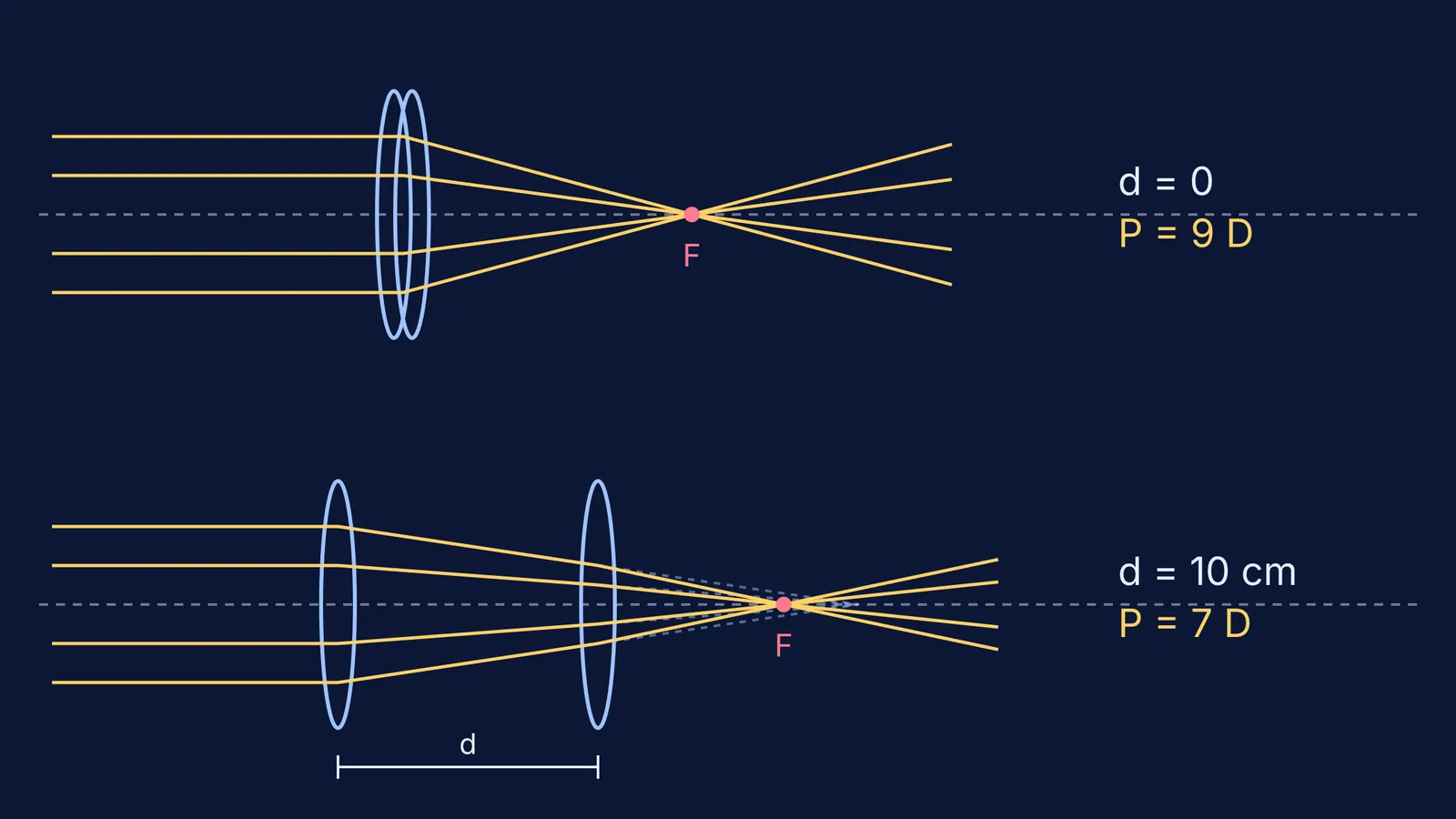
Now push the lenses together until they touch. Parallel rays should cross the axis about 11 cm from the pair, closer than either lens manages alone (20 cm or 25 cm). To rehearse single-lens behaviour first, our guide to convex lens image formation in a simulation lists what to watch.
What changes when you separate the two lenses?
Slide lens B 10 cm away from lens A and the adding rule stops working. For two thin lenses a distance d apart, Wikipedia's lens article gives 1/f = 1/f1 + 1/f2 − d/(f1f2). Multiply through and it becomes P = P1 + P2 − d·P1·P2, with d in metres.
Prediction: P = 5 + 4 − (0.10)(5)(4) = 9 − 2 = 7 D, so the equivalent focal length is about 14.3 cm. The pair got weaker.
Here is the part most students miss: the rays will not cross 14.3 cm behind lens B. That is the equivalent focal length of the pair, not a distance measured from the second lens. The distance you actually see behind lens B is the back focal distance, which the same lens article gives as BFD = f2(d − f1)/(d − (f1 + f2)). With our numbers: 25 × (10 − 20)/(10 − 45), about 7.1 cm.
Check it without the formula. Lens A alone would focus 20 cm away, 10 cm beyond lens B, so lens B receives light heading for a point 10 cm behind it. That point is a virtual object for lens B, the same step NCERT uses in its derivation. Put u = +10 cm and f = +25 cm into 1/v − 1/u = 1/f and you get v of about 7.1 cm.
Can separating two lenses increase the power?
Yes, when one lens is concave (same separated-lens formula). Keep lens A at +5 D and swap lens B for a −4 D lens (f = −25 cm).
In contact: P = 5 − 4 = +1 D, so f = 100 cm. A weak converging pair.
10 cm apart: P = 5 + (−4) − (0.10)(5)(−4) = 1 + 2 = +3 D, so f is about 33 cm. Using u = +10 cm and f = −25 cm for lens B, the rays meet about 16.7 cm behind it.
Now pull the two convex lenses further apart. When d = f1 + f2 (45 cm here), the combined power is zero: P = 9 − (0.45)(5)(4) = 0. The lens article calls this an afocal system: a parallel beam in, a parallel beam out, the simplest type of telescope.
A checklist for lens-combination questions
Are the lenses touching or separated? In contact, add the powers. Separated, include the d term.
Did you give each lens its sign before adding? Concave lenses carry negative power.
Is d in metres when your powers are in dioptres?
Does the question want the equivalent focal length or the distance behind the last lens? Once d is not zero, they differ.
Is it a colour-correcting pair? That needs a different condition, explained in achromatic combination of two lenses.
The Fermi Simulation Lab collects interactive simulations for the ideas that are easier to see than to read. If the algebra is where you get stuck, Fermi's AI tutor works out what you already know and builds a plan for the session.
Start with the 20 cm and 25 cm pair, predict 9 D and then 7 D, and see whether the rays agree.


