

On this page
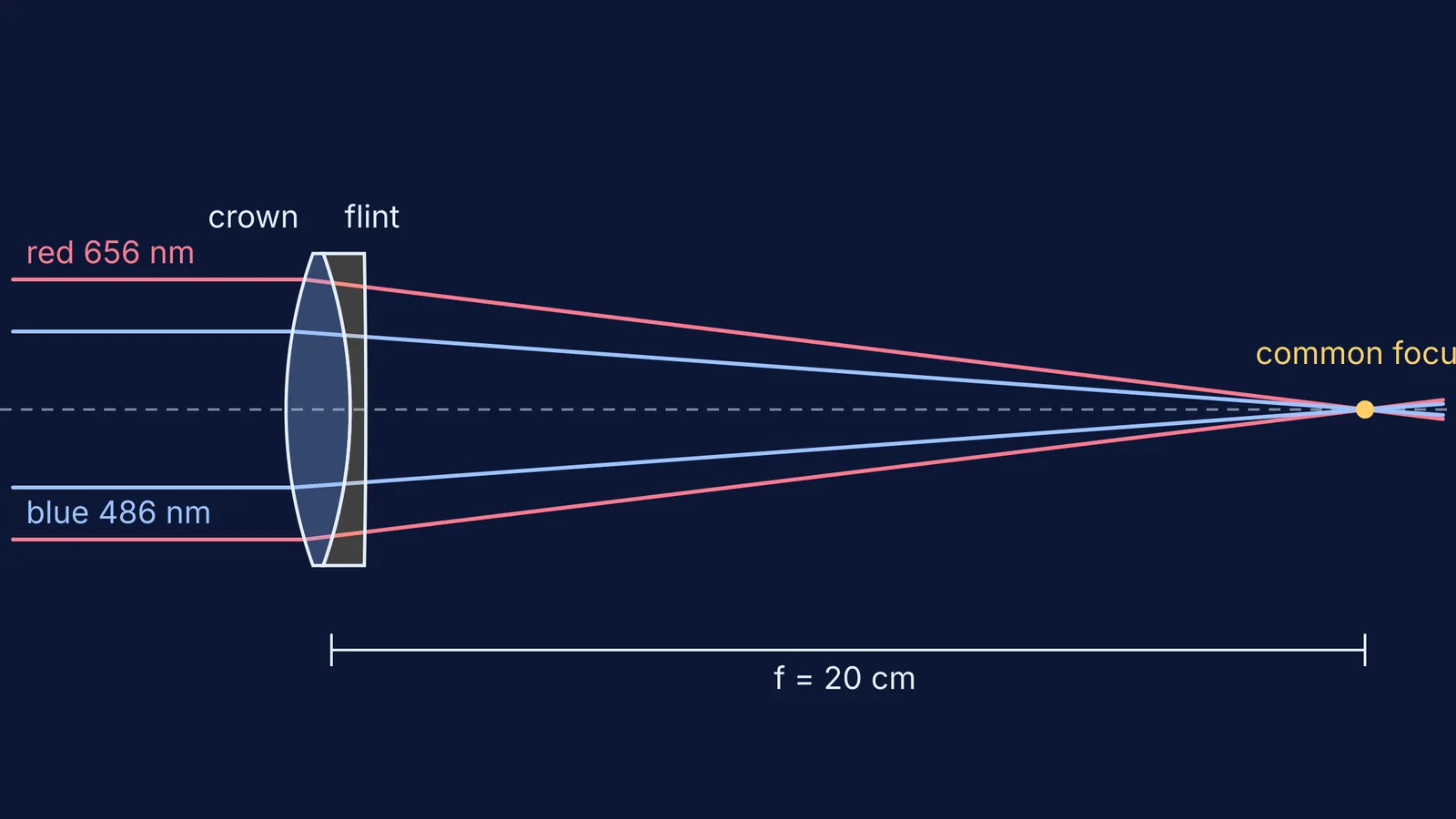
A single glass lens bends blue light more than red, so it has no single focal point: blue comes to a focus slightly closer to the lens than red. That colour error is chromatic aberration, and its cure, the achromatic doublet, is a common JEE and board question because it joins dispersion and the lens formula in one line.
What is dispersive power?
Refractive index depends on wavelength, so optics uses three standard Fraunhofer lines: C at 656.3 nm (red), d at 587.56 nm (yellow) and F at 486.1 nm (blue), as listed in the Abbe number reference.
Dispersive power is ω = (n_F − n_C)/(n_d − 1), and its reciprocal is the Abbe number V, so a high V means low dispersion (Abbe number).
Real glass makes this concrete. SCHOTT lists its crown glass N-BK7 with n_d = 1.51680, n_F − n_C = 0.008054 and Abbe number 64.17 (SCHOTT N-BK7 data). Its flint glass F2 has n_d = 1.62004, n_F − n_C = 0.017050 and Abbe number 36.37 (SCHOTT F2 data). From these, ω for N-BK7 is 0.008054/0.51680 ≈ 0.0156, and ω for F2 is 0.017050/0.62004 ≈ 0.0275.
Where does ω₁/f₁ + ω₂/f₂ = 0 come from?
The lens maker's formula says 1/f = (n − 1)K, where K = (1/R₁ − 1/R₂) depends only on the lens's shape. Going from red to blue, the power changes by (n_F − n_C)K, which is exactly ω/f. So a single lens has a colour spread in power of ω/f.
For two thin lenses in contact, 1/F = 1/f₁ + 1/f₂, so the spreads add: ω₁/f₁ + ω₂/f₂. Set this to zero and red and blue share one focus. The achromatic lens reference writes it as 1/(f₁V₁) + 1/(f₂V₂) = 0, which is the same statement because V = 1/ω.
For a single N-BK7 lens of focal length 20 cm, the red and blue focal lengths differ by about ωf = 0.0156 × 20 ≈ 0.31 cm, roughly 3 mm (worked from the SCHOTT N-BK7 values). If you need the lens formulas themselves, see our guide to the lens maker's formula and lens combinations.
Why must one lens in an achromatic doublet be diverging?
Rearrange the condition: f₂/f₁ = −ω₂/ω₁. For ordinary glass n_F is larger than n_C, so both ω values are positive, and f₁ and f₂ must have opposite signs. One lens converges, the other diverges. Two more consequences follow:
If both lenses are the same glass, ω₁ = ω₂ gives f₂ = −f₁ and a total power of zero. You would have built a flat plate, so the glasses must differ.
For a converging doublet, the converging lens must be the low-dispersion glass. That is why the standard design pairs a convex crown element such as BK7 with a concave flint element such as F2 (achromatic lens).
How do you design an achromatic doublet of a given focal length?
You have two equations: 1/f₁ + 1/f₂ = 1/F, and ω₁/f₁ + ω₂/f₂ = 0. Solving them gives:
f₁ = F(ω₂ − ω₁)/ω₂ for the crown lens
f₂ = −F(ω₂ − ω₁)/ω₁ for the flint lens
Worked example: design a +20 cm doublet from N-BK7 and F2, using the ω values computed above from SCHOTT's catalogue data.
Find the difference: ω₂ − ω₁ = 0.0275 − 0.0156 ≈ 0.0119.
Crown lens: f₁ = 20 × 0.0119/0.0275 ≈ +8.7 cm.
Flint lens: f₂ = −20 × 0.0119/0.0156 ≈ −15.3 cm.
Check the power: 1/8.7 − 1/15.3 ≈ 0.115 − 0.065 = 0.050 per cm, which is 1/20.
Check the colour: 0.0156/8.7 and 0.0275/15.3 both come to about 0.0018, so they cancel.
The crown lens is more than twice as strong as the finished doublet: the flint takes back the extra power. The closer the two ω values, the stronger both lenses must be, so designers pair glasses with very different dispersions.
What does an achromatic doublet not fix?
An achromat is corrected to bring two wavelengths, typically red and blue, to the same focus (achromatic lens). Other colours still focus very slightly apart. The same reference credits Chester Moore Hall with the first achromatic doublet and notes that John Dollond was granted a patent on it in 1758; we tell that story in John Dollond and the lens without colour fringes.
Before you submit an answer to any achromat question, run this check:
Did you compute ω from the given indices, not V or n alone?
Do f₁ and f₂ have opposite signs?
Is the converging lens the one with the smaller ω?
Does 1/f₁ + 1/f₂ give back the focal length asked for?
If dispersion itself feels shaky, revise it with our prism and dispersion problems first. For more practice, the Fermi Problem Library has worked problems with a step-by-step solver that explains the reasoning rather than printing an answer. To see how dispersion and lens combinations connect, the Fermi Concept Library gives each concept its own lesson and its place in the map.


