On this page
Prism questions look like geometry and are really about two equations. Students who memorise only the minimum deviation formula get stuck the moment a question gives a different angle of incidence. This post derives what you need, solves four problem types and lists the mistakes that cost marks.
Where do prisms appear in the syllabus?
The JEE (Main) 2026 syllabus lists "refraction of light through a prism" and, under experimental skills, "the plot of the angle of deviation vs angle of incidence for a triangular prism". The NEET (UG) 2026 syllabus has the same two lines. The CBSE 2025-26 curriculum lists refraction through a prism and the practical to find the angle of minimum deviation by plotting that graph. Dispersion is listed by name in the JEE Advanced 2026 syllabus ("deviation and dispersion of light by a prism"), while the current NCERT chapter covers deviation only. Check your own exam's bulletin.
What are the two equations behind every prism problem?
From the NCERT chapter on ray optics, for a prism of angle A with incidence i, refraction r₁ at the first face, internal incidence r₂ at the second face and emergence e:
Geometry: r₁ + r₂ = A.
Deviation: δ = (i − r₁) + (e − r₂) = i + e − A.
Add Snell's law at each face, sin i = n sin r₁ and sin e = n sin r₂, and you can solve any prism question.
The graph of δ against i falls, reaches a minimum and rises again. Except at the minimum, each δ comes from two values of i, which swap with e. At minimum deviation i = e and r₁ = r₂ = A/2, so the ray inside travels parallel to the base. Then
n = sin[(A + δₘ)/2] / sin(A/2).
Worked examples
Example 1: refractive index from minimum deviation. A = 60°, δₘ = 40°. Find n and the angle of incidence at minimum deviation.
(A + δₘ)/2 = 50°, and A/2 = 30°.
n = sin 50° / sin 30° = 0.766/0.500 = 1.53.
At minimum deviation i = (A + δₘ)/2 = 50°.
Example 2: minimum deviation from n. A = 60°, n = √2. Find δₘ.
sin[(60° + δₘ)/2] = √2 × sin 30° = 0.707.
(60° + δₘ)/2 = 45°, so δₘ = 30°.
Example 3: a ray that is not at minimum deviation. A = 60°, n = 1.5, i = 60°. Find δ.
sin r₁ = sin 60°/1.5 = 0.866/1.5 = 0.577, so r₁ ≈ 35.3°.
r₂ = A − r₁ = 24.7°.
sin e = 1.5 × sin 24.7° = 1.5 × 0.418 = 0.627, so e ≈ 38.9°.
δ = i + e − A = 60° + 38.9° − 60° = 38.9°.
Check: the minimum deviation for n = 1.5 and A = 60° is about 37.2°, and 38.9° is just above it, as it must be.
How do thin prisms and dispersion work?
For a small prism angle, the sines can be replaced by the angles, and NCERT shows that δ = (n − 1)A. Thin prisms deviate light only slightly.
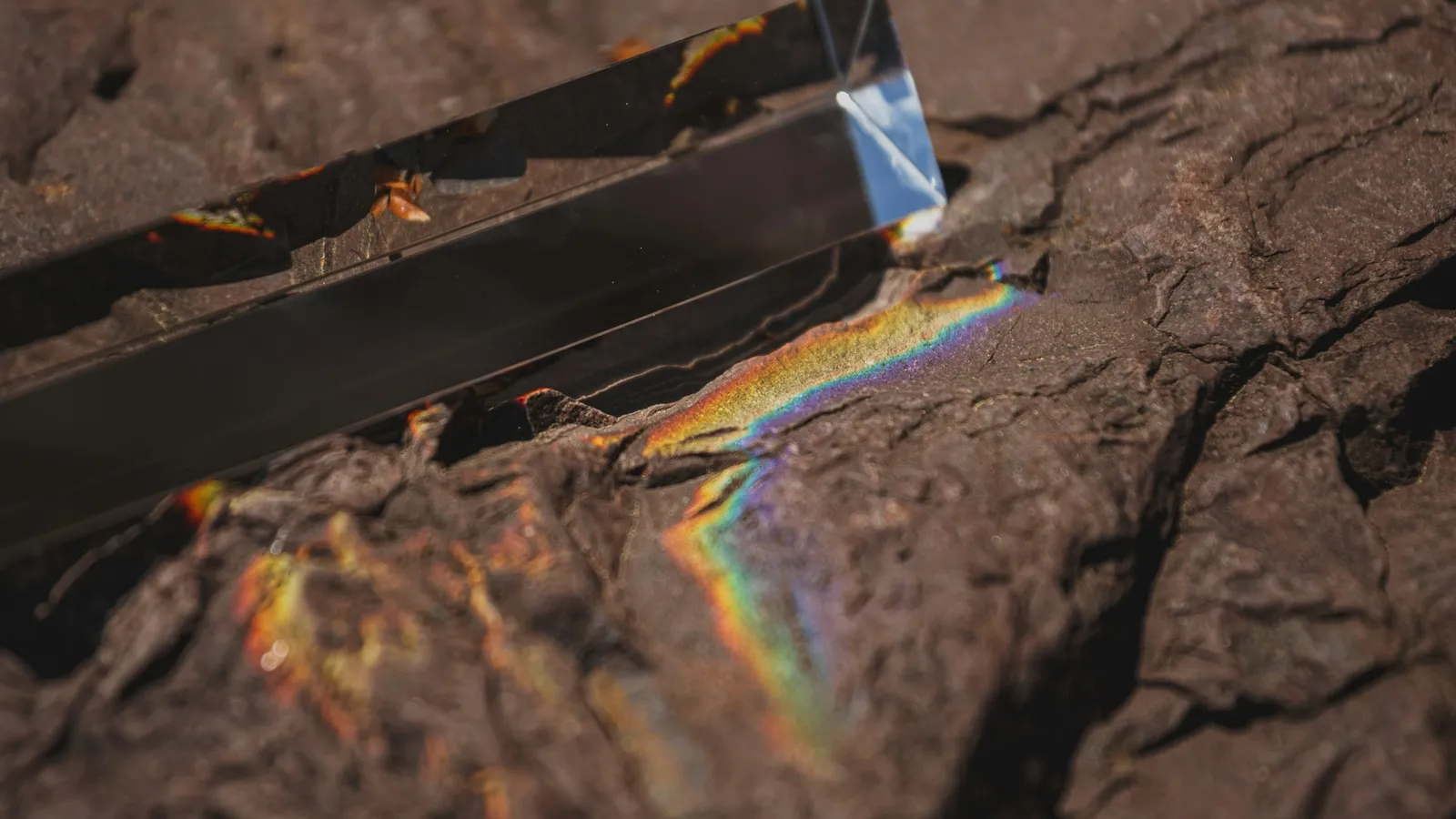
Because n depends on colour, so does δ. Isaac Newton described his experiments passing sunlight through a prism in a 1672 letter to the Royal Society, one of the first accounts of white light splitting into colours. For glass, n is larger for violet than for red, so violet deviates more.
Example 4: angular dispersion. A thin prism has A = 6°, with n = 1.532 for violet and n = 1.514 for red (values given in the problem).
δ_violet = 0.532 × 6° = 3.192°.
δ_red = 0.514 × 6° = 3.084°.
Angular dispersion = 3.192° − 3.084° = 0.108°.
Dispersive power ω = (n_v − n_r)/(n_mean − 1) = 0.018/0.523 ≈ 0.034, using n_mean = 1.523.
Common mistakes and how to avoid them
Using δ = (n − 1)A for a 60° prism. It works only for small angles; use the full formula.
Assuming minimum deviation when the question gives i. Use the two equations and Snell's law instead.
Halving the wrong angle. It is (A + δₘ)/2 on top and A/2 below.
Saying red deviates more. Violet has the larger n, so it bends more.
Calculator in radians. Set it to degrees before you start.
Reading the graph minimum carelessly in the practical. Take readings closely spaced around the lowest point. The board practical and viva guide covers the write-up.
Seeing the δ–i curve form as you sweep the angle makes the "two values of i" idea obvious. The Fermi Simulation Lab has interactive simulations for ideas that are easier to see than to read.
A practice routine for this chapter
Day 1: derive r₁ + r₂ = A and δ = i + e − A from a diagram without notes.
Day 2: five minimum deviation problems, alternating between finding n and finding δₘ.
Day 3: three problems like Example 3, each checked against δₘ.
Day 4: three thin-prism dispersion problems, including one combining two prisms for zero deviation.
Day 5: sketch the δ–i graph, mark δₘ, and explain why it has a minimum.
Today, redo Example 3 with i = 40° and see whether the ray still emerges.