

On this page
Why is the image of the Sun not a single point?
In introductory school physics, students learn that a convex lens focuses parallel rays of sunlight to a tiny spot that can ignite paper. In the Class 10 science syllabus on the NCERT textbook portal, Activity 9.11 demonstrates this concentration of light, while textbook summary tables list the image of an object at infinity as "point-sized" at the principal focus. Many students interpret "point-sized" literally, concluding that because object distance u is practically infinite, the magnification m = v / u must equal zero, giving an image of zero physical width.
In reality, the Sun is an extended celestial object. According to the NASA Sun Fact Sheet, the Sun has a mean diameter of 1,391,400 km and sits 149.6 million km from Earth (1.0 AU). Light rays from opposite edges of the solar disk reach the lens at slightly different angles rather than along identical lines. For foundational ray tracing rules, review Light in Class 10: reflection, refraction and the lens formula.
How do you calculate the size of the Sun's image?
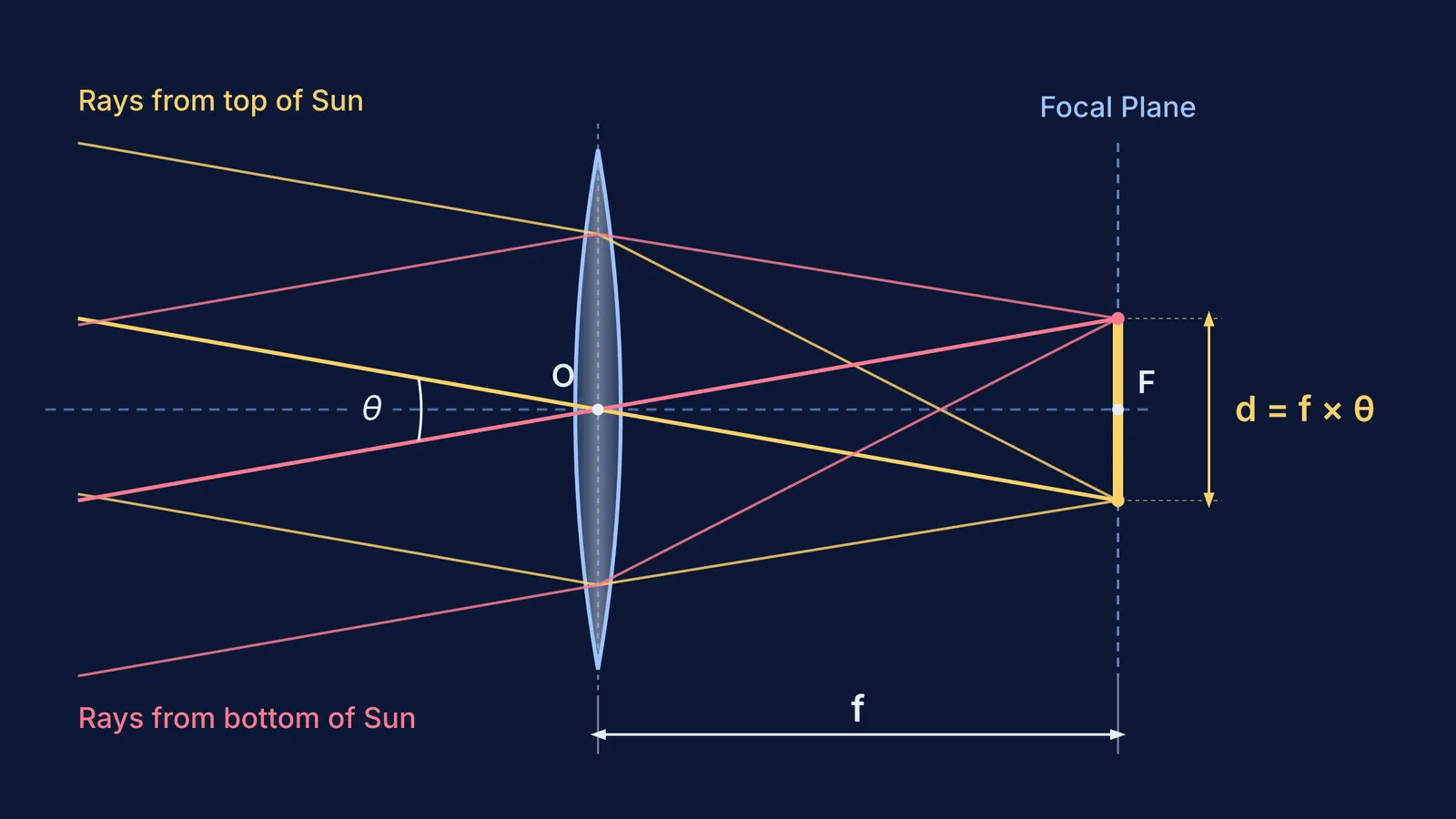
To find the image diameter, trace light through a thin convex lens of focal length f. Rays from any single point on the solar disk arrive as a mutually parallel bundle. Light from the top limb enters tilted at angle +θ/2 to the principal axis, while light from the bottom limb enters at -θ/2, where θ is the Sun's total angular diameter.
A parallel bundle entering a convex lens at an oblique angle converges in the focal plane at distance v = f behind the lens. Rays passing through optical centre O continue straight without deviation. Rays from the top and bottom limbs cross at O and strike the focal plane at heights y = ±f × tan(θ/2).
Because the angle θ is tiny (less than 0.01 radians), the small-angle approximation tan(θ/2) ≈ θ/2 holds. The diameter d of the real circular image in the focal plane is:
d = 2 × f × (θ/2) = f × θ
where θ is expressed in radians.
Why does the diameter equal roughly f/108?
Image diameter depends directly on Earth's distance from the Sun. As recorded in the NASA Sun Fact Sheet, the Sun's apparent angular diameter at 1 AU averages 1919 arcseconds, or approximately 32 arcminutes (about 0.00930 radians).
Dividing 1 by 0.00930 yields approximately 107.5, meaning roughly 108 solar diameters fit between Earth and the Sun. Substituting this into our formula gives a practical rule of thumb:
d = f × θ ≈ f / 107.5 ≈ f / 108
Because Earth moves along an elliptical orbit, the angular diameter shifts between 1887 arcseconds (0.00915 radians) at aphelion in July and 1952 arcseconds (0.00946 radians) at perihelion in January, varying the ratio between f / 106 and f / 109 throughout the year.
Astrophotographers rely on this relationship. In the NASA Solar Eclipse Photography Guide by Fred Espenak, solar image diameter is calculated as d = f / 109, yielding 0.9 mm with a 100 mm lens, 4.6 mm with a 500 mm lens, and 9.2 mm with a 1000 mm lens. When working on an optical bench, as shown in Focal length of a convex lens by the u-v method, sunlight produces this circular disk rather than an infinitely sharp point.
Does changing the lens aperture change the image size?
A common misunderstanding is that a wider convex lens creates a larger solar image. In reality, image diameter d depends exclusively on focal length f and angular size θ. It does not depend on the clear aperture diameter D of the lens.
The lens aperture dictates the focal spot's brightness and heat. Total solar energy collected scales with the lens area, proportional to D². This power is focused into an image area scaling with d² = (f × θ)². Irradiance at the focal spot is therefore proportional to (D / f)², the inverse square of the lens's focal ratio (F-number). A wider lens of equal focal length concentrates more power and burns paper faster, but the image diameter stays the same. For sign conventions and lens rules, see our guide on Ray optics sign conventions: mirror and lens formula mistakes.
How do you solve solar image problems in exams?
Consider a standard numerical problem:
Problem: A convex lens of focal length 50 cm focuses sunlight onto a screen. Taking the Sun's angular diameter as 32 arcminutes, calculate the diameter of the image formed on the screen.
Convert angular diameter to radians: θ = 32′ = (32 / 60)° = (8 / 15)°, so θ = (8 / 15) × (π / 180) ≈ 0.009308 radians.
Apply the image formula: d = f × θ = 500 mm × 0.009308 ≈ 4.65 mm (or using the f / 108 shortcut, d ≈ 500 mm / 108 ≈ 4.63 mm).
When solving ray optics numericals in JEE or NEET, watch for three recurring traps:
Do not set image size to zero using m = v / u: While u is infinite, the Sun is an extended angular object, so d = f × θ applies.
Do not confuse lens aperture D with image diameter d: Aperture alters brightness, while focal length f determines image size.
Always convert degrees and arcminutes to radians before multiplying by focal length.
When practising multi-step optics questions, having immediate access to clear reasoning helps prevent procedural mistakes. The Fermi Problem Library provides worked problems with a step-by-step solver that explains the reasoning rather than printing an answer. To explore how focal planes, aperture ratios, and optical instruments connect across the syllabus, the Fermi Concept Library covers every concept in physics with its own lesson and its place in the map.


