On this page
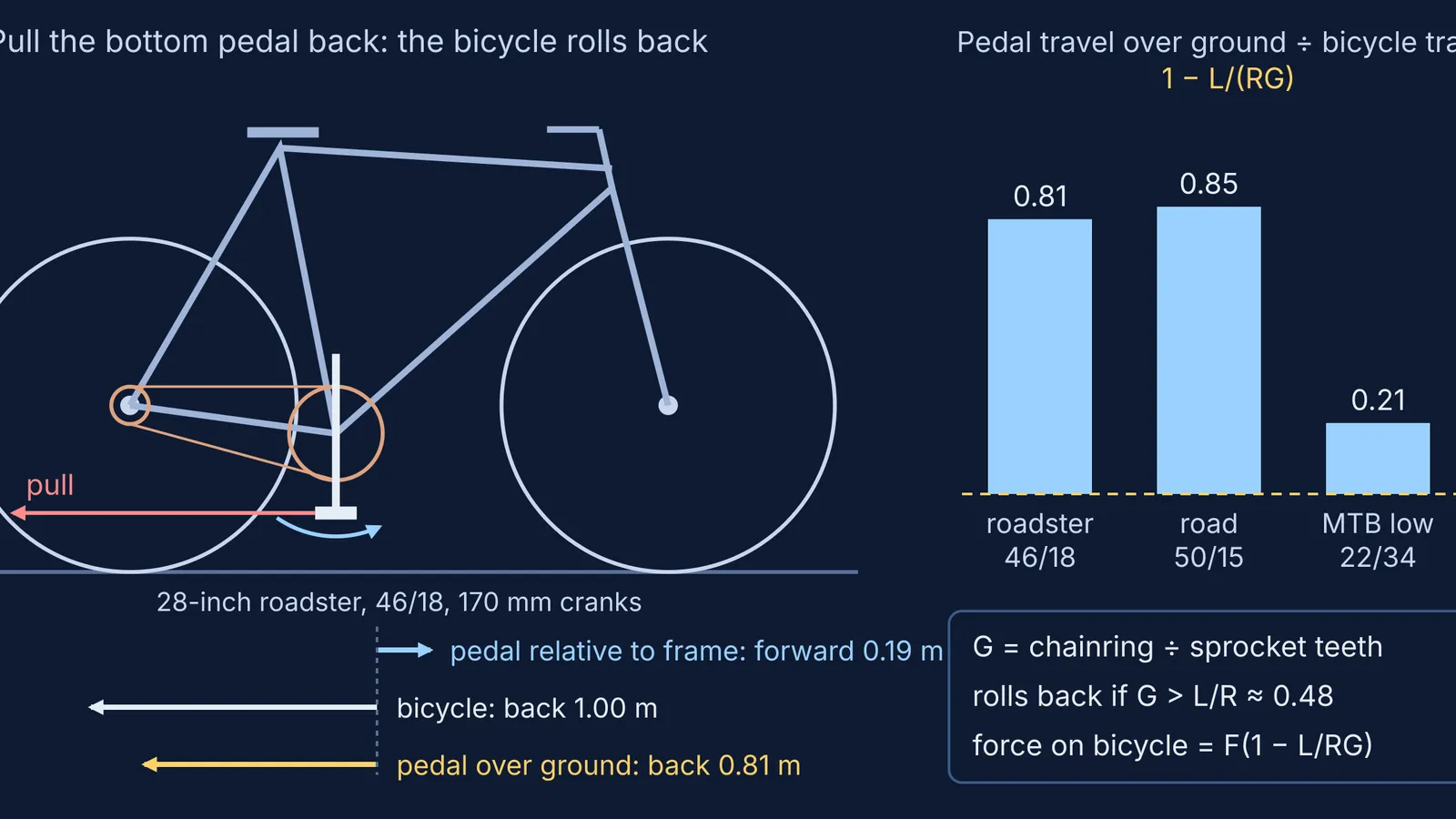
Stand a bicycle upright, turn the cranks so one pedal is at the bottom, tie a string to that pedal and pull it gently straight back. Which way does the bicycle roll? Most people say forwards, because pushing a pedal is how you ride. It rolls backwards. And the cranks turn backwards as well, so the pedal you are pulling back actually moves forward relative to the frame.
The puzzle is old. Martin Gardner discussed it in his book Mathematical Carnival (1975), and D. E. Daykin posed it as "The Bicycle Problem" in Mathematics Magazine in 1972. George Hart's Mathematical Impressions video for the Simons Foundation cites both. Here is the reasoning, with the numbers for a real roadster.
Why is pulling the pedal not like pedalling?
When you ride, your foot pushes on the pedal and the pedal moves relative to the frame. The ground pushes the tyre forward because the tyre grips the road.
With the string, your hand stays on the ground and pulls the pedal relative to the ground. What decides the motion is how far the pedal moves over the ground when the bicycle moves. A force does positive work only if its point of application moves along the force. So ask: if the bicycle rolls back by x, does the pedal move back over the ground, or forward?
How far does the pedal move when the bicycle rolls back?
Use three symbols: R, the rear wheel's radius; L, the crank length; and G, the gear ratio, equal to the chainring teeth divided by the sprocket teeth.
The bicycle moves back by x, so the rear wheel turns back through an angle x/R. It rolls without slipping.
When the rear wheel turns backwards, the freewheel locks and drags the sprocket and chain backwards with it. You can check this: roll any bicycle backwards and the cranks turn.
The chain turns the chainring, and so the cranks, by the wheel's angle divided by G: x/(RG).
The bottom pedal sits below the axle. When the cranks turn backwards, the bottom pedal moves forward relative to the frame by L × x/(RG).
Over the ground the pedal moves back by x − Lx/(RG) = x(1 − L/(RG)).
If 1 − L/(RG) is positive, the pedal moves back over the ground whenever the bicycle moves back. Your backward pull then does positive work only when the bicycle goes backwards, so that is the way it goes.
Worked example: a 28-inch roadster on 46/18
The classic Indian rod-brake roadster runs on 28 × 1½ inch tyres. Sheldon Brown's tyre sizing reference gives that size a 635 mm rim and lists it for Indian roadsters. With a 1½ inch (about 38 mm) tyre, the outer diameter is about 635 + 2 × 38 = 711 mm, so R ≈ 0.356 m. For the cranks, Sheldon Brown notes that 170 mm is the most common length. For gearing, the published specification of one roadster-style city bicycle, the Linus Roadster Classic, lists a 46-tooth chainring, an 18-tooth rear cog and 170 mm cranks. Tooth counts on Indian roadsters vary by model, so treat 46/18 as a typical example rather than any one brand's figure.
G = 46/18 = 2.56.
L/(RG) = 0.170/(0.356 × 2.56) = 0.187.
Pedal travel over the ground per metre of bicycle travel = 1 − 0.187 = 0.81 m, backwards.
Crank turn per metre = 1/(RG) = 1.10 rad, about 63° backwards.
Pedal movement relative to the frame = 0.19 m forward per metre.
Force. By the work–energy argument, a pull F on the pedal acts like a force F(1 − L/(RG)) on the bicycle as a whole. A 50 N pull gives 50 × 0.81 ≈ 40.6 N. On a 20 kg bicycle, with friction and the wheels' spin ignored, that is about 2.0 m/s² backwards. The spinning wheels make the real acceleration smaller but cannot reverse it.
Does every bicycle roll backwards?
Run the same formula for other bicycles, keeping L = 0.170 m.
700c road bicycle on 50/15 (700 × 28c tyre, R ≈ 0.339 m): L/(RG) = 0.15, ratio 0.85. Backwards.
26-inch mountain bike in its lowest gear, 22/34 (2.1 inch tyre, R ≈ 0.333 m): G = 0.65, L/(RG) = 0.79, ratio 0.21. Still backwards, but the pedal now moves back only 0.21 m per metre, so the push on the bicycle is much weaker.
The answer flips only when L/(RG) is greater than 1, that is G < L/R. For the roadster, L/R = 0.170/0.356 = 0.48. You would need a chainring less than half the size of the sprocket, such as an 18-tooth ring driving a 38-tooth cog. Ordinary bicycles do not have gears that low, so in practice the bicycle rolls backwards.
You can think of it as a lever and a gearbox in one. The gear ratio and crank torque post shows how the chain trades force for distance when you ride; testing the sprockets one by one shows the same ratio at the wheel. Here the same ratio decides the direction.
What if you pull the top pedal, or the bicycle has a fixed gear?
Pull the top pedal backwards and the sign changes. The top pedal sits above the axle, so turning the cranks backwards moves it back relative to the frame as well. It moves back over the ground by x(1 + L/(RG)), and the bicycle rolls backwards even more readily.
A fixed-gear bicycle has no freewheel, so the wheel always drags the cranks. It behaves the same way. One warning: on a bicycle with a back-pedal (coaster) brake, turning the cranks backwards applies the brake, so the wheel locks and the bicycle skids instead of rolling.
How do you try it safely?
Use a flat, quiet surface away from traffic, such as a courtyard or a corridor. Hold the handlebar lightly so the bicycle stays upright, and pull slowly with a string, not your foot. For the brakes and drive train behind all this, see how bicycle brakes and the chain drive work.
The Fermi Problem Library has relative-motion and work problems with a step-by-step solver that explains the reasoning. If you are preparing for JEE Main & Advanced, Fermi Test Prep offers personalised preparation with an AI tutor, live classes, adaptive mocks, mentorship and a study plan that updates based on mastery.
Quick checklist
Bicycle back by x, wheel back by x/R, cranks back by x/(RG).
The bottom pedal moves forward relative to the frame by Lx/(RG).
Over the ground it moves back by x(1 − L/(RG)): 0.81 m per metre on a 46/18 roadster.
A pull F acts like F(1 − L/(RG)) on the bicycle: 50 N gives about 41 N.
Only gearing below G = L/R ≈ 0.48 would make it roll forwards.
A coaster brake locks the wheel, so try this on a bicycle without one.