On this page
Why does pedalling feel so much harder on an incline?
When you ride on level ground, your pedals only fight tyre rolling resistance and air drag. As soon as the road tilts upward, gravity pulls directly down the slope. For a combined rider and bicycle mass m on an incline of angle θ, the gravitational component pulling backward along the road is m × g × sin θ. To keep moving forward at a steady pace, the rear tyre must push backward against the road with an equal tractive drive force.
On a single-speed bicycle or in a high gear, producing that drive force demands punishing muscular effort. In a 1938 paper in the Proceedings of the Royal Society of London, physiologist Archibald Vivian Hill showed that skeletal muscle contracts with high force only at low velocities, and that operating under near-maximal tension exhausts energy reserves rapidly. Without mechanical help, an incline bogs down your pedalling speed, turning every revolution into an unsustainable strain.
How do lower gears increase torque at the rear wheel?
A bicycle transmission functions as a pair of rotating levers linked by a chain. Pushing down on the pedal with force F_pedal turns the crank arm of length L_c about the bottom bracket spindle. This principle is grounded in calculating torque as r × F:
τ_crank = F_pedal × L_c
This crank torque pulls the chain with tension T = τ_crank / R_front, where R_front is the radius of the front chainring. The chain transfers this tension to the rear sprocket attached to the wheel hub, matching the mechanics of rotational dynamics and tension transfer in pulleys. At the rear hub, the chain pulls at sprocket radius R_rear, generating an axle torque:
τ_wheel = T × R_rear = τ_crank × (R_rear / R_front)
Because tooth count is proportional to radius, R_rear / R_front equals the tooth ratio N_rear / N_front:
τ_wheel = τ_crank × (N_rear / N_front)
To climb a steep hill, you shift into a low gear: a small chainring in front (small N_front) and a large cog in the rear (large N_rear). This maximizes the ratio N_rear / N_front, multiplying the torque delivered to the wheel for the same pedal pressure. In the Fermi Simulation Lab, you can adjust sprocket diameters interactively to see how torque and angular velocity balance in rotational systems.
Does changing gears reduce the total work done?
Lower gears make pedalling feel easier, but they do not reduce the physical work required to reach the top. Work equals force multiplied by distance, as defined in work, energy, and power principles. Lifting a combined mass m up a vertical height h requires a fixed change in gravitational potential energy:
W = m × g × h
In *Bicycling Science* from The MIT Press, David Gordon Wilson and Theodor Schmidt note that clean derailleur drives operate at 90% to 99% mechanical efficiency. Because energy is conserved, trading force for distance is mandatory:
A high gear turns the wheel multiple times per pedal stroke, moving you forward quickly but demanding heavy force.
A 1-to-1 climbing gear turns the wheel just once per pedal stroke, cutting the required force but covering less ground per revolution.
Lower gears simply spread the same total work over more pedal strokes, trading crushing force for greater distance.
What happens to muscle cadence and fatigue on steep hills?
The true advantage of low gearing is physiological. Human leg muscles deliver power most sustainably at cadences between 60 and 100 revolutions per minute (rpm), as documented in Bicycling Science.
When an incline forces your cadence down, muscle strain spikes. A 2005 study by William Bertucci and colleagues in the Journal of Biomechanics examined cyclists on a 9.25% grade and found that the peak crank torque jumped by 42% when cadence fell from 100 rpm to 60 rpm during uphill cycling. This sharp increase forces muscles to rely on fast-twitch fibres, which deplete glycogen quickly and trigger rapid fatigue.
Selecting a smaller gear lets you spin at a healthy 80 rpm even if road speed drops to a crawl. You stay within your aerobic capacity, relying on steady cardiovascular oxygen transport rather than exhaustive muscular force.
How much does a climbing gear reduce pedal force?
Consider a 75 kg rider and bicycle climbing an 8% gradient (slope angle θ where sin θ ≈ 0.08, taking g = 9.8 m/s²). Applying the mechanical framework from Bicycling Science reveals the dramatic difference gearing makes:
Gravitational resistance along the slope is F_slope = 75 × 9.8 × 0.08 = 58.8 N. Adding 6.2 N for rolling resistance and air drag yields a required tyre drive force of F_drive = 65.0 N.
For a standard 0.34 m radius wheel, the rear axle requires τ_wheel = 65.0 × 0.34 = 22.1 N·m of torque.
With 0.17 m crank arms, required pedal force depends on your gear selection:
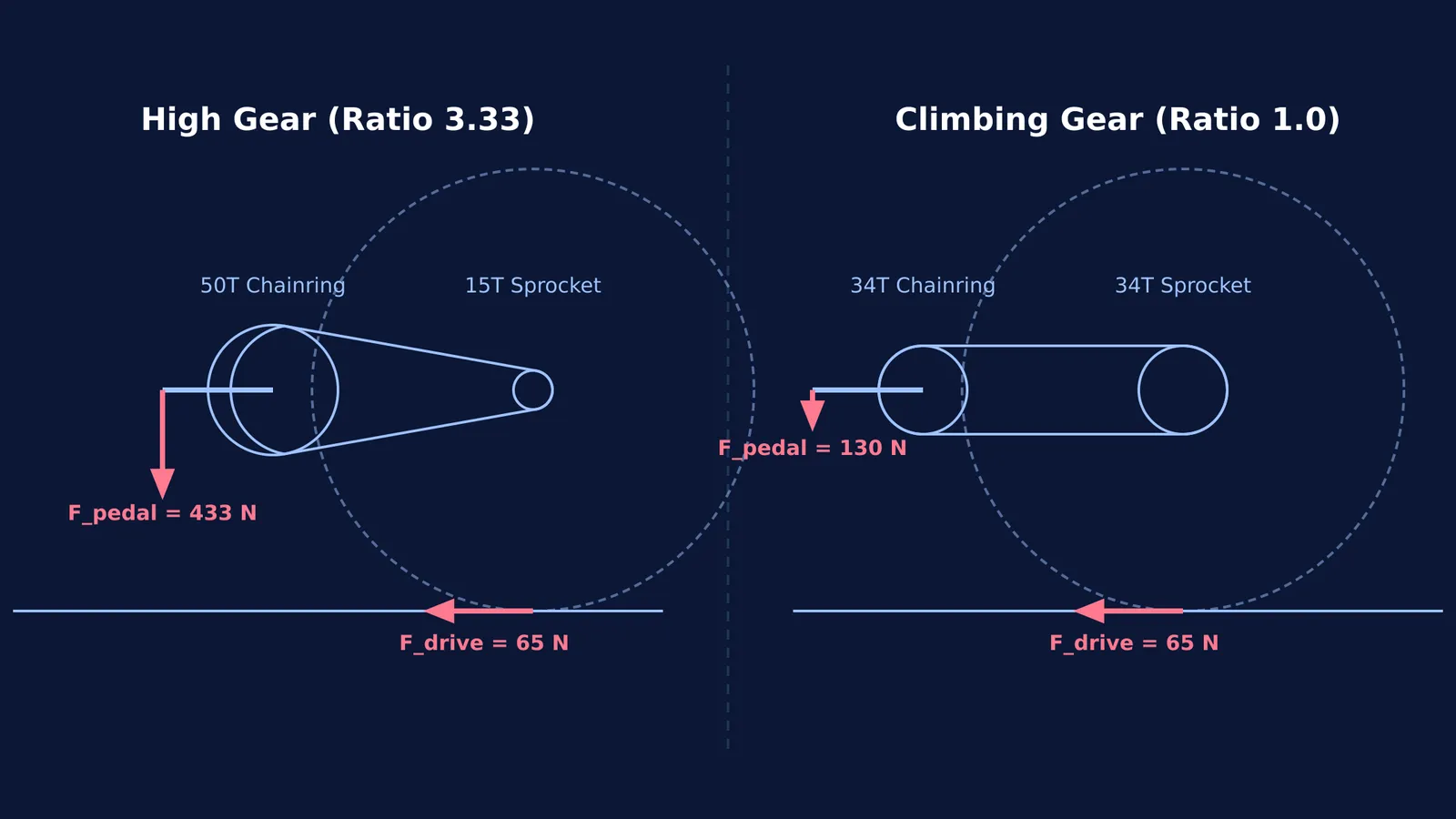
High gear (50T front / 15T rear, ratio 3.33): Crank torque must reach 22.1 × (50 / 15) = 73.67 N·m, demanding a pedal force of 433 N (roughly 44 kg of effort per stroke).
Climbing gear (34T front / 34T rear, ratio 1.00): Crank torque is 22.1 N·m, requiring only 130 N (roughly 13.3 kg of effort).
Shifting to the 34/34 climbing gear reduces pedal force by 70%, turning an exhausting strain into a sustainable spin. Exploring torque balances in the Fermi Problem Library helps you master how rotational mechanics and energy conservation connect in real machines.