On this page
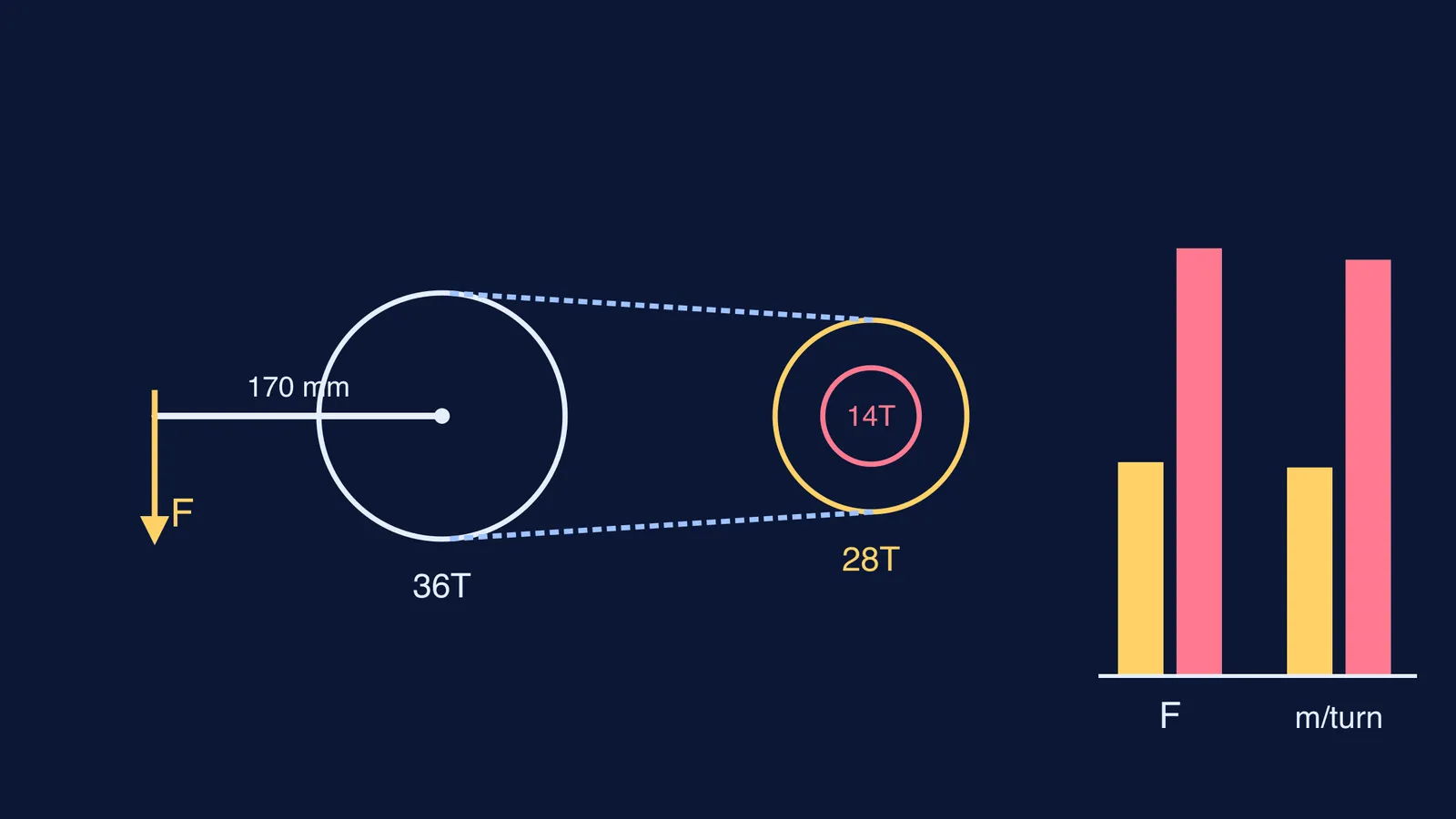
You are at the bottom of a steep road with a 36-tooth chainring in front and two rear sprockets to choose from: 14 teeth or 28 teeth. Predict which makes the climb easier, and what you give up for it. Write it down with one reason, then we will test it the way you would in a simulation: change one thing, keep the rest fixed.
Which bicycle gear makes climbing easier?
The big rear sprocket (28 teeth). It cuts the force you push with, and it cuts how far the bike moves per pedal turn. Both come from torque.
How do bicycle gears trade force for speed?
Torque is force multiplied by the perpendicular distance from the axle, τ = F × r, as OpenStax University Physics sets it out. Follow the force through the bike in three steps:
Your foot pushes on the pedal at the end of the crank, putting a torque on the chainring.
The chain carries one tension to the rear sprocket. A bigger sprocket has a bigger radius, so the same tension makes a bigger torque on the back wheel.
The back wheel turns that torque into a push on the road: more torque, more push for the same foot force.
Tooth count stands in for radius. On a new bicycle chain the distance from one roller centre to the next, the pitch, is precisely 1/2 inch (12.7 mm), and the pitch and the number of teeth set the sprocket's size, as Sheldon Brown's chain wear guide explains. Twice the teeth means roughly twice the radius.
Sheldon Brown packed this into one number, the gain ratio: wheel radius ÷ crank length × front teeth ÷ rear teeth. The gain ratio is the distance the bike travels for every unit of distance your pedal travels around its circle. His example uses 170 mm cranks and a 340 mm wheel radius, a radius ratio of 2.0, and we use the same values below.
Worked example: 14 teeth or 28 teeth on an 8% climb?
Take a rider and bike of 70 kg on a road that rises 8 m for every 100 m across, ignoring air drag and friction. We use g = 9.81 m/s², the NIST standard value rounded.
Force the road must push back with: 70 × 9.81 × sin(angle of an 8% grade) ≈ 70 × 9.81 × 0.0797 ≈ 55 N.
Gain ratio with the 28-tooth sprocket: 2.0 × 36 ÷ 28 ≈ 2.57. With the 14-tooth sprocket: 2.0 × 36 ÷ 14 ≈ 5.14.
Average pedal force needed (road force × gain ratio): about 141 N with 28 teeth, about 282 N with 14 teeth.
Distance per pedal turn (wheel circumference 2π × 0.34 m ≈ 2.14 m, times front teeth ÷ rear teeth): about 2.75 m with 28 teeth, about 5.49 m with 14 teeth.
At 60 pedal turns a minute, that is about 9.9 km/h with 28 teeth and 19.8 km/h with 14 teeth.
Doubling the teeth on the rear sprocket halved the force and halved the distance per turn.
Does a lower gear save energy on a hill?
No. Rotational power is torque times angular speed, P = τω, from the same OpenStax chapter. Climbing at 2.75 m/s against 55 N needs about 150 W whichever gear you choose. In the 28-tooth gear you supply it as 141 N at 60 pedal turns a minute. In the 14-tooth gear you would need 282 N at only 30 turns a minute to go the same speed. The gear only changes how you deliver the same work: a gentle push turned quickly or a hard push turned slowly.
Real chains also lose some energy. Spicer and colleagues in the Journal of Mechanical Design measured bicycle chain drive efficiency under varied power, speed and lubrication and found that chain tension and sprocket size primarily affected it.
The same force-for-distance swap appears in a pulley system's mechanical advantage, and the power side in why climbing stairs fast takes more power.
How can you test sprocket sizes yourself?
Use this plan on a geared cycle, or on any gear and torque simulation:
Count the teeth on your chainring and on your biggest and smallest rear sprockets.
Predict the gain ratio for each pair before you ride.
Mark the tyre with chalk and count wheel turns for exactly one pedal turn in each gear. Compare with front teeth ÷ rear teeth.
Change only one thing at a time, then explain the result in terms of torque.
If the torque step still feels abstract, start with torque and rotation in a simulation, then try the Fermi Simulation Lab, which has interactive simulations for ideas that are easier to see than to read. When you get stuck on a step, Fermi's AI tutor notices where you are stuck and decides whether to explain, ask or show.