

On this page
A pulley system is one of the classic simple machines taught in physics, famous for allowing a single person to lift heavy loads. But when you face a numerical problem involving multiple pulleys and strings, it can be tricky to work out exactly how much effort is needed. The secret lies in counting the ropes that pull up on the load. By looking at the number of supporting ropes, you can quickly find the mechanical advantage and predict both the force required and the length of rope you must pull.
What determines the mechanical advantage of a pulley?
The mechanical advantage (MA) of a pulley system is the ratio of the output force to the input effort. For an ideal, friction-free system, this mechanical advantage equals the number of cables pulling directly upward on the load (OpenStax).
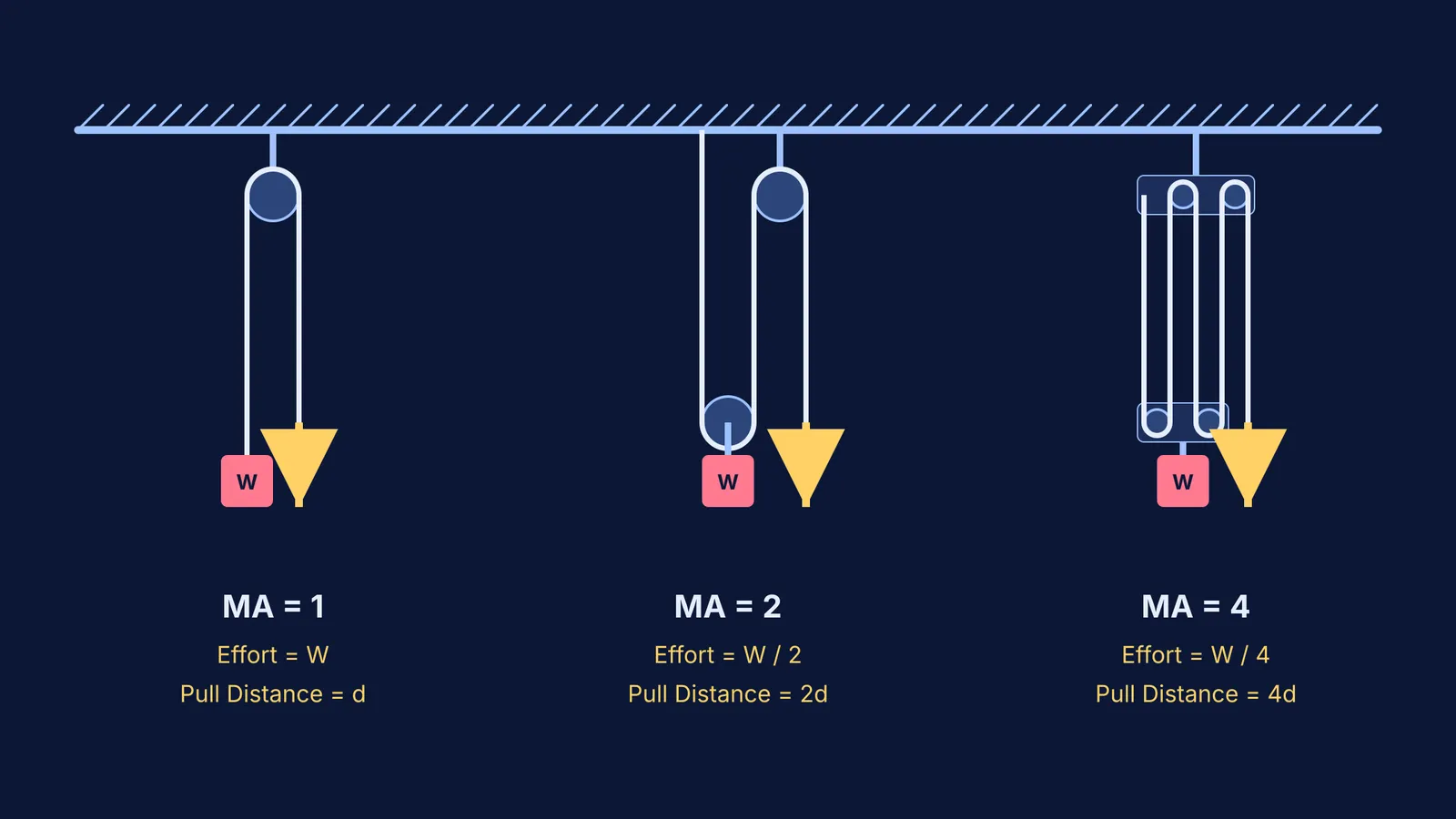
One rope (MA = 1): A single fixed pulley simply changes the direction of your force. If you are lifting a 100 N box, you must pull down with 100 N of effort.
Two ropes (MA = 2): When a pulley moves with the load and is supported by a rope anchored to the ceiling, two segments of rope share the weight. This cuts the required effort in half.
Four ropes (MA = 4): In a block and tackle system with four supporting ropes, a 100 N load only requires 25 N of effort.
How do you count the supporting ropes in a free-body diagram?
When you encounter a complex block and tackle system, drawing a free-body diagram is the most reliable way to find the mechanical advantage. A free-body diagram isolates the moving part of the system—usually the lower block and the load—from the rest of the world.
To draw this diagram, imagine drawing a dashed circle entirely around the lower movable block and the mass you are lifting. Then, look at where the ropes cross that dashed boundary. Every rope segment that crosses the boundary and pulls upward contributes one unit of tension to supporting the load (OpenStax).
If the string is continuous and the pulleys are frictionless, the tension is the same everywhere along the string. If there are four rope segments pointing up from the movable block, the total upward force is four times the tension. When this system is in equilibrium, that upward force must perfectly balance the downward weight of the load. The effort you apply is simply the tension in that single string, making it one-quarter of the total weight.
Notice that the rope you pull with your hands only counts toward the mechanical advantage if it pulls directly upward on the movable load. If the final rope passes over a fixed pulley at the ceiling and you pull downward, that final segment does not lift the load; it merely changes the direction of the effort.
How does the effort-distance trade-off work?
While a system with four ropes makes a load feel lighter, it does not do less work. The fundamental law of conservation of energy dictates that the work done (force multiplied by distance) must remain the same whether you use a machine or not (OpenStax).
Because you have decreased the force required by a factor of four, you must apply that smaller force over a distance four times as long. To lift the load one metre using a four-rope system, you have to pull four metres of rope through your hands.
How to run a pulley system mechanical advantage simulation?
Drawing free-body diagrams helps you see how tension splits across the ropes, but watching the system move makes the trade-off obvious. Inside the Fermi Simulation Lab, you can explore interactive simulations for the ideas that are easier to see than to read.
You can set up virtual pulley systems with one, two or four supporting ropes and attach the same heavy mass to each. As you drag the effort rope in the simulation, you can measure both the input force vectors and the length of rope that passes through your hand. This kind of active experimentation shows you instantly why mechanical advantage is a strict exchange between force and distance.
Once you have mastered the basics of mechanical advantage, you will be ready to tackle more complex mechanics problems, such as calculating simple pendulum string tension at different angles, finding the changing forces of a monkey climbing a rope, or working out which way a spool pulled by its string will roll.


