

On this page
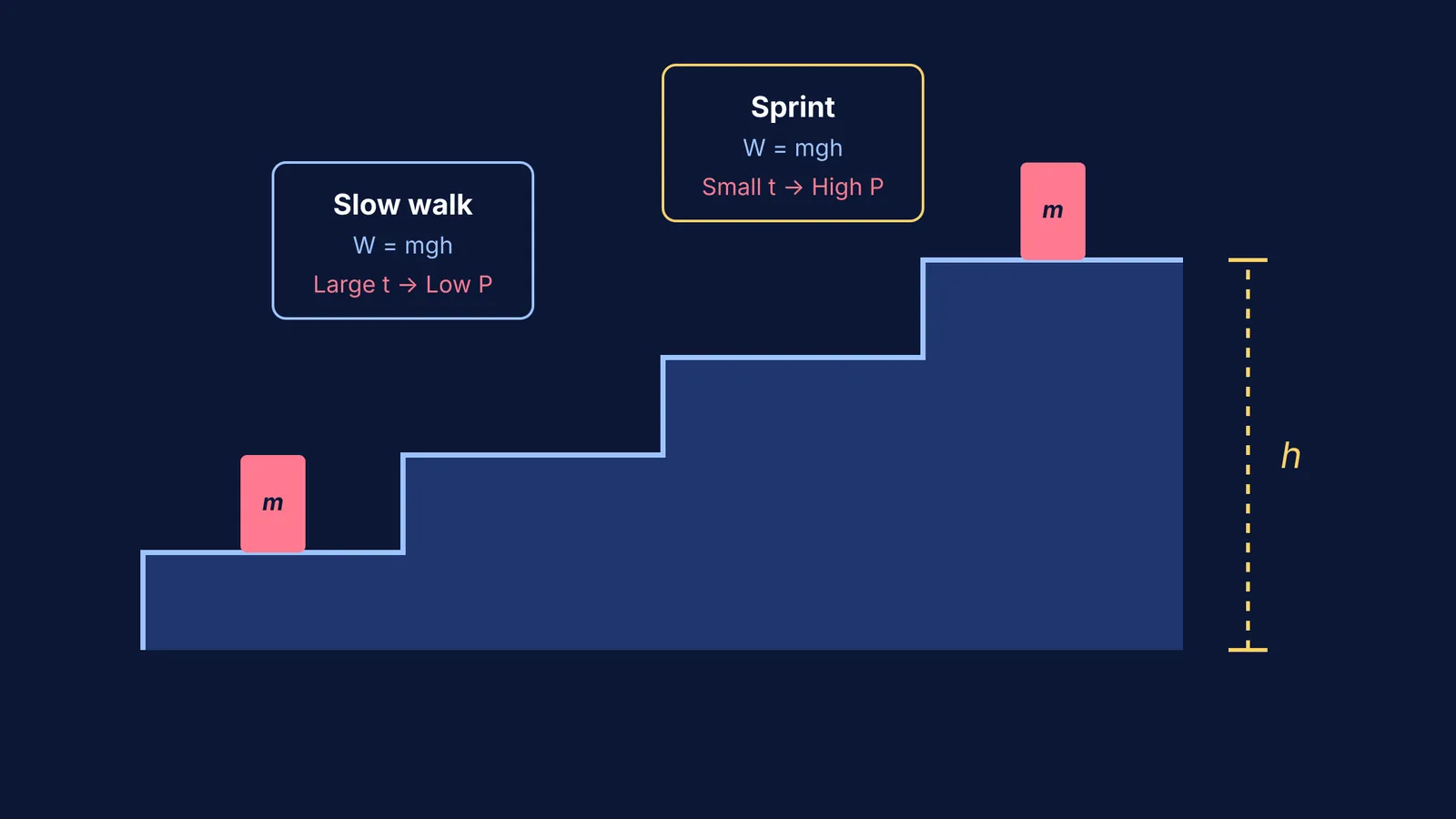
If you have ever rushed to class and taken the stairs two at a time, you know it leaves you breathless much faster than a slow walk. It feels like you are doing more work, but physics says otherwise.
Is work different when you run or walk?
In physics, mechanical work is defined as the force applied over a distance. When you climb stairs, you are lifting your body mass (m) against the pull of gravity (g) to a certain vertical height (h).
The formula for the work done is W = mgh.
Notice that time does not appear in this equation. Whether you take 10 seconds or 60 seconds to reach the top, the vertical height and your mass remain exactly the same. So, the mechanical work you do is identical in both cases. You have only transferred a fixed amount of chemical energy into gravitational potential energy.
Why does power climbing stairs fast vs slow change?
Power is the rate at which you do work. The formula is P = W / t, where W is work and t is time.
Because power is divided by time, time makes all the difference. When you run up the stairs, the time (t) shrinks, which causes the power output (P) to spike.
Let's look at the numbers. A 75 kg student climbing a standard 3-metre staircase does 2205 Joules of mechanical work (assuming g = 9.8 m/s²). If they walk up the stairs slowly in 25 seconds, their mechanical power is around 90 Watts. If they run up the same stairs in just 6 seconds, their mechanical power output surges to about 370 Watts.
You can test problems like this or motion at constant power to see how velocity scales with power. For a visual approach to lifting and moving masses, use the Fermi Simulation Lab to see how reducing the time taken for a fixed task directly drives up the required power.
The metabolic cost: one step or two?
The physics of mechanical power explains why sprinting is explosive, but it does not fully capture the calories your body burns (metabolic power). Much of the energy your body expends is lost as heat, which is why you sweat.
A 2012 study published in *PLOS ONE* investigated whether taking stairs one step at a time or two steps at a time burns more energy. The researchers found that skipping steps requires a higher rate of energy expenditure—about 9.2 kilocalories per minute compared to 8.5 kilocalories per minute for a single-step climb.
However, walking one step at a time is less efficient overall. Because climbing one step at a time takes much longer and involves more frequent leg movements, it results in a higher total calorie burn for the entire staircase. If your goal is to burn maximum calories, take it slow. If your goal is to train your cardiovascular system and increase peak power, run or take two steps at a time.
If you want more practice finding work from a force-displacement graph, or just need help unpacking standard mechanics problems, Fermi's AI tutor can work out what you know and build a plan for the session, teaching you how to set up the equations rather than just giving you the answer.


