On this page
The NMC's NEET (UG) 2026 syllabus lists this chapter under Unit 7 (Genetics and Evolution). Every rule and exception below comes from Chapter 4 of NCERT's Class 12 Biology textbook (Reprint 2026-27), with sections. Departures from Mendel's ratios, such as co-dominance and linkage, have their own list; this set covers sex determination, mutation and genetic disorders. All 12 questions are original, not past-paper items. Disorders appear only as NCERT describes them: a study summary, not medical advice.
What are the NCERT exceptions in Principles of Inheritance and Variation?
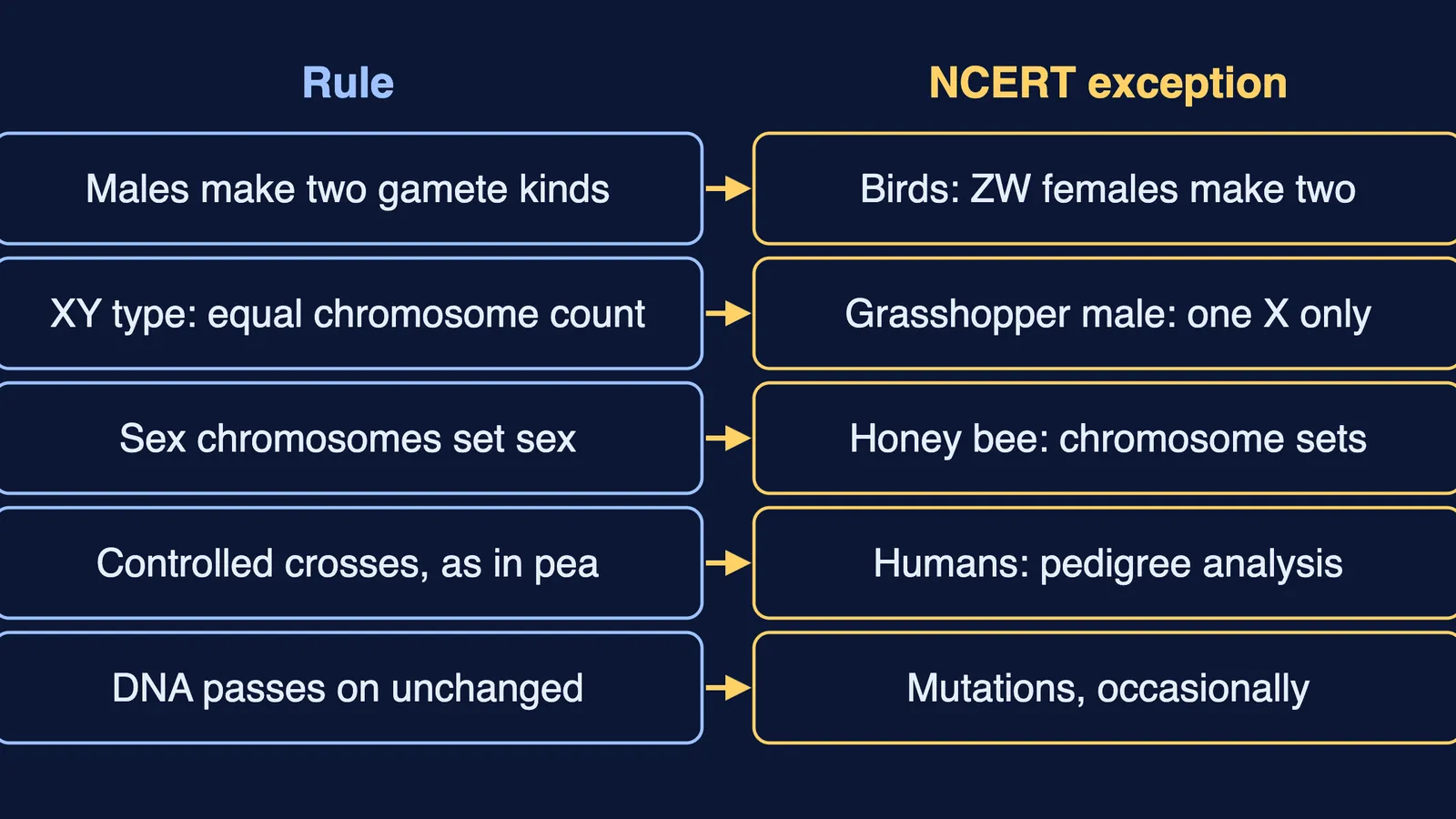
In the XO and XY types, males produce two kinds of gametes (male heterogamety). Exception: in birds the ZW female produces the two kinds, female heterogamety (4.6).
In the XY type, males and females carry the same number of chromosomes. Exception: in the XO type, a grasshopper male has a single X besides the autosomes while the female has a pair (4.6).
Sex usually follows which sex chromosomes a zygote receives. Exception: in the honey bee it follows the number of chromosome sets (females 32, drones 16). This one case also gives a fatherless drone, from an unfertilised egg, and sperms made by mitosis (4.6.2).
Human females have a pair of X chromosomes (4.6.1). Exception: Turner's syndrome females have one X, 45 with X0 (4.8.3).
A normal human cell has 46 chromosomes in 23 pairs. Exception: Down's syndrome carries an additional copy of chromosome 21, a trisomy (4.8.3).
DNA is transmitted from one generation to the next without change. Exception: changes do occur occasionally, and NCERT calls them mutation (4.8.1).
Inheritance is worked out from controlled crosses, as in pea. Exception: such crosses are not possible in humans, so family history is read through pedigree analysis (4.8.1).
Mendelian disorders mainly come from a change in a single gene. Exception: α thalassemia rests on two closely linked genes on chromosome 16, HBA1 and HBA2 (4.8.2).
An X-linked recessive disease passes from a carrier female to some of her sons. Exception: a haemophilic female is possible but extremely rare, since her mother must be at least a carrier and her father haemophilic (4.8.2).
Every disorder the chapter describes in detail (haemophilia, colour blindness, sickle-cell anaemia, phenylketonuria, thalassemia) is recessive. Exception: Figure 4.14 names myotonic dystrophy as an autosomal dominant trait (4.8.2).
How do you handle odd-one-out and exception questions?
Name the basis before reading the options, then mark each option yes or no on that basis alone. If two come out different, you have drifted to another feature; reread the stem. In a "NOT an exception" item, pick the option that quietly obeys the rule.
Odd-one-out questions
Q1. Judged by whether males and females carry the same total number of chromosomes, which is the odd one out? (1) Humans (2) Drosophila (3) Birds (4) Grasshopper
Answer: (4). Only the XO grasshopper male has one chromosome fewer than the female (4.6).
Q2. Judged by whether NCERT gives the trait as dominant or recessive, which is the odd one out? (1) Myotonic dystrophy (2) Sickle-cell anaemia (3) Thalassemia (4) Phenylketonuria
Answer: (1). It is the autosomal dominant example; the others are autosomal recessive (4.8.2).
Q3. Judged by how many genes NCERT says control the condition, which is the odd one out? (1) α thalassemia (2) β thalassemia (3) Sickle-cell anaemia (4) Phenylketonuria
Answer: (1). Two linked genes, HBA1 and HBA2; the others rest on one gene (4.8.2).
Q4. Judged by whether NCERT traces the disorder to a change in chromosome number, which is the odd one out? (1) Down's syndrome (2) Turner's syndrome (3) Klinefelter's syndrome (4) Colour blindness
Answer: (4). Colour blindness comes from mutated genes on the X chromosome (4.8.2, 4.8.3).
Q5. Judged by whether NCERT lists it as making Drosophila suitable for Morgan's work, which is the odd one out? (1) Grows on a simple synthetic medium (2) Completes its life cycle in about two weeks (3) Males and females look nearly alike (4) One mating gives many progeny
Answer: (3). NCERT says the sexes are easily told apart (4.3.2).
Which is NOT an exception?
Q6. Rule: in the XY type, females are XX and males XY. Which is NOT an exception? (1) A Turner's syndrome female, 45 with X0 (2) A Klinefelter's syndrome male, 47, XXY (3) A female bird with ZW (4) A female Drosophila with XX
Answer: (4). Drosophila follows the XY type (4.6).
Q7. Rule: DNA passes between generations without change. Which is NOT an exception NCERT describes? (1) Mutated X-chromosome genes behind colour blindness (2) Deletion of an α globin gene (3) Loss of an X chromosome in Turner's syndrome (4) Two alleles separating into different gametes
Answer: (4). Segregation shares alleles out unchanged (4.2.2, 4.8.1).
Two-statement and single-correct questions
Codes for Q8 to Q11: (1) Both correct (2) Only I correct (3) Only II correct (4) Neither correct.
Q8. I: In humans, the ovum decides the sex of the child. II: Half the sperms a man produces carry an X chromosome.
Answer: (3). The sperm's genetic makeup decides sex (4.6.1).
Q9. I: Henking saw his "X body" in only half the sperms after spermatogenesis. II: Henking showed that the X body decides sex.
Answer: (2). He could not explain its significance (4.6).
Q10. I: A haemophilic female needs a haemophilic father and a mother who is at least a carrier. II: Haemophilia affects one protein in the blood-clotting cascade.
Answer: (1). Both match 4.8.2.
Q11. I: Controlled crosses like those in pea are possible in humans, so pedigrees are seldom needed. II: Pedigree analysis cannot show whether a trait is dominant or recessive.
Answer: (4). Both contradict 4.8.1 and 4.8.2.
Q12. Which rule-exception pair is correct? (1) A normal human cell has 46 chromosomes; Down's syndrome (2) Females carry a pair of X chromosomes; Klinefelter's syndrome (3) Both sexes have equal chromosome numbers; birds (4) Detailed disorders are recessive; sickle-cell anaemia
Answer: (1). Down's adds a chromosome 21; the others obey their rules (4.6, 4.8.2, 4.8.3).
What should you do with your misses?
Missed Q1, Q6, Q8 or Q9: draw XO, XY and ZW side by side. Missed the rest: reread 4.8. Then try the principles of inheritance statement and match-the-list questions or the solved principles of inheritance NEET practice questions.
Which exception keeps slipping away from you? Fermi's AI tutor works out what you already know and builds a plan for the session.