On this page
Every rule, exception and answer comes from NCERT's Class 12 Biology chapter on Molecular Basis of Inheritance (Chapter 5, 2026-27 reprint), with its section. The NEET (UG) 2026 syllabus files the topic under Unit 7, Genetics and Evolution. All 12 questions are ours, not past-paper items or predictions.
What are the NCERT exceptions in Molecular Basis of Inheritance?
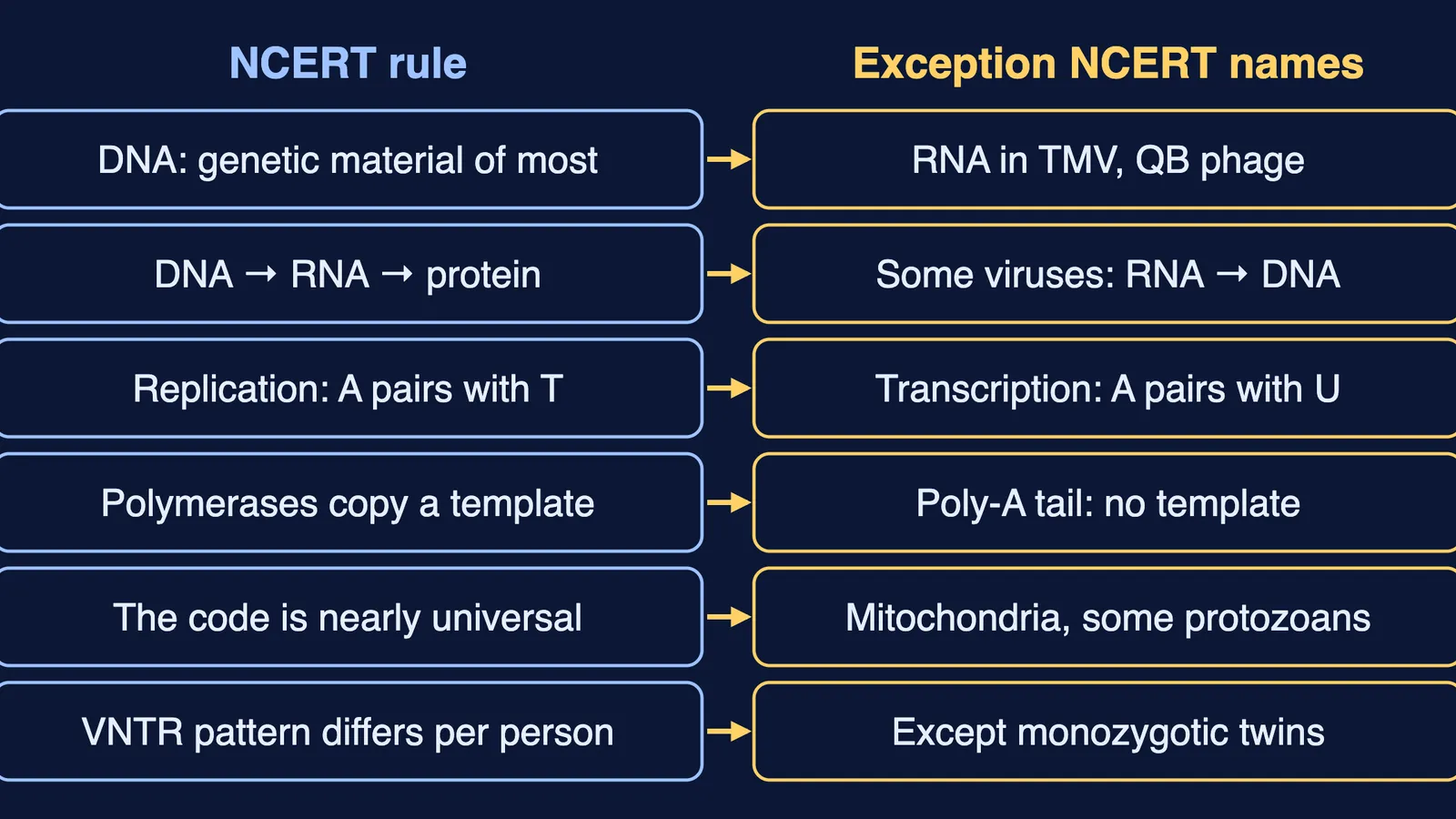
DNA is the genetic material of most organisms. Exception: some viruses carry RNA instead, such as Tobacco Mosaic virus and QB bacteriophage (5.2.2).
The central dogma runs DNA to RNA to protein. Exception: in some viruses information flows in reverse, from RNA to DNA (5.1.1).
Complementarity governs transcription, as it does replication. Exception NCERT names: adenine now pairs with uracil instead of thymine (5.5).
DNA-dependent polymerases build on a template (5.4.2, 5.5.3). Exception: tailing adds 200 to 300 adenylate residues to hnRNA's 3' end in a template independent manner (5.5.3); Severo Ochoa's enzyme also polymerised RNA without a template (5.6).
Biochemical reactions are usually catalysed by protein enzymes. Exception: some use RNA catalysts (5.3); in bacteria, 23S rRNA forms the peptide bond as a ribozyme (5.7).
The code is nearly universal: UUU means phenylalanine from bacteria to humans. Exception: some mitochondrial codons and some protozoans (5.6).
tRNAs are specific for each amino acid and read codons through the anticodon. Exception: there are no tRNAs for stop codons; a release factor binds the stop codon to end translation (5.6.2, 5.7).
Without lactose the repressor keeps the lac operon off. Exception: a very low expression level must persist, or lactose could not enter the cell (5.8.1).
The VNTR band pattern differs from individual to individual. Exception: monozygotic (identical) twins (5.10).
How do you handle odd-one-out and exception questions?
Find the basis in the stem (nucleic acid, template, base pairing) and test all four options on it.
Try a second feature, such as virus or bacterium; if it picks a different outsider, the basis in the stem decides.
In "NOT an exception" items, look for a plain rule posing as a special case.
In wrong-pairing items, check each exception really breaks its rule.
Odd-one-out and "NOT an exception" questions
Q1. Judged by the nucleic acid NCERT gives as its genetic material, which is the odd one out? (1) *Streptococcus pneumoniae* (2) *Escherichia coli* (3) Tobacco Mosaic virus (4) Bacteriophage lambda
Answer: (3). It uses RNA; the others use DNA (5.1, 5.2.2).
Q2. Judged by the base it places opposite a template adenine, which enzyme is the odd one out? (1) RNA polymerase I making rRNA (2) RNA polymerase II making hnRNA (3) DNA-dependent DNA polymerase at a replication fork (4) RNA polymerase III making tRNA
Answer: (3). It places thymine; RNA polymerases place uracil (5.5).
Q3. Which is NOT a case NCERT sets apart from a general rule? (1) Identical twins sharing a DNA fingerprint (2) Adenine pairing with uracil in transcription (3) Guanine joining cytosine through three hydrogen bonds (4) Lac operon expression at a very low level without lactose
Answer: (3). That is the ordinary pairing rule (5.1.1).
Q4. Which pairs a rule with the wrong exception? (1) Universal code: some mitochondrial codons (2) Fingerprints differ between people: monozygotic twins (3) DNA to RNA to protein: RNA copied into DNA in some viruses (4) Complementarity in transcription: guanine pairs with uracil
Answer: (4). NCERT's exception is adenine pairing with uracil (5.5).
Q5. Judged by whether NCERT expects their VNTR patterns to differ, which pair is the odd one out? (1) A mother and her son (2) Two brothers born years apart (3) Monozygotic twins (4) A father and his daughter
Answer: (3). Patterns differ between individuals except identical twins (5.10).
Two-statement and single-correct questions
Judge each statement alone; words like all and every often make one false.
Options for Q6 to Q8: (1) both correct (2) both incorrect (3) only I is correct (4) only II is correct.
Q6. Statement I: Transcription copies just one strand, and only a stretch of the DNA, into RNA. Statement II: If both strands were copied, NCERT says the two RNAs would be identical.
Answer: (3). They would be complementary and pair into double-stranded RNA (5.5).
Q7. Statement I: Hershey and Chase showed DNA is the genetic material in every living system, viruses included. Statement II: NCERT calls the genetic code nearly universal, with exceptions in some mitochondrial codons.
Answer: (4). Hershey and Chase showed DNA passing from a phage into bacteria, and some viruses use RNA (5.2.1, 5.2.2, 5.6).
Q8. Statement I: The start codon AUG is recognised only by the initiator tRNA. Statement II: AUG codes for methionine and also acts as the initiator codon.
Answer: (1). Both match NCERT (5.6, 5.7).
Q9. NCERT hedges how structural genes are arranged. Which version matches the chapter? (1) Monocistronic mostly in eukaryotes, polycistronic mostly in bacteria (2) Polycistronic mostly in eukaryotes, monocistronic mostly in bacteria (3) Monocistronic in every organism (4) Polycistronic in every organism
Answer: (1). Note the word mostly on both sides (5.5.2).
Q10. In some viruses, information flows from RNA to DNA. This reverses which step of the central dogma? (1) Translation (2) Transcription (3) Splicing (4) Charging of tRNA
Answer: (2). Transcription copies DNA into RNA (5.1.1, 5.5).
Q11. Per NCERT, DNA from one person's blood, skin and saliva: (1) gives a different VNTR pattern per tissue (2) shows the same degree of polymorphism (3) cannot be used in paternity disputes (4) carries no repetitive DNA
Answer: (2). That is why it serves forensic work (5.10).
Q12. Which is correct about RNA polymerases, per NCERT? (1) Bacteria use three, one per RNA type (2) Bacteria use one for all RNA types; eukaryotic nuclei have at least three (3) Eukaryotes have one, only in organelles (4) Eukaryotic organelles have no RNA polymerase of their own
Answer: (2). NCERT adds an RNA polymerase in the organelles to the three nuclear ones (5.5.3).
What should you do after this set?
Redo all 12 with answers covered, naming each basis aloud.
Add every miss to your rule-and-exception list with its section.
Then try the statement and match-the-list set on this chapter, the diagram-based questions on molecular basis of inheritance and the assertion-reason questions for this chapter.
Which exception keeps slipping away? Fermi's AI tutor works out what you already know and builds a plan for the session.