

On this page
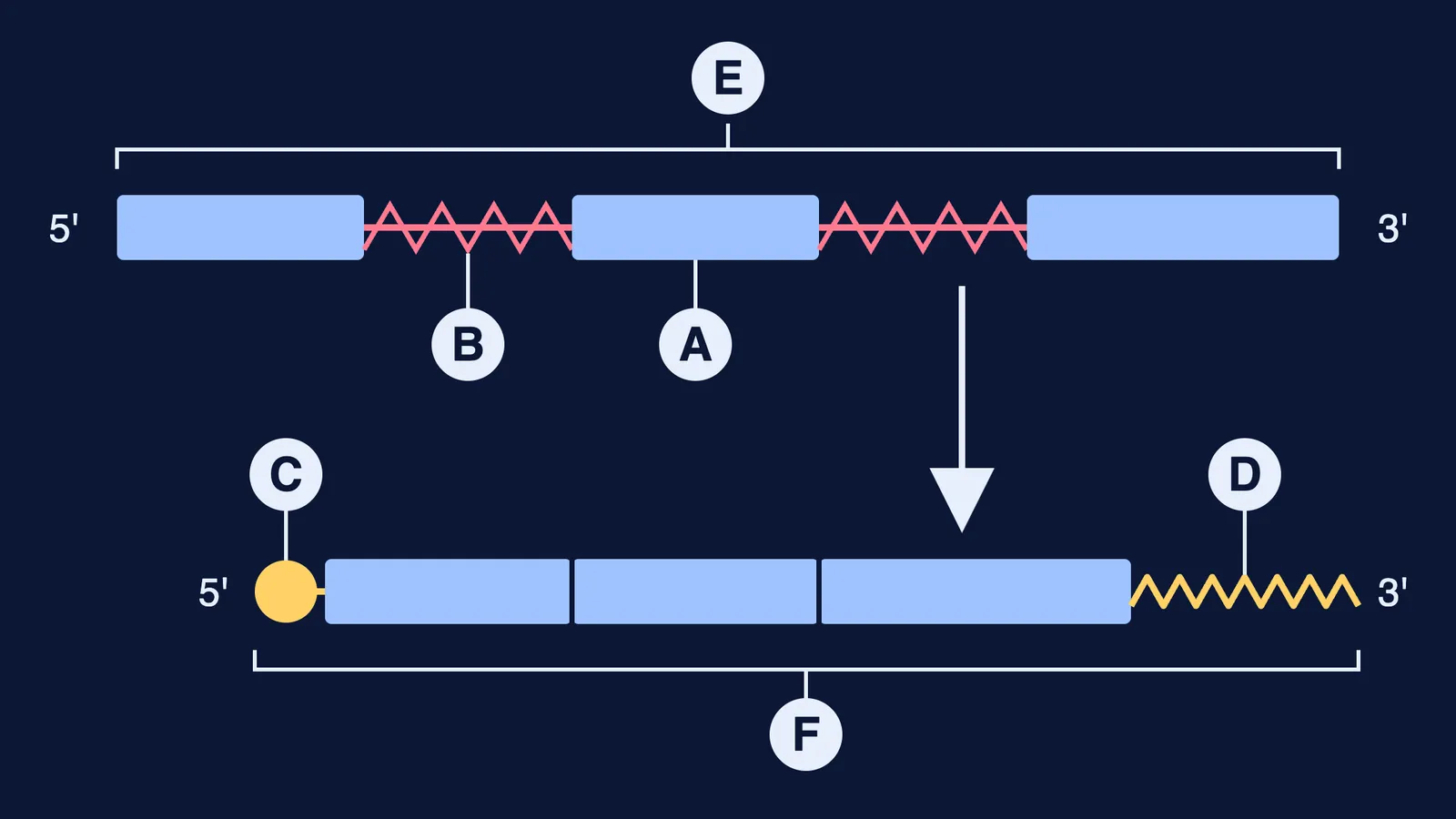
Our hero is a lettered schematic of a figure from NCERT Class 12 Biology Chapter 5, Molecular Basis of Inheritance: a eukaryotic primary transcript (top) and the mature RNA made from it (bottom). The NEET (UG) 2026 syllabus lists this chapter under Unit 7, Genetics and Evolution.
Questions 1 to 6 use the letters A to F. Questions 7 to 14 describe other chapter figures in words. Each answer cites the NCERT text (Reprint 2026-27).
How do you read a NEET diagram question?
Name every letter in the margin before reading the question.
Use the figure's clues: 5' and 3' ends, what disappears between two stages, what an arrow joins.
Check whether you are asked for a name, function or location; wrong options often fit the wrong letter.
Can you identify parts A to F of the RNA schematic?
Attack note: in match-the-list items, fix your surest pair and strike out options that disagree. In two-statement items, judge each statement alone first. Options for two-statement items: (1) Both I and II are correct (2) Both I and II are incorrect (3) I is correct, II is incorrect (4) I is incorrect, II is correct.
Part B in the schematic is: (1) an exon (2) the 5' cap (3) an intron (4) an untranslated region
Which part is added without any template? (1) A (2) F (3) B (4) D
I: Part C is an unusual nucleotide, methyl guanosine triphosphate. II: Molecule E is transcribed by RNA polymerase III.
Match the letters with List-II. List-I: A, B, C, D. List-II: I. Removed during splicing II. 200 to 300 adenylate residues III. Sequence that appears in the mature RNA IV. Methyl guanosine triphosphate. Options: (1) A-III, B-I, C-IV, D-II (2) A-I, B-III, C-IV, D-II (3) A-III, B-I, C-II, D-IV (4) A-IV, B-I, C-III, D-II
Molecule E cannot work as it is because: (1) it contains thymine (2) it still carries parts like B (3) it is double-stranded (4) it lacks every part like A
Which statement about molecule F is correct? (1) It is the precursor called hnRNA (2) It is made by RNA polymerase I (3) It still contains every part like B (4) It is moved out of the nucleus for translation
Answer key for the lettered diagram
A: exon. B: intron. C: 5' cap. D: adenylate (poly-A) tail. E: primary transcript (hnRNA). F: processed mRNA. NCERT covers these in Section 5.5.3 of the chapter.
1: (3). Introns are in the primary transcript but not the mature RNA.
2: (4). NCERT calls tailing template independent; adenylate residues join the 3' end.
3: (3). The cap is methyl guanosine triphosphate, but RNA polymerase II makes hnRNA.
4: (1). Exons stay, introns are spliced out, cap at 5', tail at 3'.
5: (2). Primary transcripts carry introns and are non-functional until spliced.
6: (4). Processed mRNA leaves the nucleus for translation.
More on capping, tailing and splicing: RNA processing in eukaryotes.
Which other figures of this chapter can be asked in words?
Attack note: picture the figure before reading the options. Two-statement items use the same four options as above.
In a figure of one polynucleotide chain, the end labelled 3' carries: (1) a free OH on the 3' carbon of the sugar (2) a free phosphate on the 5' carbon (3) a base with no sugar (4) a link to the next nucleotide
For a double-stranded DNA figure: I: A purine always faces a pyrimidine, keeping the gap between the strands nearly uniform. II: Stacking of one base-pair plane over the next adds to the helix's stability, along with hydrogen bonds.
A replicating fork figure opens only a small stretch of the helix because: (1) DNA polymerase works only on loops (2) separating the full length needs very high energy (3) ligase cannot join long strands (4) every fork needs a vector
Match List-I with List-II for a transcription unit figure. List-I: A. Promoter B. Terminator C. Template strand D. Coding strand. List-II: I. Has 3'→5' polarity; acts as template II. Downstream, usually marks the end of transcription III. Same sequence as the RNA, T in place of U IV. Upstream binding site for RNA polymerase. Options: (1) A-II, B-IV, C-I, D-III (2) A-IV, B-II, C-III, D-I (3) A-IV, B-II, C-I, D-III (4) A-I, B-II, C-IV, D-III
I: In a transcription unit figure, the promoter lies towards the 3' end of the structural gene, judged by the coding strand. II: Swapping the promoter and terminator would reverse which strand counts as the template.
For the clover-leaf figure of tRNA, which is correct? (1) The clover-leaf is its actual shape in the cell (2) The amino acid binds at the anticodon loop (3) One tRNA carries all amino acids (4) The real molecule is compact and shaped like an inverted L
For a lac operon figure: I: The repressor is made only after lactose enters the cell. II: Glucose or galactose can act as the inducer.
A bacterial transcription figure shows ribosomes on an mRNA still being made. This is possible because: (1) RNA polymerase II works in the cytoplasm (2) the mRNA needs no processing and no nucleus separates it from the cytosol (3) the mRNA is spliced instantly (4) the mRNA has no stop codon
Answers, from the NCERT chapter:
7: (1). The 3' end of a chain has a free OH on the 3' carbon of its sugar.
8: (1). Purine-pyrimidine pairing keeps the width even; stacking adds stability.
9: (2). Full-length separation would need very high energy.
10: (3). The promoter binds RNA polymerase upstream, and the template strand runs 3'→5'.
11: (4). The promoter is upstream, towards the 5' end; swapping it with the terminator reverses the strands.
12: (4). The clover-leaf is secondary structure; real tRNA is a compact inverted L.
13: (2). The repressor is made all the time; glucose and galactose cannot induce.
14: (2). No processing and one compartment let the two steps couple.
Where should you practise next?
For text-only items, try our statement and match-the-list set on molecular basis of inheritance. For question 9's figure, see our replication fork diagram guide.
Unsure which figure to redraw before the others? Fermi's AI tutor works out what you already know and builds a plan for the session.


