

On this page
Molecular Basis of Inheritance, the fifth chapter of NCERT's Class 12 Biology, runs from the structure of DNA to DNA fingerprinting. The NEET (UG) 2026 syllabus places it in Unit 7, Genetics and Evolution, with topics from the search for genetic material to DNA fingerprinting.
Below are 15 original questions across the chapter: five two-statement items, three match-the-list items and seven single-correct MCQs, each with a one-line reason from the 2026-27 NCERT reprint.
How do you attack two-statement questions?
Mark each statement T or F on its own before reading the options. Most false statements here swap one detail: an end (5' or 3'), an enzyme or a carbon number.
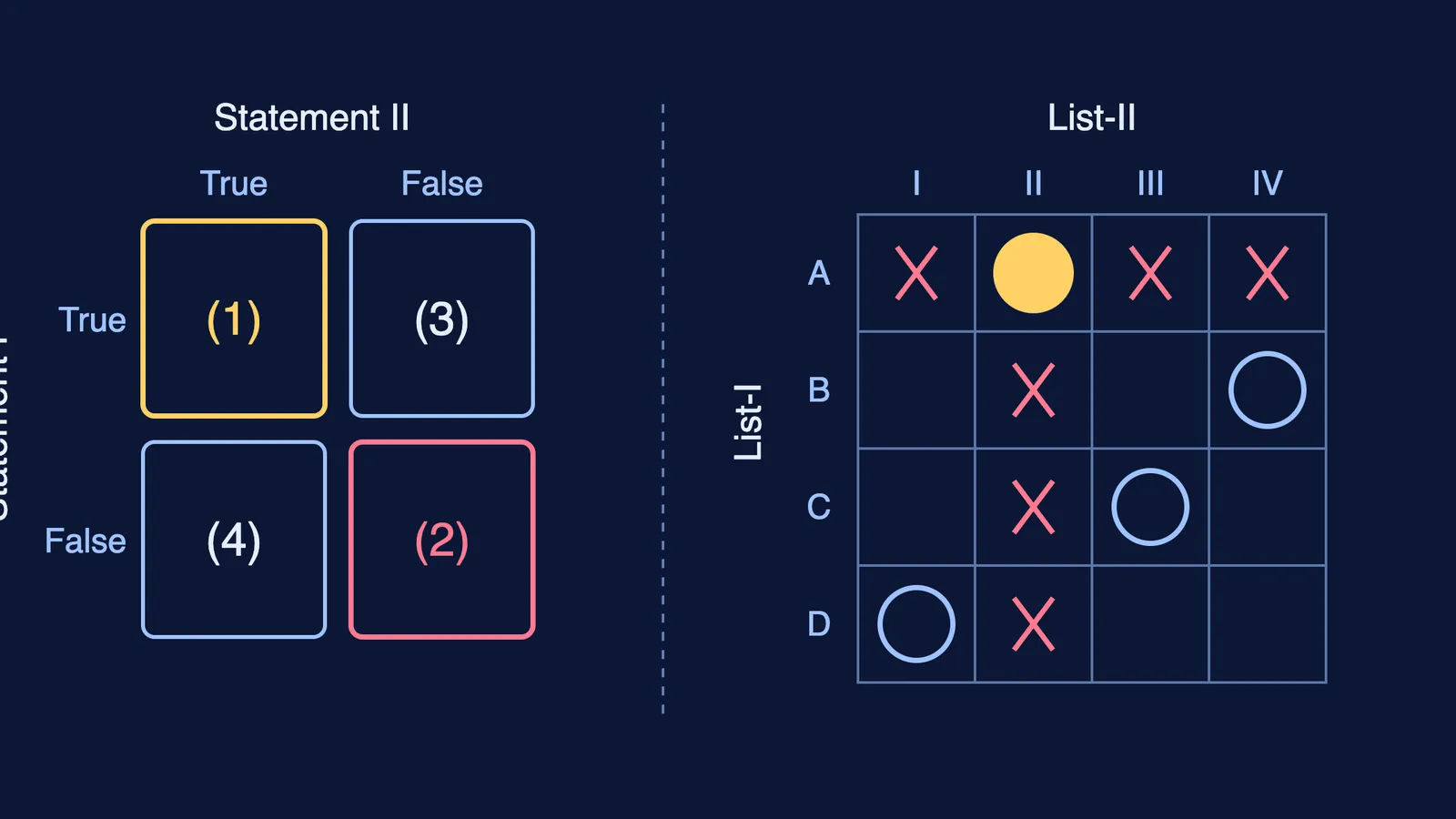
For questions 1 to 5 the options are: (1) Both I and II are correct (2) Both I and II are incorrect (3) I is correct, II is incorrect (4) I is incorrect, II is correct.
I: Adenine and guanine are purines, while cytosine, thymine and uracil are pyrimidines. II: A nucleoside is formed when a phosphate group joins the 1' carbon of the pentose sugar.
I: In Griffith's experiment, mice injected with heat-killed S strain bacteria alone died of pneumonia. II: Avery, MacLeod and McCarty found that RNase stopped transformation.
I: At the replication fork, the template with 3'→5' polarity is copied continuously. II: DNA ligase joins the fragments made on the other template.
I: Euchromatin is densely packed and transcriptionally inactive. II: Packaging chromatin at higher levels needs non-histone chromosomal (NHC) proteins.
I: Of the 64 codons, 61 code for amino acids. II: Each stop codon has its own tRNA.
Answers. 1: (3). A base joined at the 1' carbon makes a nucleoside; phosphate at the 5' carbon makes a nucleotide. 2: (2). Heat-killed S cells alone did not kill mice, and only DNase blocked transformation. 3: (1). Both match NCERT's account of the fork. 4: (4). Euchromatin is loosely packed and active; heterochromatin is the dense, inactive form. 5: (3). NCERT states that there are no tRNAs for stop codons.
How do you solve match-the-list questions fast?
Lock the pair you are surest of and strike out every option that disagrees. A second sure pair usually leaves one option.
List-I: A. George Gamow B. Har Gobind Khorana C. Marshall Nirenberg D. Severo Ochoa. List-II: I. Cell-free system for protein synthesis II. Enzyme that polymerises RNA without a template III. Argued that the code must be a triplet IV. Chemical method to make RNA with defined base combinations. Options: (1) A-III, B-IV, C-I, D-II (2) A-IV, B-III, C-I, D-II (3) A-III, B-I, C-IV, D-II (4) A-II, B-IV, C-I, D-III
List-I: A. i gene B. z gene C. y gene D. a gene. List-II: I. Transacetylase II. Repressor III. Permease IV. Beta-galactosidase. Options: (1) A-IV, B-II, C-III, D-I (2) A-II, B-IV, C-III, D-I (3) A-II, B-III, C-IV, D-I (4) A-I, B-IV, C-III, D-II
List-I: A. Sigma (σ) factor B. Rho (ρ) factor C. 5' untranslated region D. Release factor. List-II: I. Binds the stop codon and ends translation II. Lets RNA polymerase begin transcription III. Lets RNA polymerase end transcription IV. Stretch of mRNA before the start codon. Options: (1) A-III, B-II, C-IV, D-I (2) A-II, B-III, C-I, D-IV (3) A-II, B-III, C-IV, D-I (4) A-IV, B-III, C-II, D-I
Answers. 6: (1). Gamow reasoned that 4 bases coding for 20 amino acids need triplets, giving 4 × 4 × 4 = 64 codons. 7: (2). The i gene makes the repressor; z, y and a code for beta-galactosidase, permease and transacetylase. 8: (3). RNA polymerase only elongates; it briefly joins σ to start and ρ to stop.
Which single-correct MCQs test the whole chapter?
Recall the fact before reading the options. For sums, write the rule first, such as "A–T has two hydrogen bonds, G–C has three".
A double-stranded DNA segment has 120 base pairs, of which 50 are G–C pairs. How many hydrogen bonds join its two strands? (1) 240 (2) 290 (3) 310 (4) 360
Taking roughly 10 base pairs per turn, how many turns does a 150 bp stretch of the double helix make? (1) 1.5 (2) 34 (3) 15 (4) 51
A template strand reads 3'-CAGTTA-5'. The mRNA made from it is: (1) 5'-GUCAAU-3' (2) 5'-CAGUUA-3' (3) 5'-GTCAAT-3' (4) 5'-UAACUG-3'
Phages grown with radioactive sulfur infect E. coli. After blending and centrifuging, the bacteria are: (1) radioactive, as protein entered (2) not radioactive, as phage protein did not enter (3) radioactive, as DNA contains sulfur (4) not radioactive, as sulfur labels only RNA
Which is a finding of the Human Genome Project as NCERT reports it? (1) Chromosome 1 has the fewest genes (2) The largest known human gene is about 3000 bases long (3) The total gene count is 80,000 to 1,40,000 (4) Under 2 per cent of the genome is protein-coding
Which change in a structural gene leaves the reading frame unaltered after the change? (1) Inserting one base (2) Deleting two bases (3) Inserting three bases (4) Deleting one base
VNTRs used as probes in DNA fingerprinting belong to: (1) exons (2) micro-satellites (3) expressed sequence tags (4) mini-satellites
Answers. 9: (2). 70 A–T pairs give 140 bonds and 50 G–C pairs give 150. 10: (3). The pitch of 3.4 nm holds about 10 bp, so 150 bp is 15 turns. 11: (1). RNA is complementary to the template, with U in place of T, and runs 5'→3'. 12: (2). Sulfur labels protein, which did not enter the bacteria. 13: (4). Chromosome 1 has the most genes, dystrophin (2.4 million bases) is the largest, and genes number about 30,000. 14: (3). Inserting or deleting three bases, or multiples of three, keeps the frame. 15: (4). NCERT classes VNTR as a mini-satellite.
Where should you go next on this chapter?
For another format, try our molecular basis of inheritance assertion-reason questions. If a term slowed you down, revise the molecular basis of inheritance key terms. For worked base-pairing and Meselson-Stahl sums, see our NEET walkthrough of this chapter.
Not sure which section to revise first? Fermi's AI tutor works out what you already know and builds a plan for the session.


