On this page
This set has 10 original questions on Chapter 5 of CBSE Class 12 Biology, Molecular Basis of Inheritance: 6 assertion-reason items and 4 statement pairs, from easy to hard. Every statement is checked against the NCERT chapter (Reprint 2026-27). For what to write in longer answers, keep our molecular basis of inheritance board exam answer guide open beside it.
How do you read assertion-reason questions?
The CBSE Biology curriculum for 2026-27 lists assertion-reasoning questions among its question types, and the 2026-27 sample question paper carries a block of them with the same four options used below.
Judge each statement alone first. If both are true, join them with "because" and ask whether R is the direct reason NCERT gives for A. Our three-check method for assertion-reason questions explains this in detail.
Keys for Q1-Q6:
(A) Both A and R are true and R is the correct explanation of A.
(B) Both A and R are true but R is NOT the correct explanation of A.
(C) A is true but R is false.
(D) A is false but R is true.
Assertion-reason questions on molecular basis of inheritance
Q1 (easy). Assertion (A): In double-stranded DNA, the amount of adenine equals the amount of thymine. Reason (R): Every adenine on one strand pairs with a thymine on the opposite strand.
Answer: (A). Both are true. Base pairing puts one thymine opposite each adenine, which is why Chargaff found the A:T ratio equal to one. Trap: applying the rule to single-stranded nucleic acids, where nothing forces the counts to match.
Q2 (easy). Assertion (A): Histones carry a net positive charge. Reason (R): Histones are rich in lysine and arginine, whose side chains are positively charged.
Answer: (A). NCERT gives this as the cause: lysine and arginine are basic, with positive side chains. Trap: thinking the charge comes from the DNA wrapped around them; DNA is negative.
Q3 (medium). Assertion (A): Meselson and Stahl separated heavy and light DNA by centrifugation in a caesium chloride density gradient. Reason (R): 15N is a radioactive isotope of nitrogen.
Answer: (C). A is true. R is false: 15N is a heavy, non-radioactive isotope, so DNA labelled with it can only be told apart by density. Trap: mixing this up with Hershey and Chase, who did use radioactive phosphorus and sulfur.
Q4 (medium). Assertion (A): Viruses with an RNA genome tend to mutate and evolve faster. Reason (R): RNA can directly code for the synthesis of proteins.
Answer: (B). Both are true. A follows from RNA being unstable (its reactive 2'-OH group), which raises the mutation rate; R explains why RNA expresses characters easily, not why it mutates. Trap: ticking (A) because both statements praise RNA.
Q5 (hard). Assertion (A): Deleting one base between the start codon and the stop codon of an mRNA changes the reading frame from that point onward. Reason (R): The genetic code is degenerate.
Answer: (B). Both are true. The frame shifts because codons are read three at a time without punctuation; degeneracy (several codons for one amino acid) has nothing to do with it. Trap: picking any true fact about the code as the reason.
Q6 (hard). Assertion (A): Glucose acts as an inducer of the lac operon. Reason (R): Beta-galactosidase hydrolyses lactose into glucose and galactose.
Answer: (D). A is false: NCERT states that glucose and galactose cannot act as inducers; lactose (or allolactose) inactivates the repressor. R is true. Trap: assuming a product of lactose breakdown must also switch the operon on.
Statement I and Statement II questions with answers
Keys for Q7-Q10:
(A) Both statements are correct.
(B) Both statements are incorrect.
(C) Statement I is correct, Statement II is incorrect.
(D) Statement I is incorrect, Statement II is correct.
Q7 (medium). Statement I: In eukaryotes, RNA polymerase III transcribes tRNA, 5S rRNA and snRNAs. Statement II: RNA polymerase I transcribes hnRNA, the precursor of mRNA.
Answer: (C). Statement I matches NCERT. Statement II is wrong: RNA polymerase II makes hnRNA, while RNA polymerase I makes the 28S, 18S and 5.8S rRNAs. Trap: assuming polymerase I starts with the most important RNA, mRNA.
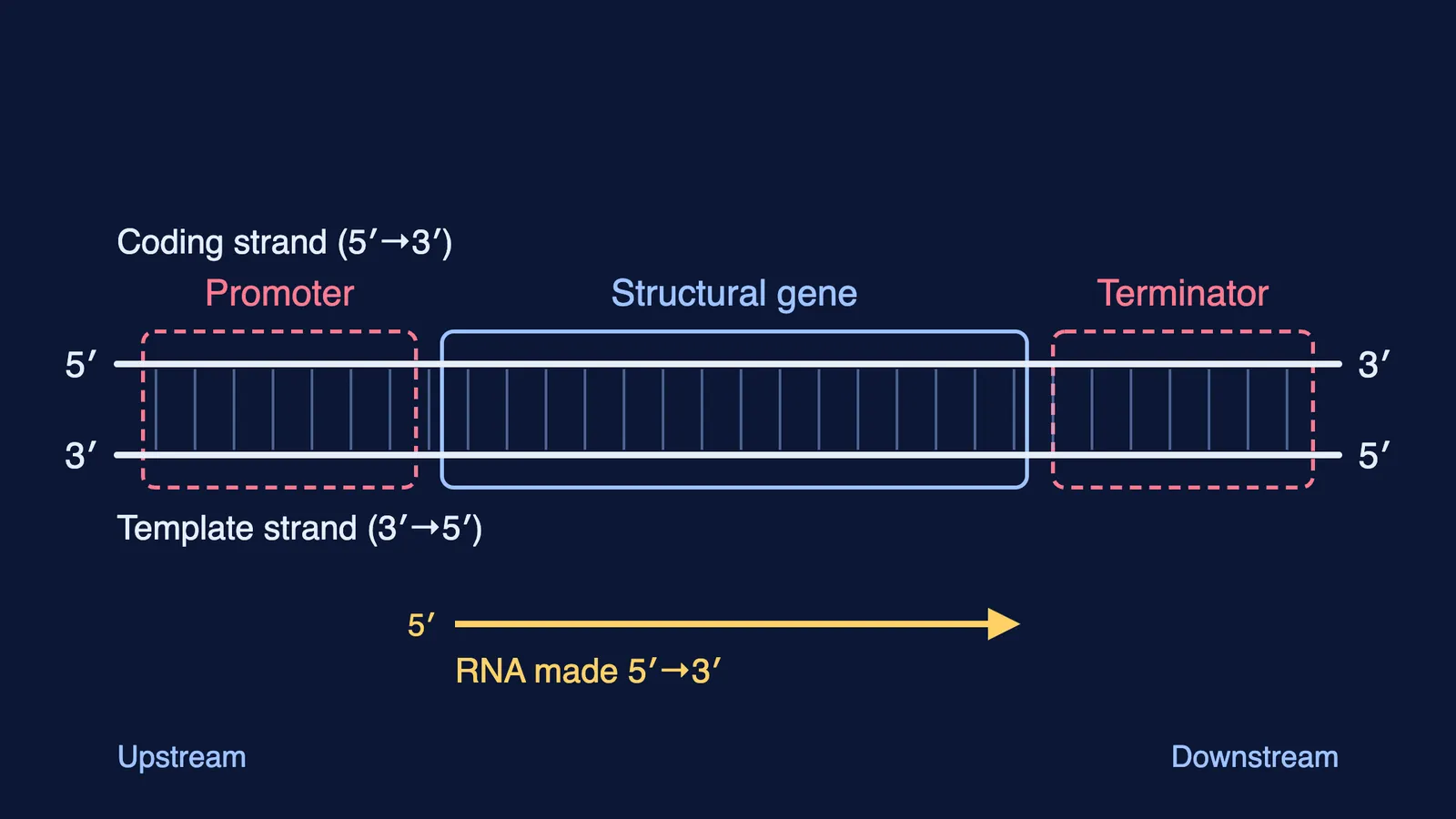
Q8 (medium). Statement I: In a transcription unit, the coding strand has 3'→5' polarity and acts as the template. Statement II: The promoter lies towards the 5' end (upstream) of the structural gene, taking the coding strand as reference.
Answer: (D). Statement I is wrong: the 3'→5' strand is the template; the 5'→3' strand, which matches the RNA except for T in place of U, is the coding strand. Statement II is correct. Trap: the name "coding" suggests it is the strand that gets read.
Q9 (hard). Statement I: In capping, methyl guanosine triphosphate is added to the 3' end of hnRNA. Statement II: In tailing, adenylate residues are added by copying a matching stretch of the DNA template.
Answer: (B). The cap goes on the 5' end, and the 200-300 adenylate residues of the tail are added at the 3' end without any template, as the NCERT chapter describes. Trap: getting one end right and trusting the rest.
Q10 (hard). Statement I: In bacteria, 23S rRNA acts as the enzyme (a ribozyme) that catalyses peptide bond formation. Statement II: Untranslated regions lie at both the 5' and 3' ends of an mRNA and are needed for efficient translation.
Answer: (A). Both are straight from NCERT's section on translation. Trap: assuming catalysts must be proteins, or that a region which is not translated must be useless.
How should you use this set?
Attempt all 10 in one sitting, writing only the letter.
For every miss, write which half failed: a false statement you believed, or a true pair you linked wrongly.
Reread that part of the NCERT chapter, then rewrite the item so a different key becomes correct.
Move to case passages next: our molecular basis of inheritance case study questions test the same ideas with data.
If one idea keeps tripping you up, such as which strand is the template, the Fermi Concept Library covers every concept in biology with its own lesson and its place in the map.