

On this page
These three cases cover Chapter 5 of CBSE Class 12 Biology: DNA structure, replication and the lac operon. The scenarios and numbers are original. For what to write in long answers, use our board exam answer guide for molecular basis of inheritance.
The CBSE Biology sample question paper for 2026-27 lists Section D as 2 case-based questions of 4 marks each. Our cases carry one extra part (1 + 1 + 1 + 2 marks) for practice. Every fact below matches the NCERT chapter, Reprint 2026-27.
Case 1: How long is a curd-spoiling phage's DNA?
A dairy in Anand, Gujarat, finds that batches of curd stop setting. Its lab traces the problem to a bacteriophage that infects the starter bacteria. The phage genome is double-stranded DNA of 36,500 base pairs (bp). Chemical analysis shows that 28% of its bases are cytosine. A second phage from the same tank has a single-stranded DNA genome, and its analysis reads adenine 25%, thymine 33%, guanine 24% and cytosine 18%.
(i) What percentage of the first phage's bases is adenine? (a) 28% (b) 22% (c) 44% (d) 56%
(ii) What is the length of the first phage's DNA in micrometres, and how many helical turns does it have?
(iii) Why do the second phage's results not follow Chargaff's rule?
(iv) How many hydrogen bonds hold the two strands of the first phage's DNA together? Show your working. (2 marks)
Answers.
(i) (b) 22%. Cytosine equals guanine, so C + G = 56%; the remaining 44% is split equally between A and T, giving 22% each.
(ii) Length = 36,500 bp × 0.34 nm = 12,410 nm, or about 12.41 µm. With about 10 bp per turn, it has about 3,650 turns.
(iii) Chargaff's rule (A = T and G = C) holds for double-stranded DNA, where every base pairs with its complement. A single strand has no partner strand, so its base ratios need not be equal.
(iv) G + C = 56% of bases, so 56% of base pairs are G≡C: 0.56 × 36,500 = 20,440 pairs, with 3 hydrogen bonds each = 61,320. The other 16,060 pairs are A=T with 2 each = 32,120. Total = 93,440 hydrogen bonds.
Case 2: What if Meselson and Stahl ran in reverse?
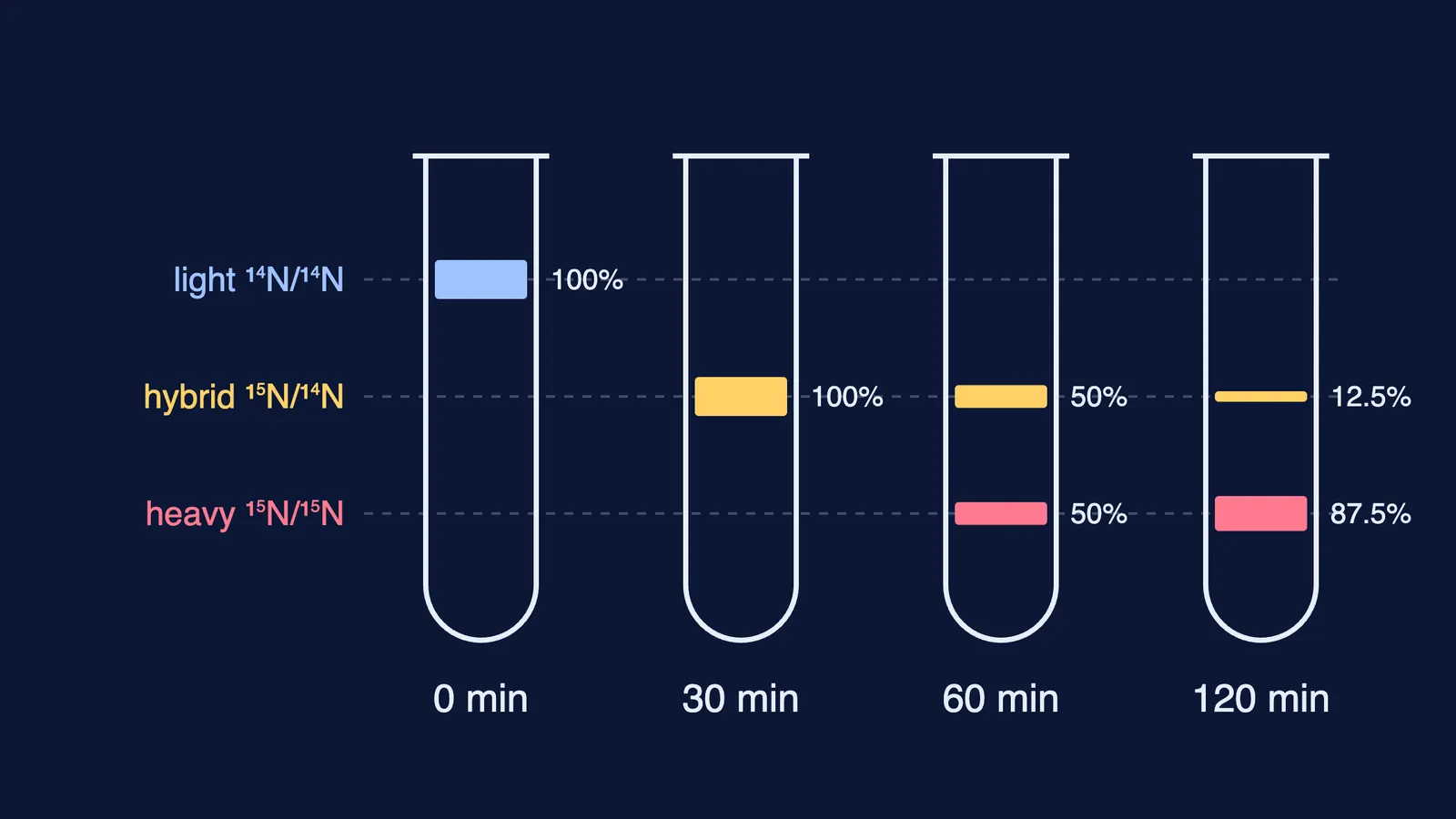
A research lab in Pune grows E. coli for many generations in a medium whose only nitrogen source is ¹⁴NH₄Cl, so all its DNA is light. The cells are then moved to a medium with ¹⁵NH₄Cl. In this medium the cells divide every 30 minutes. DNA is extracted at 30, 60 and 120 minutes and spun in a caesium chloride (CsCl) density gradient.
(i) At 30 minutes, the DNA forms: (a) one light band (b) one hybrid band (c) one heavy band (d) a light and a heavy band
(ii) What are the proportions of the bands at 60 minutes?
(iii) At 120 minutes, what percentage of DNA molecules is hybrid?
(iv) If replication were conservative, what bands would appear at 30 minutes, and how does the real result rule this out? (2 marks)
Answers.
(i) (b) one hybrid band. Each molecule keeps one old light strand and gains one new heavy strand.
(ii) Two generations give 4 molecules per original molecule: 2 hybrid and 2 heavy, so 50% hybrid and 50% heavy.
(iii) 120 minutes is 4 generations, giving 2⁴ = 16 molecules. Only 2 still carry an original light strand, so 2/16 = 12.5% are hybrid and 87.5% are heavy.
(iv) Under conservative replication, the parent molecule would stay fully light and the copy would be fully heavy, so 30 minutes would give a light band and a heavy band (50% each) and no hybrid band. A single hybrid band at 30 minutes fits only semiconservative replication, which is what Meselson and Stahl showed in 1958.
Case 3: Making enzyme for lactose-free milk
A company in Karnataka grows E. coli to harvest beta-galactosidase, the enzyme that splits lactose in milk into glucose and galactose. Its lab grows three strains in flasks with no glucose and measures enzyme activity in arbitrary units. The normal strain gives 950 units with lactose and 12 units with galactose. Mutant M1 gives 940 units with galactose. Mutant M2 gives 15 units with lactose.
(i) Which gene of the lac operon codes for beta-galactosidase? (a) i (b) z (c) y (d) a
(ii) Why does the normal strain make about 79 times less enzyme with galactose than with lactose?
(iii) M1 makes enzyme without any inducer. Which gene is most likely mutated, and how?
(iv) Suggest one gene in which M2 could carry a mutation, and explain how it keeps the operon off even with lactose present. (2 marks)
Answers.
(i) (b) z.
(ii) 950 ÷ 12 ≈ 79. Galactose cannot act as an inducer, so the repressor stays bound to the operator and only the very low background level of the operon is expressed.
(iii) The i gene. If it makes no working repressor, nothing blocks the operator, so RNA polymerase transcribes the operon all the time. (Also accepted: an operator mutation the repressor cannot bind.)
(iv) The y gene: without working permease, lactose cannot enter the cell, so it cannot inactivate the repressor and the operon stays off. (Also accepted: an i gene mutation that makes a repressor which still binds the operator but can no longer be inactivated by the inducer.)
How to attack case-study questions on this chapter?
Write the rule before the number. "A = T, G = C in double-stranded DNA" or "0.34 nm per bp" earns the method even if the arithmetic slips.
Check for single strands. If a case gives a single-stranded genome, Chargaff's rule does not apply.
Draw the strands for density questions. Sketch light and heavy strands for each generation; after n generations there are 2ⁿ molecules, and only 2 keep an original strand.
Name the gene and its product together. "z gene, beta-galactosidase" is safer than either alone.
For lac operon mutants, ask where lactose is stopped: at entry (permease), at the repressor, or at the operator.
If a step such as base pairing or repressor binding still feels shaky, the Fermi Concept Library has a lesson for each concept in biology. For more practice in other formats, try our assertion-reason questions on DNA and gene expression, and read how case-based questions work in board exams.


