On this page
These are the key terms of Chapter 5, Molecular Basis of Inheritance, in the NCERT Class 12 Biology textbook (Reprint 2026-27), in chapter order, each with a plain definition, an example and the term it is often confused with. All sit inside Chapter 5 of the CBSE Class 12 Biology syllabus for 2026-27. For full answers, see our board exam answer guide for this chapter.
What is DNA made of, and how is it packed?
Source: section 5.1 of the NCERT chapter.
Nucleoside: a nitrogenous base attached to a pentose sugar, with no phosphate. Example: adenosine, cytidine. Don't confuse with: nucleotide, which is a nucleoside plus a phosphate group.
Antiparallel strands: the two strands of the helix run in opposite directions, one 5'→3' and its partner 3'→5'.
Chargaff's rule: in double-stranded DNA, adenine equals thymine and guanine equals cytosine. Example: if cytosine is 20 per cent, guanine is 20 per cent and adenine is 30 per cent.
Complementary base pairing: adenine pairs with thymine through two hydrogen bonds and guanine with cytosine through three, so one strand predicts the other.
Double helix: the 1953 Watson-Crick model: two right-handed coiled strands, a pitch of 3.4 nm, about 10 base pairs per turn and 0.34 nm between pairs.
Central dogma: Crick's idea that genetic information flows from DNA to RNA to protein. Don't confuse with: reverse transcription, the RNA-to-DNA flow seen in some viruses.
Nucleosome: negatively charged DNA wound around an octamer of positively charged histones (rich in lysine and arginine); each carries roughly 200 bp of DNA, and a chain of them looks like beads on a string.
Euchromatin: loosely packed, light-staining chromatin that is transcriptionally active. Don't confuse with: heterochromatin, which is dense, stains dark and is inactive.
How was DNA proven to be the genetic material?
Source: sections 5.2 to 5.4 of the NCERT chapter.
Transforming principle: the factor from heat-killed S-strain pneumococcus that made live R-strain bacteria virulent in Griffith's 1928 experiment. Avery, MacLeod and McCarty showed it was DNA: only DNase blocked it.
Hershey-Chase experiment (1952): phages labelled with radioactive phosphorus (in DNA) or sulfur (in protein); only the phosphorus label entered the bacteria.
RNA world: the idea that RNA was the first genetic material and a catalyst, with DNA evolving later as a more stable store.
Semiconservative replication: each new DNA molecule keeps one parent strand and gains one new one. Meselson and Stahl proved it in 1958 with heavy, non-radioactive 15N and caesium chloride gradients.
DNA-dependent DNA polymerase: the main replication enzyme, which adds deoxynucleotides in the 5'→3' direction only.
Replication fork: the small opened region where copying happens; synthesis is continuous on one strand and in pieces on the other, which DNA ligase joins.
Transcription and the genetic code: which terms get mixed up?
Source: sections 5.5 and 5.6 of the NCERT chapter.
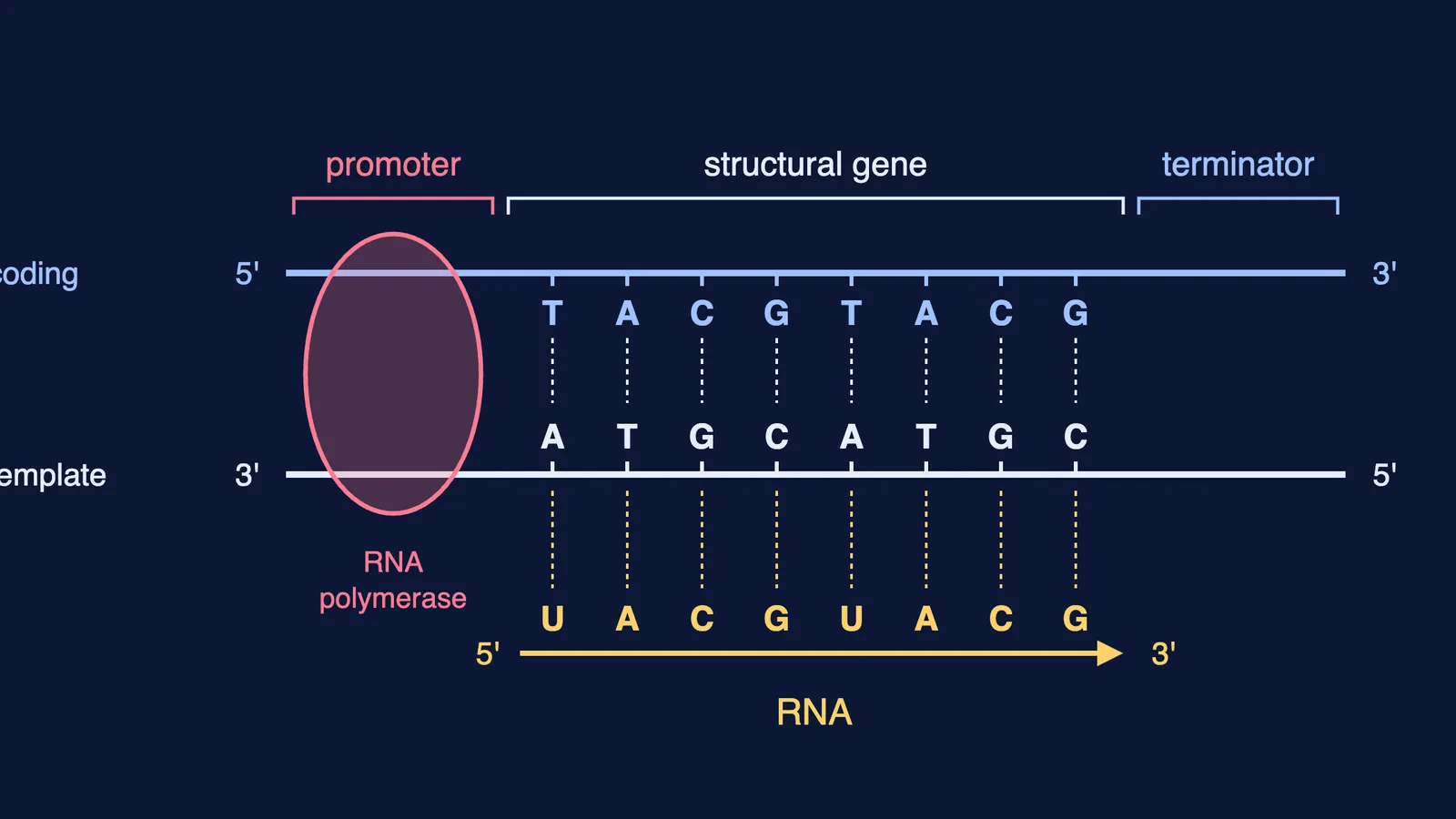
Transcription unit: a promoter, a structural gene and a terminator. The promoter, upstream, is where RNA polymerase binds; the terminator, downstream, ends transcription.
Template strand: the 3'→5' strand that RNA polymerase reads. Don't confuse with: coding strand, the 5'→3' strand whose sequence matches the RNA (with T in place of U) and which is not copied.
Cistron: a DNA segment coding for one polypeptide. Structural genes are mostly monocistronic in eukaryotes and mostly polycistronic in bacteria.
Exons and introns: exons stay in the mature RNA; introns are cut out.
Splicing, capping and tailing: eukaryotic processing of hnRNA, the primary transcript. Splicing joins exons, capping adds methyl guanosine triphosphate at the 5' end, tailing adds 200-300 adenylate residues at the 3' end.
Codon: three mRNA bases that specify one amino acid; 61 codons code for amino acids and 3 are stop codons (UAA, UAG, UGA).
Degenerate code: one amino acid can have more than one codon. AUG is special, coding for methionine and also acting as the start codon.
Frameshift mutation: inserting or deleting one or two bases, which shifts every codon after that point. Don't confuse with: a point mutation such as the single change behind sickle cell anaemia, where glutamate becomes valine.
Translation and the lac operon
Source: sections 5.6.2 to 5.8 of the NCERT chapter.
tRNA (adapter molecule): carries a specific amino acid at one end and reads the codon through its anticodon loop. There is no tRNA for stop codons.
Ribozyme: an RNA that acts as an enzyme. Example: 23S rRNA in bacteria catalyses peptide bond formation.
Operon: bacterial genes regulated together by a common promoter and regulatory genes. Example: lac, trp and ara operons.
Lac repressor: the protein made by the i gene (i for inhibitor) that sits on the operator and blocks transcription of z, y and a.
Operator: the DNA site next to the promoter where the repressor binds. Don't confuse with: promoter, where RNA polymerase binds.
Inducer: lactose or allolactose, which inactivates the repressor and switches the operon on; glucose and galactose cannot. Positive regulation of the lac operon is beyond the chapter's scope.
Human Genome Project and DNA fingerprinting terms
Source: sections 5.9 and 5.10 of the NCERT chapter.
Human Genome Project (HGP): the effort to sequence the human genome, launched in 1990 and completed in 2003.
SNP: a single-base difference between people; scientists have identified about 1.4 million such sites in humans.
DNA polymorphism: a heritable variant found at a locus in more than 1 per cent of a population.
VNTR: a minisatellite, a kind of satellite (repetitive) DNA whose repeat number varies between people, so its size runs from 0.1 to 20 kb; Alec Jeffreys used it as the probe in DNA fingerprinting.
How to learn these terms
Learn confusable terms as pairs: template and coding strand, exon and intron, operator and promoter, nucleoside and nucleotide.
Draw a transcription unit with 5' and 3' on both strands, then write the RNA under it.
Make an experiment timeline: Griffith 1928, Hershey-Chase 1952, Watson-Crick 1953, Meselson-Stahl 1958.
Sketch the lac operon twice, with and without lactose, and label repressor, operator, inducer and z, y, a.
If a term still feels hollow, the Fermi Concept Library gives every concept in biology its own lesson and its place in the map.
For NEET, read molecular basis of inheritance for NEET, from DNA to the lac operon.