On this page
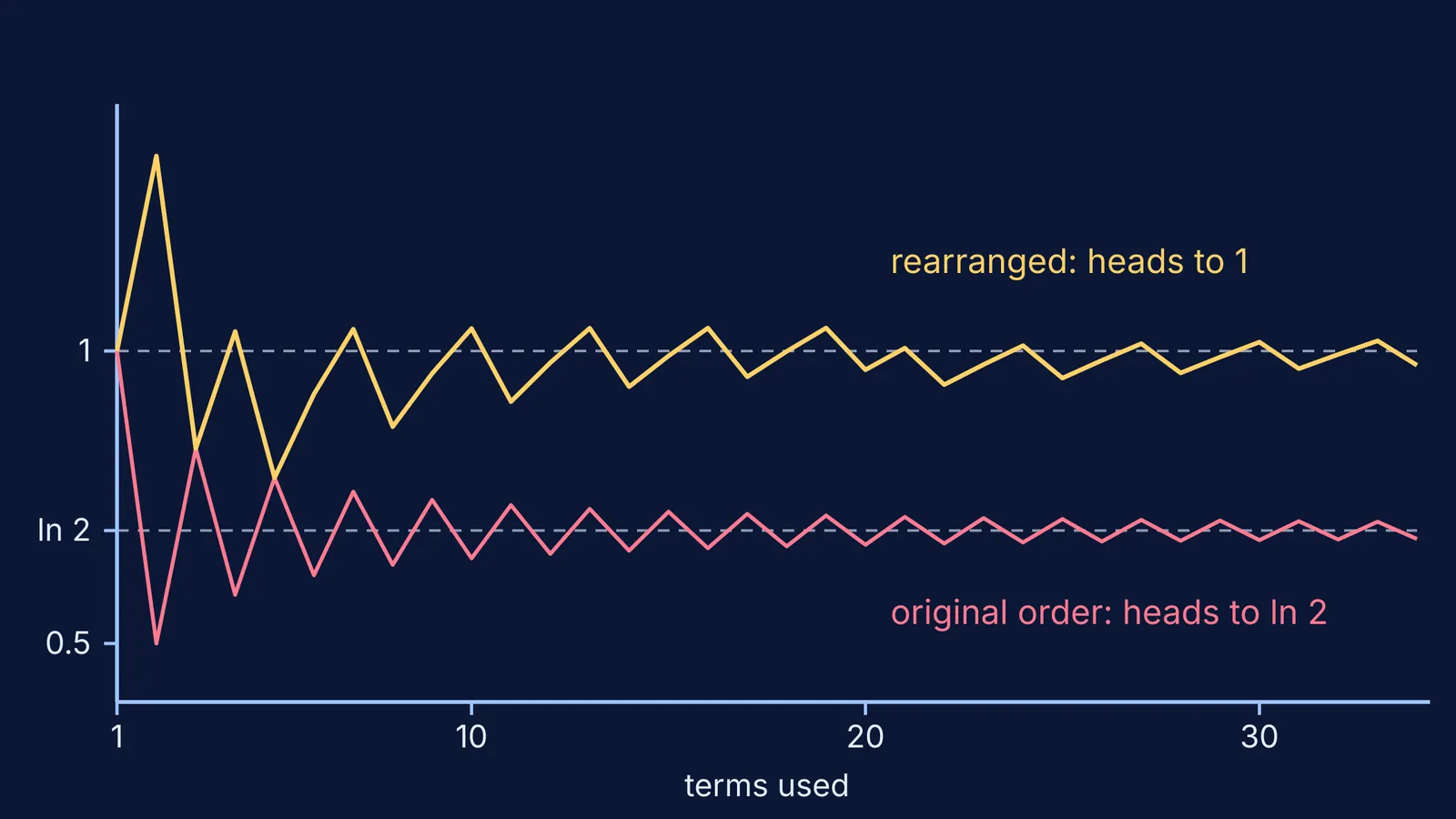
Add up 1 − 1/2 + 1/3 − 1/4 + … and you get ln 2, about 0.693, as MathWorld's entry on the natural logarithm of 2 records. Write the same numbers in a different order and the total can become 1.04, or 1, or 1000. This is not a slip in notation; it is a theorem.
Why does the alternating harmonic series equal ln 2?
The Mercator series ln(1 + x) = x − x²/2 + x³/3 − … still holds at x = 1, and setting x = 1 gives 1 − 1/2 + 1/3 − 1/4 + … = ln 2 (MathWorld). The series converges because its terms alternate in sign and shrink to zero, the Leibniz test from our post on when an alternating series converges.
An infinite sum is the limit of the partial sums, taken in the order the terms are written. Change the order and you change the partial sums, so you can change the limit.
How can rearranging a series change its sum?
Here is the classic worked example. Call the sum S, so S = ln 2.
Write S = 1 − 1/2 + 1/3 − 1/4 + 1/5 − 1/6 + 1/7 − 1/8 + …
Halve every term: S/2 = 1/2 − 1/4 + 1/6 − 1/8 + …
Space it out with zeros so the terms line up: S/2 = 0 + 1/2 + 0 − 1/4 + 0 + 1/6 + 0 − 1/8 + …
Add the two lines term by term, which is allowed for convergent series: 3S/2 = 1 + 0 + 1/3 − 1/2 + 1/5 + 0 + 1/7 − 1/4 + …
Drop the zeros: 1 + 1/3 − 1/2 + 1/5 + 1/7 − 1/4 + 1/9 + 1/11 − 1/6 + … = (3/2) ln 2, about 1.04.
The last line holds exactly the terms of S, each once, now taken two positives then one negative. MathWorld's Riemann series theorem page shows the opposite move, one positive then two negatives, (1 − 1/2 − 1/4) + (1/3 − 1/6 − 1/8) + …, which sums to half of ln 2.
What does Riemann's theorem say?
The Riemann series theorem states that a conditionally convergent series can be rearranged to converge to any desired value, or to diverge (MathWorld). A series is conditionally convergent when it converges but the series of its absolute values does not. Here the absolute values give 1 + 1/2 + 1/3 + …, the harmonic series, which diverges (the p-series test with p = 1, explained in our post on when 1/nᵖ converges).
Bernhard Riemann gave the result in his paper on representing a function by a trigonometric series, his Habilitationsschrift of 1854, published in 1868 after his death (EMIS archive of Riemann's papers).
How do you rearrange a series to hit any target?
Riemann's own recipe, quoted on Wikipedia's Riemann series theorem page, is greedy: take positive terms until the sum is greater than the target, then negative terms until it is less, and repeat. Here it is for a target of 1, with partial sums rounded to three places:
+1 gives 1.000 (not yet above 1), then +1/3 gives 1.333
−1/2 gives 0.833
+1/5 gives 1.033
−1/4 gives 0.783
+1/7 +1/9 gives 1.037
−1/6 gives 0.871
+1/11 +1/13 gives 1.038
−1/8 gives 0.913
Two facts make this work every time:
The positive terms 1 + 1/3 + 1/5 + … diverge, and so do the negative ones 1/2 + 1/4 + 1/6 + … (half the harmonic series). You never run out of push in either direction, so every term is used eventually.
The terms shrink to zero, and the same Wikipedia page notes the deviation from the target never exceeds the size of the term at the last switch. The swings narrow, so the partial sums close in on 1.
Try a target of 2: you need eight positive terms, 1 + 1/3 + … + 1/15 (about 2.02), before the first negative one.
Why can't you rearrange an absolutely convergent series?
A series converges absolutely when the sum of its absolute values is finite. Wikipedia's page on absolute convergence states that when an absolutely convergent series is rearranged, its sum is always preserved.
The greedy method needs an endless supply of both signs. If the absolute values add to a finite number, the positive terms add to a finite P and the negative ones to a finite N, and the sum is P − N in any order. So 1 − 1/4 + 1/9 − 1/16 + … cannot be pushed anywhere, because 1 + 1/4 + 1/9 + … converges.
A quick check before you reorder or regroup anything in a proof or an exam answer:
Does the series of absolute values converge (comparison, ratio or p-series test)? Then reorder freely.
Does it converge only conditionally? Then the order is part of the question. Keep it.
Does it diverge? Then there is no sum to protect, as Grandi's series 1 − 1 + 1 − … shows.
If the line between conditional and absolute convergence still feels blurry, the Fermi Concept Library gives each concept its own lesson, including the ideas behind this one. To practise, the Fermi Problem Library has a step-by-step solver that explains the reasoning rather than printing an answer.