

On this page
In 1703 the Italian monk and mathematician Guido Grandi looked at the series 1 − 1 + 1 − 1 + … and noticed that moving the brackets could make it equal 0 or 1, as Scientific American recounts. It shows quickly that an infinite sum is a limit, and a limit may not exist.
What is 1 − 1 + 1 − 1 + …?
It is called Grandi's series: the terms alternate between +1 and −1 for ever. Bracket it as (1 − 1) + (1 − 1) + … and every bracket is 0, so the total looks like 0. Bracket it as 1 + (−1 + 1) + (−1 + 1) + … and the total looks like 1. Brackets may only be moved freely in a series that already converges.
A third trick gives a third answer. Call the sum S. Then S = 1 − (1 − 1 + 1 − …) = 1 − S, so S = 1/2, the argument set out on Wikipedia's page on Grandi's series. That algebra quietly assumes S exists, which is exactly the thing in doubt.
Why do the partial sums never settle?
The sum of an infinite series is defined as the limit of its partial sums: the running totals after 1, 2, 3, … terms. If that definition is rusty, our sequences and series key terms for Class 11 and limits and derivatives key terms cover it.
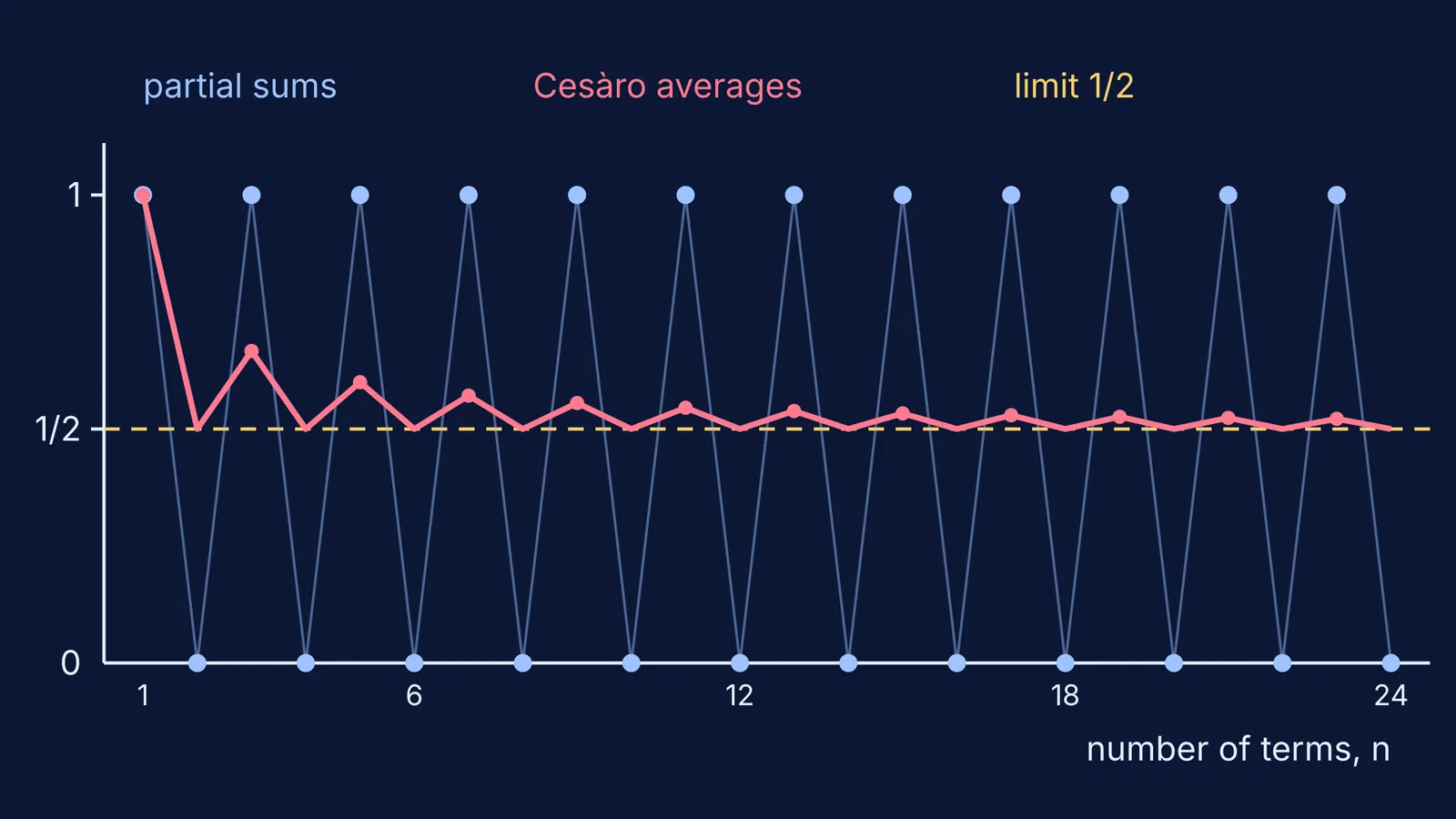
For Grandi's series the partial sums are 1, 0, 1, 0, 1, 0, … They "oscillate between 0 and 1 without ever homing in on a single value", as Scientific American puts it. So under the standard definition the series diverges: it has no sum.
How does Cesàro averaging get 1/2?
Ernesto Cesàro published the first rigorous method for summing divergent series in 1890, according to Wikipedia's account of Grandi's series. His idea: instead of asking where the partial sums go, ask where their running average goes.
Worked example: write S for each partial sum and average the first n of them.
n = 1: S = 1, average 1/1 = 1
n = 2: S = 0, average (1 + 0)/2 = 1/2
n = 3: S = 1, average 2/3, about 0.667
n = 4: S = 0, average 2/4 = 1/2
n = 5: S = 1, average 3/5 = 0.6
The pattern: for even n the average is exactly 1/2, and for odd n it is (n + 1)/(2n), which is 1/2 + 1/(2n). The gap 1/(2n) shrinks to zero, so the averages converge to 1/2. That limit is the Cesàro sum.
Grandi's series has a Cesàro sum of 1/2, Scientific American reports, and the same article tells how Leibniz reached 1/2 earlier by treating 0 and 1 as equally likely, and how Euler argued for 1/2 in 1760.
Does the sum depend on the method?
Abel's method turns the series into the power series 1 − x + x² − x³ + … = 1/(1 + x) and lets x approach 1 from below, which again gives 1/2, as Wikipedia's Grandi's series page shows.
Now insert zeros: 1 + 0 − 1 + 1 + 0 − 1 + … Ordinary arithmetic says zeros change nothing. But the partial sums become 1, 1, 0, 1, 1, 0, …, which sit at 1 two times out of three, so their average tends to 2/3. The same page confirms that the Cesàro sum of this diluted series is 2/3. Same nonzero terms, same order, a different "sum".
So the honest answer to "what is 1 − 1 + 1 − 1 + …?" has three parts: it diverges; its Cesàro and Abel sums are 1/2; and any value for a divergent series means something only once the method is named. Convergence is also what makes the clever algebra legitimate in why the sum of 1/n² is π²/6.
How should you handle a series like this in an exam?
Run this four-question check before you manipulate any infinite series:
Do the terms go to 0? If not, as here, the series cannot converge.
Can you write the nth partial sum in closed form? Then take its limit.
Are you regrouping, rearranging or writing "let S = …"? Only safe once convergence is shown.
Does the question name another method, such as Cesàro or Abel? Then say which one and use its definition.
If a step in your working feels like Grandi's brackets, the Fermi Problem Library has worked problems with a step-by-step solver that explains the reasoning rather than printing an answer. For the definition of convergence itself, the Fermi Concept Library gives every mathematics concept its own lesson.
Try it yourself: compute the running averages of 1 + 0 − 1 + 1 + 0 − 1 + … for n = 3, 6 and 9, and check that each one is exactly 2/3.


