On this page
These are the key terms of Chapter 8 of the NCERT Class 11 Mathematics textbook (Reprint 2026-27), grouped by topic. For solved examples, see our Sequences and Series Class 11 chapter guide.
Every term below is in the chapter and in the Sequence and Series unit of the Class XI CBSE Mathematics curriculum for 2026-27. The current reprint mentions the sums of k, k² and k³ only in its introduction, and names the infinite geometric series without any section on its sum, so this list stops at the sum of n terms.
What is a sequence, and how is it different from a series?
Sequence: numbers in a definite order set by a rule; formally, a function with domain the natural numbers or a set {1, 2, …, k}. Example: aₙ = n² gives 1, 4, 9, 16, …
nth term (general term): aₙ, the term in position n. Example: aₙ = 3n − 1 gives a₁₀ = 29.
Finite and infinite sequence: finite has a fixed number of terms (1, 3, …, 19 has ten); infinite is any other (1, 1/2, 1/3, … never ends).
Recurrence relation: a rule building each term from earlier ones, plus starting terms. Example: a₁ = 2 and aₙ = 3aₙ₋₁ − 1 for n ≥ 2 give 2, 5, 14, 41.
Fibonacci sequence: a₁ = a₂ = 1 and aₙ = aₙ₋₁ + aₙ₋₂ for n > 2, giving 1, 1, 2, 3, 5, 8, 13.
Progression: a sequence that follows a definite pattern. The A.P. (add a fixed common difference d) is Class 10 recall; the G.P. is this chapter's new progression.
Series: the expression a₁ + a₂ + a₃ + … built from a sequence. Example: 2 + 5 + 8 + 11. Don't confuse with: the sequence 2, 5, 8, 11, a list.
Sum of a series: the number you get by adding the terms. Example: 2 + 5 + 8 + 11 has sum 26.
Sigma notation: Σ aₖ from k = 1 to n is short for a₁ + a₂ + … + aₙ. Example: Σ (2k + 1) from k = 1 to 4 = 3 + 5 + 7 + 9 = 24.
Sₙ: the sum of the first n terms; for 2, 5, 8, …, S₃ = 15.
What is a geometric progression (G.P.)?
Geometric progression: non-zero terms where each term divided by the one before gives the same constant. Example: 3, −6, 12, −24. Counter-example: 1, 2, 4, 7 (ratios 2, 2, 7/4).
First term (a) and common ratio (r): a = a₁ and r = aₖ₊₁/aₖ. Example: for 81, 27, 9, …, r = 1/3. Don't confuse with: the common difference d of an A.P., which is added, not multiplied.
General term of a G.P.: aₙ = arⁿ⁻¹. Example: 3, 6, 12, … has a₆ = 3 × 2⁵ = 96. Don't confuse with: arⁿ, which is the (n + 1)th term.
Last term (l): the final term of a finite G.P. Example: 2, 6, 18, …, 486 has l = 486 = 2 × 3⁵, so n = 6.
Finding r from two terms: dividing cancels a. Example: a₂ = 6 and a₅ = 48 give r³ = 8, so r = 2.
Three numbers in G.P.: non-zero x, y, z are in G.P. exactly when y² = xz. Example: 4, 6, 9, since 36 = 4 × 9.
Terms a/r, a, ar: three unknown terms in G.P.; their product is a³.
How do you find the sum of a G.P.?
Geometric series: a + ar + ar² + …, finite or infinite.
Sum to n terms: Sₙ = a(rⁿ − 1)/(r − 1) = a(1 − rⁿ)/(1 − r), for r ≠ 1. Example: 3 + 6 + … to six terms gives 3 × 63 = 189.
The case r = 1: Sₙ = na, since the formula above would divide by zero. Example: 5 + 5 + 5 + 5 = 20.
Series that turn into a G.P.: some sums can be rewritten using one. Example: 3 + 33 + 333 = (3/9)(9 + 99 + 999) = 369.
What are the arithmetic mean and geometric mean?
Arithmetic mean (A.M.): for two numbers a and b, A = (a + b)/2. Example: for 2 and 18, A = 10.
Geometric mean (G.M.): for two positive numbers a and b, G = √(ab), so a, G, b is a G.P. Example: for 2 and 18, G = 6. Don't confuse with: the A.M., which makes a, A, b an A.P.
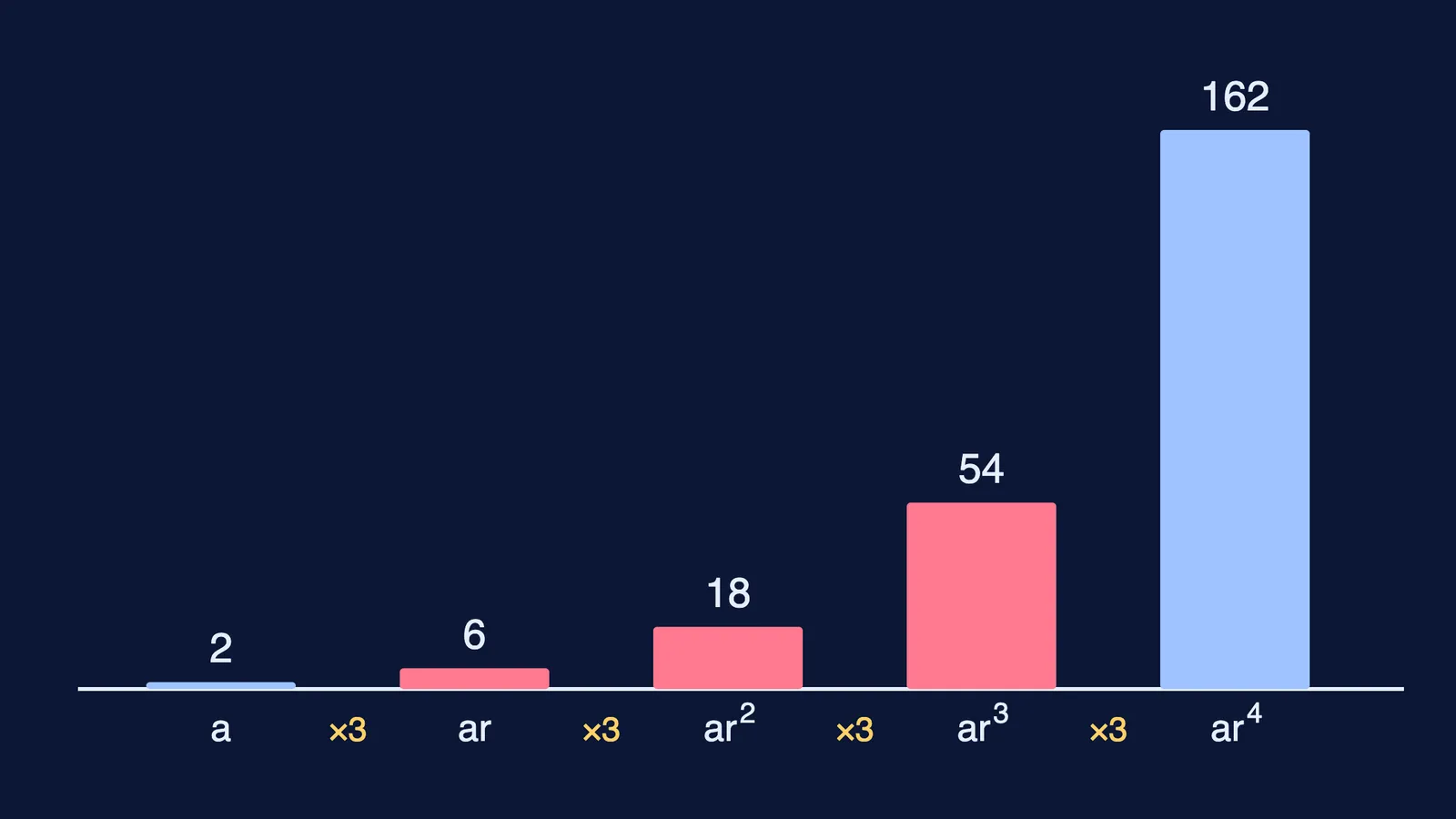
Inserting geometric means: placing n numbers between positive a and b so the list is a G.P.; b is the (n + 2)th term, so r = (b/a)^(1/(n + 1)). Example: three means between 2 and 162 need r⁴ = 81, so r = 3 gives 6, 18, 54 (r = −3 gives −6, 18, −54).
A.M.-G.M. inequality: for positive a and b, A − G = (√a − √b)²/2, so A ≥ G, with A = G only when a = b. Example: for 2 and 18, A − G = 4.
Numbers from A and G: a + b = 2A and ab = G². Example: A = 10 and G = 6 give 2 and 18.
Where do G.P.s show up in word problems?
Compound growth: a fixed percentage rise multiplies by the same factor each year. Example: ₹1,000 at 10% compounded annually gives 1,000, 1,100, 1,210, 1,331 (r = 1.1).
Depreciation: a fixed percentage fall. Example: ₹50,000 losing 20% a year gives 50,000, 40,000, 32,000 (r = 0.8).
How to learn these terms
Pair sequence with series and A.M. with G.M., with one example each.
For every G.P. you meet, write a, r and the next term before doing anything else.
In word problems, ask: same amount added (A.P.) or same factor multiplied (G.P.)?
Revise the Sequences and series Class 11 formulas with examples, then test yourself with the sequences and series assertion-reason questions. If a definition feels slippery, the Fermi Concept Library gives every concept in mathematics its own lesson and its place in the map.