On this page
Every statement below stays inside the NCERT Class 11 chapter on sequences and series (Reprint 2026-27), and we checked every number with Python. Use it as practice. For the formulas first, read our Sequences and Series Class 11 guide.
How do you answer assertion-reason questions on sequences and series?
The CBSE Class XI Mathematics curriculum for 2026-27 lists sequences and series, the A.M., the G.P., its nth term and sum, the G.M. and the A.M.-G.M. relation. It marks the sums of k, k² and k³ as assessed only formatively, so we leave them out.
Judge A on its own, judge R on its own, then read "A, because R" aloud. If the sentence sounds wrong, the key is (B). More in our assertion-reason question strategy.
Assertion-reason keys:
(A) Both A and R are true and R is the correct explanation of A.
(B) Both A and R are true but R is NOT the correct explanation of A.
(C) A is true but R is false.
(D) A is false but R is true.
Statement I / Statement II keys:
(A) Both statements are correct.
(B) Both statements are incorrect.
(C) Statement I is correct, Statement II is incorrect.
(D) Statement I is incorrect, Statement II is correct.
Sequences and series assertion-reason questions with answers
Q1 (easy). Assertion (A): 3, −6, 12, −24, ... is a G.P. Reason (R): Each term is non-zero and each term divided by the one before it gives the same number, −2.
Answer: (A). The ratios are all −2, and R is exactly the NCERT definition of a G.P., so R explains A.
Trap: thinking alternating signs rule out a G.P. A negative ratio is allowed.
Q2 (easy). Assertion (A): The 5th term of the sequence aₙ = n² − 1 is 24. Reason (R): The terms of every sequence can be given by an algebraic formula in n.
Answer: (C). a₅ = 25 − 1 = 24, so A is true. R is false: NCERT points out that the sequence of primes has no formula for its nth term.
Trap: accepting R because this sequence has a formula.
Q3 (medium). Assertion (A): The sum of the first 8 terms of 4, 4, 4, ... is 32. Reason (R): For every G.P., Sₙ = a(rⁿ − 1)/(r − 1).
Answer: (C). Here r = 1, so Sₙ = na = 8 × 4 = 32 and A is true. R is false: the formula needs r ≠ 1, since r = 1 gives 0/0.
Trap: forcing the formula into 0/0.
Q4 (medium). Assertion (A): The A.M. of 2 and 18 is less than their G.M. Reason (R): For positive a and b, (A.M.) − (G.M.) = (√a − √b)²/2.
Answer: (D). A = 10 and G = √36 = 6, so the A.M. is larger and A is false. R is the NCERT step that proves A ≥ G.
Trap: mixing up which mean is bigger.
Q5 (hard). Assertion (A): The three numbers that make 2, _, _, _, 162 a G.P. with a positive ratio are 6, 18 and 54. Reason (R): If n numbers are inserted between positive a and b to form a G.P. with a positive ratio, the common ratio is (b/a)^(1/(n + 1)).
Answer: (A). With n = 3, r = 81^(1/4) = 3, giving 6, 18, 54. R is the rule that produces them.
Trap: using the power 1/n. The ratio is applied n + 1 times, since 162 is the 5th term.
Q6 (hard). Assertion (A): The least n for which 1 + 3 + 9 + ... (n terms) exceeds 1000 is 7. Reason (R): The 7th term of 1, 3, 9, ... is less than 1000.
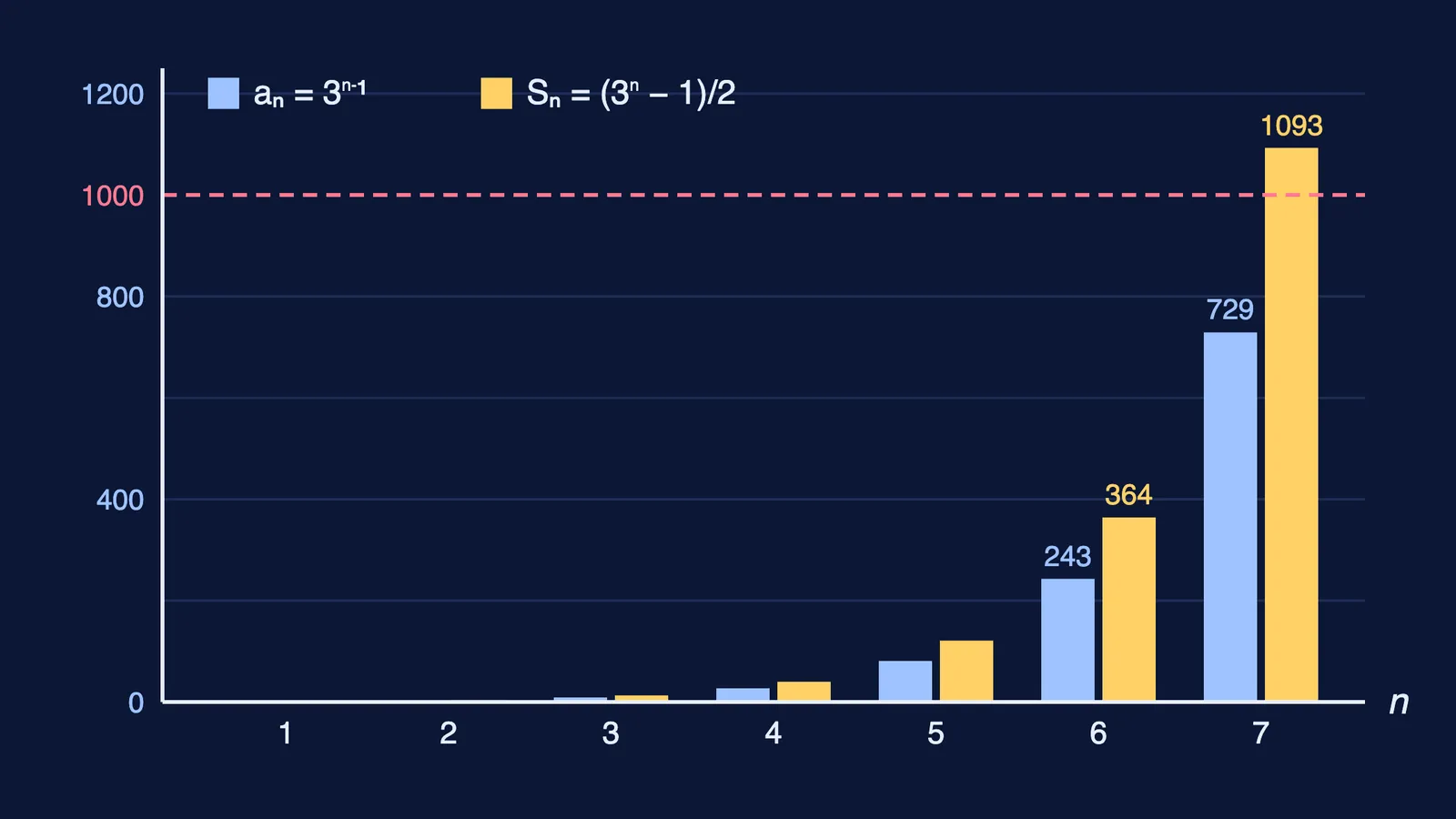
Answer: (B). Sₙ = (3ⁿ − 1)/2 gives S₆ = 364 and S₇ = 1093, so A is true. R is true (a₇ = 729), but one term below 1000 says nothing about when the sum passes 1000, so R does not explain A.
Trap: solving 3ⁿ⁻¹ > 1000 and answering 8, which tests one term, not the total (see the chart above).
Statement I and Statement II questions on sequences and series
Q7 (easy). Statement I: 2, 0, 0, 0, ... is a G.P. with common ratio 0. Statement II: The 20th term of aₙ = 2n − 1 is 41.
Answer: (B). I is false: NCERT requires every term of a G.P. to be non-zero. II is false: a₂₀ = 40 − 1 = 39.
Trap: computing 2(20 + 1) − 1 by plugging in the wrong n.
Q8 (medium). Statement I: The G.M. of 3 and 27 is 15. Statement II: The A.M. of 3 and 27 exceeds their G.M. by 6.
Answer: (D). 15 is the A.M.; the G.M. is √81 = 9, so I is false. II is true: 15 − 9 = 6.
Trap: halving the sum when the question asks for the G.M.
Q9 (medium). Statement I: The sum of the first 6 terms of 1, −2, 4, −8, ... is −21. Statement II: If the 3rd term of a G.P. is 12 and the 6th is −96, its common ratio is −2.
Answer: (A). I: (1 − (−2)⁶)/(1 − (−2)) = −63/3 = −21. II: dividing ar⁵ by ar² gives r³ = −8, so r = −2.
Trap: dropping the sign of r, which turns S₆ into 63.
Q10 (hard). For positive x and y: Statement I: If xy = 64, then x + y ≥ 16. Statement II: If x + y ≥ 16, then xy ≥ 64.
Answer: (C). I follows from A ≥ G: (x + y)/2 ≥ √64 = 8. II is false: x = 15, y = 1 gives xy = 15.
Trap: reversing the inequality. A fixed product gives a least sum, not a least product.
How should you use this set?
Cover the answers and do all ten in one sitting.
For every miss, write the trap in your own words next to the question.
Redo Q3, Q6 and Q10 after a week. They test the conditions people forget: r ≠ 1, sum versus term, and the direction of A ≥ G.
If G.P. sums keep slipping, the Fermi Problem Library has worked problems with a step-by-step solver that explains the reasoning rather than printing an answer.