On this page
This chapter has fewer formulas than most, and nearly all of them grow from one rule: multiply by the same ratio each time. The CBSE Mathematics curriculum for 2026-27 lists sequence and series, the arithmetic mean (A.M.), the geometric progression (G.P.) with its general term and sum of n terms, the infinite G.P. and its sum, the geometric mean (G.M.) and the relation between A.M. and G.M. The NCERT chapter (Reprint 2026-27) builds the formulas below. Each group gives symbols, conditions, a worked example and a slip to avoid.
Not covered: the special sums of k, k² and k³, which the same curriculum lists separately from this unit, and the A.P. formulas you met in Class 10.
Sequences, series and sigma notation
Symbols: n is a natural number (the position), aₙ the nth term, Sₙ the sum of the first n terms.
A sequence is a function whose domain is the natural numbers {1, 2, 3, …} or a subset {1, 2, …, k}; aₙ is also written a(n).
Series: a₁ + a₂ + a₃ + … + aₙ, written in sigma notation as Σ aₖ from k = 1 to n.
Recurrence: a rule giving aₙ from earlier terms, with the starting terms stated, e.g. Fibonacci: a₁ = a₂ = 1, aₙ = aₙ₋₁ + aₙ₋₂ for n > 2.
Worked example: for aₙ = 3n − 1, the first five terms are 2, 5, 8, 11, 14, and Σ (3k − 1) from k = 1 to 5 = 40. For the recurrence a₁ = 2, aₙ = 2aₙ₋₁ + 1 (n ≥ 2), the terms are 2, 5, 11, 23, 47.
Watch for: a recurrence needs its starting term. Without a₁ = 2, the rule aₙ = 2aₙ₋₁ + 1 does not fix any term.
What is the nth term of a G.P.?
Symbols: a is the first term (a ≠ 0), r the common ratio (r ≠ 0), n the number of the term.
G.P.: every term is non-zero and aₖ₊₁ / aₖ = r for all k ≥ 1.
General term: aₙ = arⁿ⁻¹.
Any two terms: aₘ / aₖ = rᵐ⁻ᵏ, which finds r when two terms are given.
Three unknown terms in G.P.: take a/r, a, ar (their product is a³).
Three non-zero numbers x, y, z are in G.P. when y² = xz.
Worked example: the 2nd term of a G.P. is 10 and the 5th is 80. Then r³ = 80/10 = 8, so r = 2, and a = 10/2 = 5. The 9th term is 5 × 2⁸ = 1280. Which term of 5, 15, 45, … is 1215? Here 5 × 3ⁿ⁻¹ = 1215 gives 3ⁿ⁻¹ = 243 = 3⁵, so n = 6.
Watch for: writing arⁿ for the nth term. Test it with n = 1: the formula must give a.
How do you find the sum of a G.P.?
Symbols: Sₙ is the sum of the first n terms; S∞ the sum to infinity.
Sₙ = a(rⁿ − 1)/(r − 1) = a(1 − rⁿ)/(1 − r), when r ≠ 1.
Sₙ = na, when r = 1.
Repeated-digit series such as 7 + 77 + 777 + … (n terms): write each term as (7/9)(10ᵏ − 1), which gives Sₙ = (7/9)[10(10ⁿ − 1)/9 − n].
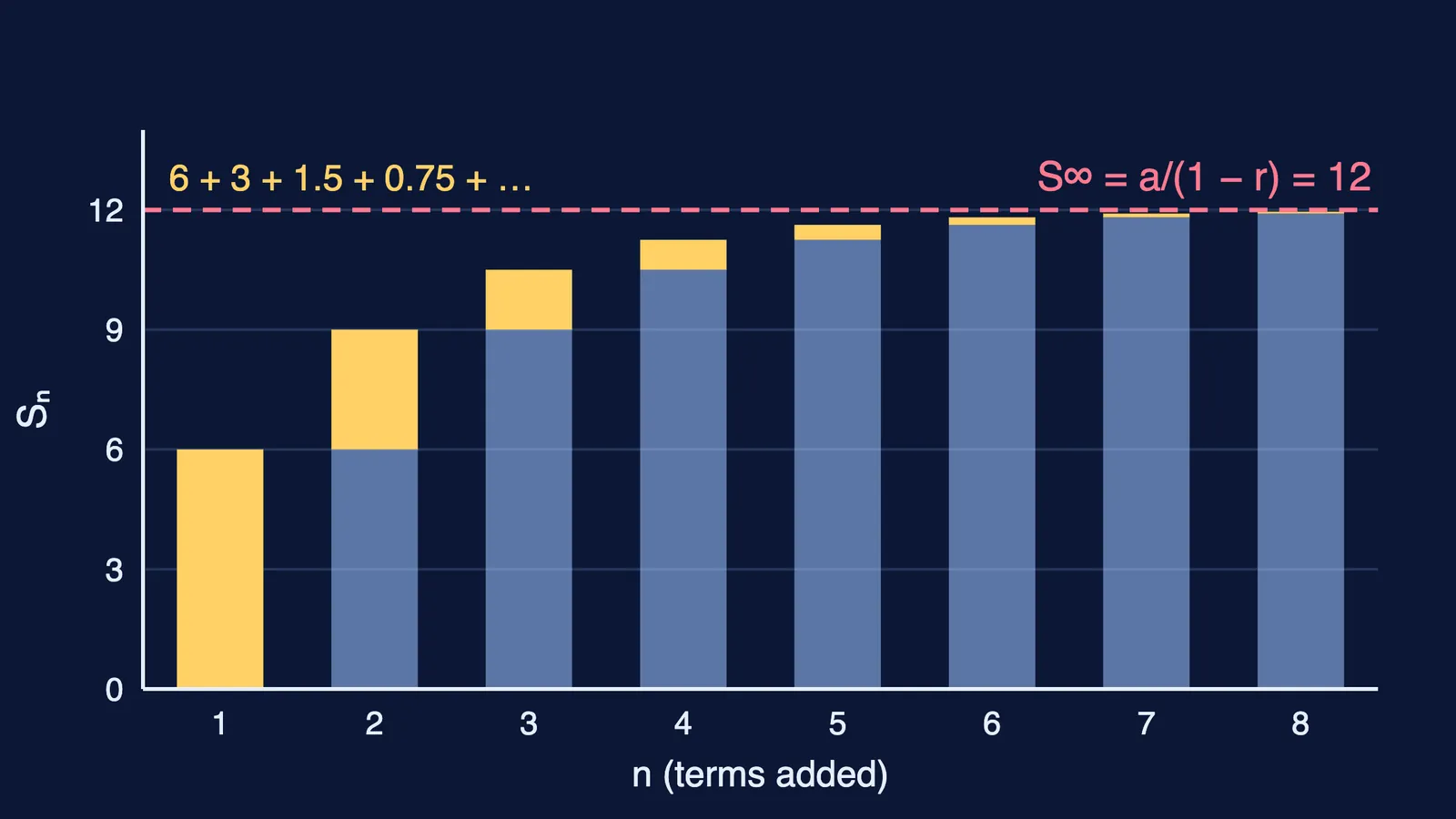
Infinite G.P.: S∞ = a/(1 − r), only when |r| < 1 (that is, −1 < r < 1).
Worked example: for 2, 6, 18, …, S₆ = 2(3⁶ − 1)/(3 − 1) = 728. For 4 + 44 + 444 + 4444, the same method gives (4/9)(11110 − 4) = 4936, matching the hand sum. For 6 + 3 + 1.5 + …, a = 6 and r = 1/2, so S∞ = 6/(1/2) = 12, the line the partial sums approach in the graph above. The same formula turns 0.444… into 0.4/(1 − 0.1) = 4/9.
Watch for: using a/(1 − r) when |r| ≥ 1. For 1 + 2 + 4 + …, the formula gives −1, but the sum grows without limit.
The curriculum names the infinite G.P. and its sum, but the current NCERT chapter has no section on it, so ask your teacher how your school covers it.
What are the A.M. and G.M., and why is A ≥ G?
Symbols: a and b are two positive real numbers; A is their arithmetic mean and G their geometric mean.
A = (a + b)/2.
G = √(ab), so a, G, b is a G.P.
Inserting n G.M.s between a and b: r = (b/a)^(1/(n+1)), and Gₖ = arᵏ for k = 1, 2, …, n.
A − G = (√a − √b)²/2 ≥ 0, so A ≥ G, with A = G only when a = b.
Given A and G, the numbers are the roots of x² − 2Ax + G² = 0, that is A ± √(A² − G²).
Worked example: two positive numbers have A.M. 17 and G.M. 15. Then a + b = 34 and ab = 225, so the numbers are 17 ± √(289 − 225) = 17 ± 8, which gives 25 and 9. To insert three G.M.s between 2 and 162, 162 is the 5th term, so r⁴ = 81 and r = 3 or −3: the numbers are 6, 18, 54 or −6, 18, −54.
Watch for: taking only r = 3 when r⁴ = 81. Both real roots give a valid G.P.
How to revise this formula sheet
Derive Sₙ once by subtracting rSₙ from Sₙ. Four lines rebuild both forms of the sum.
Before using S∞, write "|r| < 1" next to your working, with the value of r.
Prove A ≥ G from (√a − √b)² ≥ 0 until you can do it without notes, including when equality holds.
Practise each group with the sequences and series case study questions and the assertion-reason set for this chapter.
For what the syllabus keeps and more solved examples, read our Sequences and Series Class 11 guide. If a step keeps going wrong, the Fermi Problem Library has worked problems with a step-by-step solver that explains the reasoning rather than printing an answer.