On this page
Chapter 12 of the rationalised NCERT Class 11 Mathematics textbook (Reprint 2026-27) starts calculus, and its words are easy to mix up. Below are 32 terms from it, grouped by topic and checked against the CBSE Class XI Mathematics syllabus for 2026-27. For the full walk-through, read our Limits and Derivatives Class 11 guide.
What is a limit in Class 11 maths?
x tends to a (x → a): x gets ever closer to a, from either side, never equalling it.
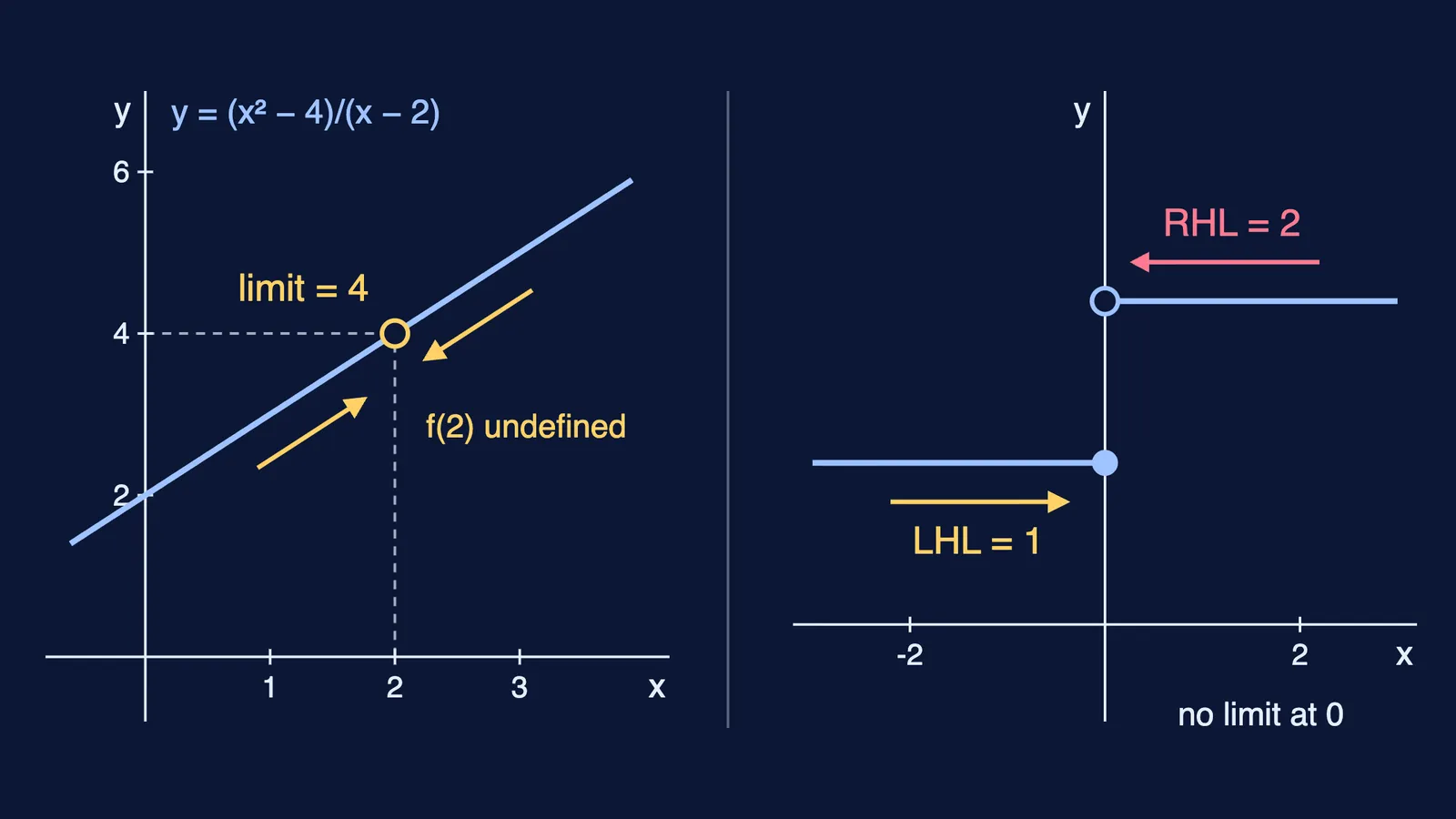
Limit: lim(x → a) f(x) = l means f(x) gets as close to l as we like when x is close enough to a. Example: (x² − 4)/(x − 2) is undefined at x = 2, yet its limit there is 4.
Left hand limit (LHL): lim(x → a⁻) f(x), the value f(x) approaches using only x < a.
Right hand limit (RHL): lim(x → a⁺) f(x), the same using only x > a.
Existence of a limit: lim(x → a) f(x) exists only when the LHL and RHL exist and are equal. Counter-example: f(x) = 1 for x ≤ 0 and 2 for x > 0 has LHL 1 and RHL 2 at 0, so there is no limit. Don't confuse with: f(a); here f(0) = 1 exists anyway.
How do you evaluate limits of polynomials and rational functions?
Algebra of limits: if lim f(x) and lim g(x) both exist as x → a, the limit of a sum, difference or product is the sum, difference or product of the limits; also lim λf(x) = λ·lim f(x).
Quotient of limits: lim [f(x)/g(x)] = lim f(x)/lim g(x), only when lim g(x) ≠ 0.
Polynomial function: f(x) = a₀ + a₁x + … + aₙxⁿ with real coefficients, aₙ ≠ 0 and degree n. Its limit at a is f(a). Example: lim(x → 2) (x³ − 3x + 1) = 3.
Rational function: p(x)/q(x), where p and q are polynomials and q(x) ≠ 0. If q(a) ≠ 0, its limit at a is p(a)/q(a).
The 0/0 case: when p(a) = q(a) = 0, cancel the factor (x − a), allowed because x ≠ a, then substitute. Example: lim(x → 1) (x² − 1)/(x − 1) = lim (x + 1) = 2. Don't confuse with: 0/0 = 0 or 1.
Limit does not exist (rational case): q(a) = 0 but p(a) ≠ 0, as in 1/(x − 1) at x = 1.
Standard limit (xⁿ − aⁿ)/(x − a): tends to naⁿ⁻¹ as x → a, for any positive integer n; NCERT notes it also holds for rational n when a > 0. Example: lim(x → 1) (x⁷ − 1)/(x − 1) = 7.
Which theorems handle trigonometric limits?
Comparison theorem: if f(x) ≤ g(x) and both limits at a exist, then lim f(x) ≤ lim g(x).
Sandwich theorem: if f(x) ≤ g(x) ≤ h(x) and lim f(x) = lim h(x) = l as x → a, then lim g(x) = l.
Radian measure: the trigonometric limits below need x in radians.
lim(x → 0) (sin x)/x = 1: proved by squeezing (sin x)/x between cos x and 1. Example: lim(x → 0) (sin 6x)/(sin 2x) = 6/2 = 3.
lim(x → 0) (1 − cos x)/x = 0. Don't confuse with: (sin x)/x, which tends to 1.
The syllabus also names exponential and logarithmic limits; this NCERT chapter does not cover them.
What is a derivative?
Average rate of change: change in f divided by change in x. NCERT's dropped body falls s = 4.9t² metres, so its average velocity over the first 2 s is 9.8 m/s.
Instantaneous rate of change: the limit of average rates as the interval shrinks to zero; 19.6 m/s for that body at t = 2 s.
Derivative at a point: f′(a) = lim(h → 0) [f(a + h) − f(a)]/h, provided the limit exists. Example: for f(x) = x² at a = 3, (6h + h²)/h = 6 + h, so f′(3) = 6.
Derivative function (first principle): f′(x) = lim(h → 0) [f(x + h) − f(x)]/h, wherever the limit exists. Example: x² gives 2x. Practise with derivatives from first principles in Class 11.
Notation: f′(x), d/dx f(x) and dy/dx (for y = f(x)) mean the same thing.
Slope of the tangent: f′(a) is the slope of the tangent to y = f(x) at (a, f(a)). Don't confuse with: the slope of a chord (secant) PQ, which approaches it as Q moves to P.
Where a derivative fails: counter-example: for f(x) = |x| at 0, the quotient |h|/h is −1 from the left and 1 from the right, so f′(0) does not exist.
What are the rules of differentiation?
Sum and difference rule: (u ± v)′ = u′ ± v′, on a common domain.
Derivative of a constant: 0, and (λu)′ = λu′.
Product rule (Leibnitz rule): (uv)′ = u′v + uv′. Example: d/dx (x² sin x) = 2x sin x + x² cos x.
Quotient rule: (u/v)′ = (u′v − uv′)/v², wherever v ≠ 0. Example: d/dx [x/(x + 1)] = 1/(x + 1)². Don't confuse with: uv′ − u′v on top (wrong sign).
Power rule: d/dx (xⁿ) = nxⁿ⁻¹. NCERT proves it for positive integer n; it holds for any real n.
Derivative of a polynomial: differentiate term by term. Example: d/dx (4x³ − 5x + 7) = 12x² − 5.
Derivatives of sin x and cos x: d/dx (sin x) = cos x and d/dx (cos x) = −sin x.
Derivative of tan x: sec² x, wherever cos x ≠ 0.
Not covered: the chain rule, which is not in this NCERT chapter.
How to learn these terms
Learn in pairs: LHL and RHL, limit and f(a), secant and tangent, product and quotient rule.
Draw two graphs: a hole (limit exists, f(a) undefined) and a jump (f(a) defined, no limit).
Write each standard limit with its condition: radians, positive integer n, denominator limit not zero.
Derive d/dx (sin x) = cos x from first principles once; it uses the sin x/x limit.
If a term still feels abstract, the Fermi Concept Library covers every concept in physics, chemistry, biology, mathematics and computing, each with its own lesson.