

On this page
In 1650 the Bologna mathematician Pietro Mengoli published a book on infinite series, showing among other things that 1 + 1/2 + 1/3 + … has no finite sum. But, as the MacTutor biography of Mengoli puts it, "he failed to be able to sum the series whose nth term is 1/n²."
This became the Basel problem. It is named after Basel, the home city of Leonhard Euler and of the Bernoulli family, who tried and failed to solve it (Basel problem, Wikipedia).
Does the sum of 1/n² even converge?
First make sure there is a finite number to find. Terms that shrink to zero are not enough: 1/n shrinks to zero, but the harmonic series grows forever.
The trick is to compare 1/n² with a fraction that telescopes. For n ≥ 2, n² is bigger than n(n − 1), so
1/n² < 1/(n(n − 1)) = 1/(n − 1) − 1/n.
Add this from n = 2 to n = N. Almost everything cancels:
1/4 + 1/9 + … + 1/N² < (1 − 1/2) + (1/2 − 1/3) + … + (1/(N − 1) − 1/N) = 1 − 1/N.
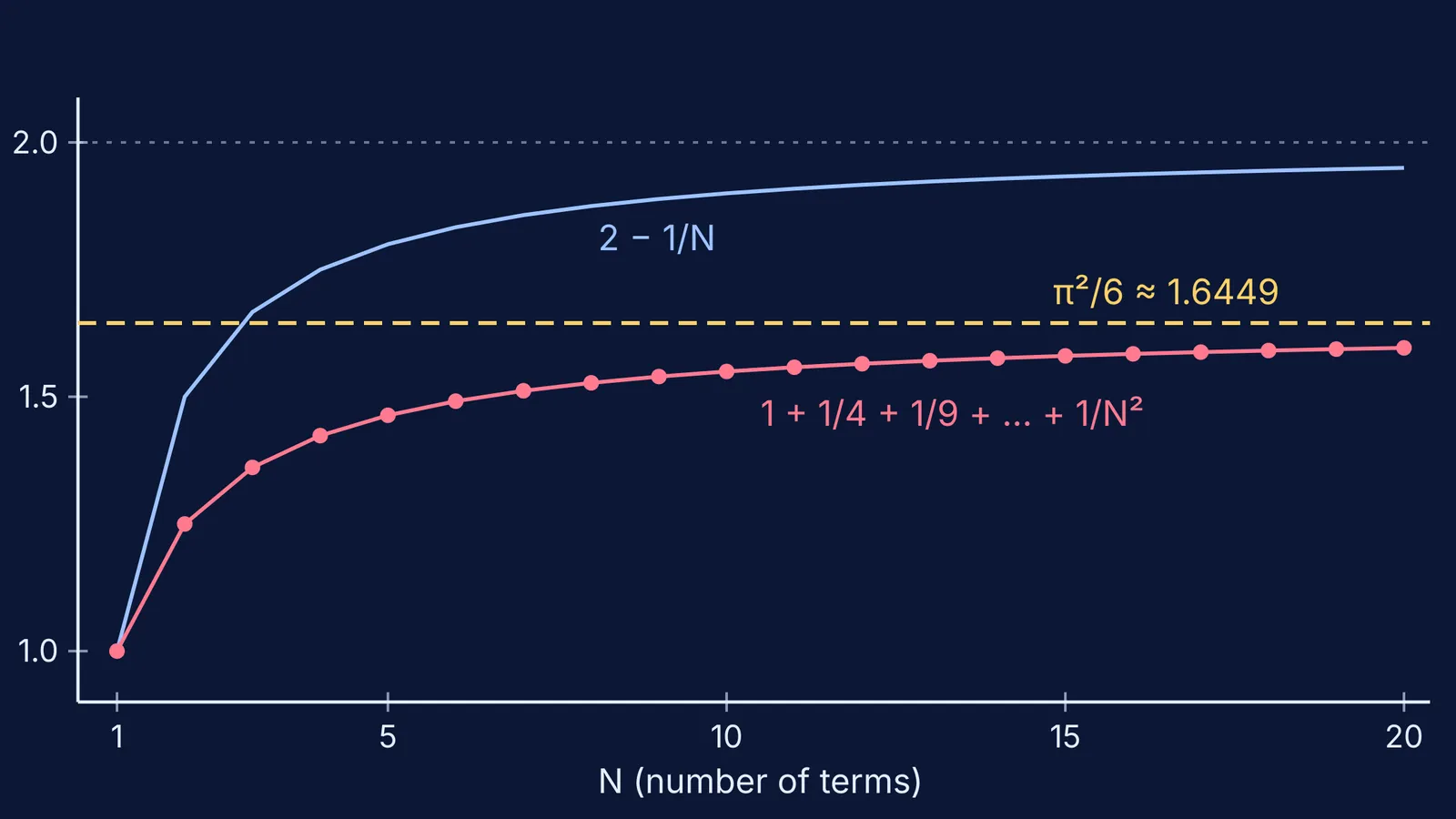
Add the first term, 1, and every partial sum is at most 2 − 1/N. The partial sums keep increasing but never pass 2, so they settle on a limit below 2. For the background on series, see our guide to Sequences and Series for Class 11.
How did Euler get π²/6 from sin x / x?
Euler's paper "De summis serierum reciprocarum" (On the sums of series of reciprocals) was written in 1735 and published in 1740, according to the Euler Archive entry for E41, which notes that it contains an infinite product formula for sin(x)/x. The argument treats sin x / x as a polynomial with infinitely many terms:
From the Taylor series of sin x, divide by x: sin x / x = 1 − x²/6 + x⁴/120 − …
sin x / x equals 1 at x = 0 and is zero at x = ±π, ±2π, ±3π, …
A polynomial that equals 1 at 0 and has roots ±a can be written with a factor (1 − x²/a²) for each pair. Euler assumed the same holds here: sin x / x = (1 − x²/π²)(1 − x²/4π²)(1 − x²/9π²)…
Multiply out the brackets and keep only the x² terms: −(1/π²)(1 + 1/4 + 1/9 + …).
Two expressions for the same function must have the same x² coefficient, so −(1/π²)(1 + 1/4 + 1/9 + …) = −1/6. Therefore 1 + 1/4 + 1/9 + … = π²/6.
Euler used series just as boldly in another famous result, why e to the iπ equals −1. If matching coefficients loses you, the Fermi Problem Library has a step-by-step solver that explains the reasoning rather than printing an answer.
What was not rigorous about Euler's argument?
Step 3 is the weak point. According to the Wikipedia account of the Basel problem, Euler's derivation "extended observations about finite polynomials and assumed that these same properties hold true for infinite series." Two things needed proof:
Roots do not fix the function. The function eˣ · sin x / x also equals 1 at x = 0 and has exactly the same zeros, because eˣ is never zero. Roots alone cannot prove that sin x / x equals the product.
Infinitely many brackets. To multiply out an infinite product and collect the x² terms, you first have to show that the product converges and can be expanded term by term.
The same Wikipedia article says Euler produced an accepted proof in 1741, and that about 100 years later Karl Weierstrass proved Euler's infinite product for the sine function is valid. The answer was right all along; the first argument lacked a proof that the shortcut was allowed.
How can you check π²/6 numerically?
Adding terms one by one is slow, so reuse the telescoping trick on the tail (everything after the Nth term), from both sides: 1/(n(n + 1)) < 1/n² < 1/(n(n − 1)) gives
1/(N + 1) < tail after N terms < 1/N.
Worked example with N = 10:
Add the first ten terms (1 + 0.25 + 0.111111 + … + 0.01): 1.549768.
The tail is between 1/11 ≈ 0.0909 and 1/10 = 0.1.
So the full sum is between 1.6407 and 1.6498.
π²/6 ≈ 1.644934 lies inside that window. Wikipedia gives the sum as approximately 1.644934.
For a sharper estimate, use 1/(N + ½) = 1/10.5 for the tail: 1.549768 + 0.095238 = 1.645006. That is within 0.0001 of π²/6, using only ten terms.
When you are ready to test yourself on series under exam conditions, work through these eight JEE Advanced questions on sequences, series and the binomial theorem. If the Taylor series in step 1 is the gap, start with it in the Fermi Concept Library.


