

On this page
Many textbooks prove Euler's identity, e^(iπ) + 1 = 0, by matching three infinite series. It works, but rarely feels like a reason. This route needs one calculus rule and one picture: the unit circle.
Where does Euler's formula come from?
Leonhard Euler gave the formula e^(ix) = cos x + i sin x in his 1748 book Introductio in analysin infinitorum, according to the MacTutor History of Mathematics biography of Euler. The same biography records that he had already found ln(−1) = πi in 1727.
Put x = π into the formula and you get cos π + i sin π = −1 + 0i = −1. That is the identity. The real question is why the formula should be true, and the answer is a rotation.
What does multiplying by i do?
Take any complex number z = a + ib. Then iz = ia + i²b = −b + ia.
Try z = 3 + 4i. You get iz = −4 + 3i. Both have length 5, and the dot product of (3, 4) and (−4, 3) is −12 + 12 = 0, so they are at right angles. Multiplying by i turns a complex number a quarter turn anticlockwise without changing its length. If you want a refresher on reading a complex number as a length and an angle, see our guide to converting a complex number to polar form.
Why does e^(iθ) move round the unit circle?
The one calculus rule we need: the derivative of e^(kθ) is k times e^(kθ). (Our post on why the derivative of e^x is e^x shows this with tangent lines.) Assume the rule still holds when k = i. Now read θ as time and z(θ) = e^(iθ) as the position of a point in the complex plane.
Where it starts. At θ = 0, z = e^0 = 1.
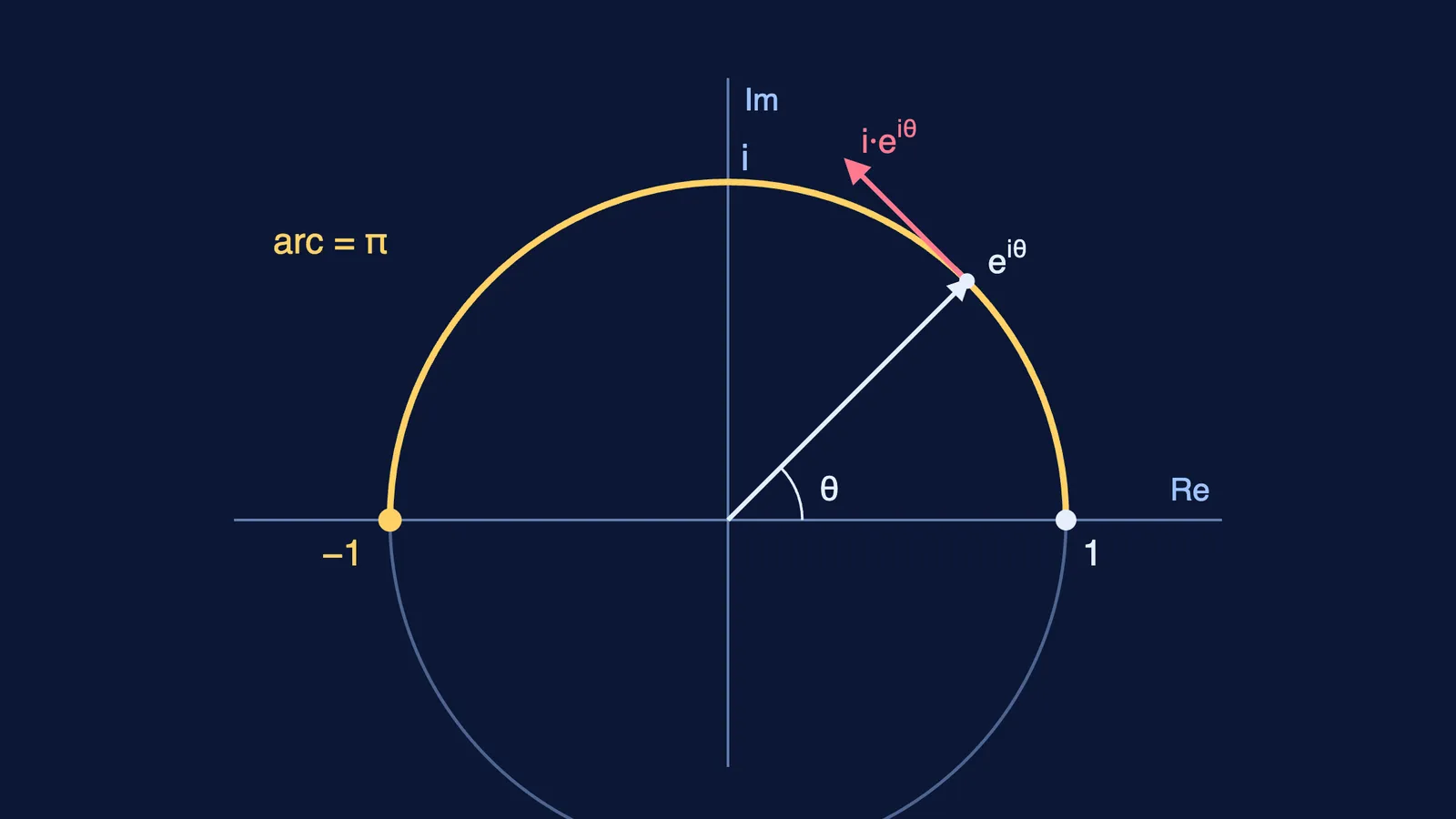
Which way it moves. Its velocity is dz/dθ = i·z. Multiplying by i is a quarter turn, so the velocity is always at right angles to the line from the origin to the point. Moving at right angles to the radius never changes your distance from the centre, like a stone whirled on a string.
How fast. The speed is the length of i·z, which is 1 × 1 = 1. So by time θ the point has travelled an arc of length θ.
Where it is. On a circle of radius 1, an arc of length θ means an angle of θ radians. A point at angle θ on the unit circle is cos θ + i sin θ.
That is Euler's formula, built from a moving point instead of a series.
So why is e to the i pi equal to minus one?
The unit circle has circumference 2π, so half of it is π. Run the clock to θ = π. The point starts at 1, heads straight up, passes through i, and after travelling π it is exactly half way round: at −1.
So e^(iπ) = −1, and adding 1 to both sides gives e^(iπ) + 1 = 0.
Check the picture against other angles:
θ = π/2, a quarter turn: e^(iπ/2) = i.
θ = π/3: e^(iπ/3) = 1/2 + i(√3/2).
θ = 2π, a full turn: e^(2πi) = 1.
Two turns add: e^(iα) × e^(iβ) = e^(i(α + β)). Raise this to a power and you get De Moivre's theorem, where powers multiply the angle.
If the moving point is hard to hold in your head, the Fermi Simulation Lab has interactive simulations for ideas that are easier to see than to read.
Can you check it without calculus?
Yes, with compounding. e^(iπ) is the limit of (1 + iπ/n)^n as n grows, just as e is the limit of (1 + 1/n)^n. Each factor turns the point by about π/n and stretches it very slightly, so n factors turn it by roughly π. Work the first two by hand:
n = 2: (1 + 1.5708i)² = 1 − 2.4674 + 3.1416i, about −1.47 + 3.14i. Far off.
n = 4: square 1 + 0.7854i to get 0.383 + 1.571i, then square again to get about −2.32 + 1.20i. Closer to the left side.
n = 100: the angles sum to 100 × arctan(π/100), about 3.1406, and the length is about 1.05, so you land near −1.05 + 0.001i.
n = 1000: about −1.005, almost on −1.
The stretch shrinks towards nothing and the total turn closes in on π, so the limit is exactly −1.
If polar form, arguments or radians still feel shaky, the Fermi Concept Library gives every concept in mathematics its own lesson and its place in the map, so you can fill the gap before the next chapter builds on it.


