On this page
In polar form, the modulus is the easy part. The angle is where it goes wrong: you work out tan⁻¹(y/x), get π/3, and write it down for a number that is nowhere near the first quadrant. This post gives you a four-step method, one fully worked example and a short practice set with answers.
What is the polar form of a complex number?
Any complex number z = x + iy can be written as z = r(cos θ + i sin θ), where r is the modulus and θ is the argument (OpenStax Precalculus 2e, section 8.5).
The modulus of x + iy is √(x² + y²), which is the distance from the point (x, y) to the origin on the Argand plane (NCERT Class 11 Mathematics, Chapter 4).
The argument is the angle between the positive real axis and the line from the origin to the point. A point has many arguments, each 2π apart. Its principal argument is the one value in the interval (−π, π] (Argument (complex analysis), Wikipedia)). Negative angles are measured clockwise, below the real axis.
The 2026-27 NCERT reprint of that chapter has a section titled "Argand Plane and Polar Representation", but it covers the Argand plane and the modulus and does not work through r(cos θ + i sin θ). For the polar form itself you will need another text, such as the OpenStax section above.
How do you convert a complex number to polar form, step by step?
Find r = √(x² + y²). It is never negative.
Find the reference angle α = tan⁻¹|y/x|, using absolute values. It always lies between 0 and π/2.
Sketch the point (x, y) and read its quadrant from the signs of x and y.
Turn α into θ using the quadrant rule below, then write r(cos θ + i sin θ).
The quadrant rule for the principal argument:
First quadrant (x > 0, y > 0): θ = α
Second quadrant (x < 0, y > 0): θ = π − α
Third quadrant (x < 0, y < 0): θ = −(π − α)
Fourth quadrant (x > 0, y < 0): θ = −α
Points on an axis have no quadrant to choose. The positive real axis gives 0, the negative real axis π, the positive imaginary axis π/2 and the negative imaginary axis −π/2.
How do you find the modulus and argument of −1 − i√3?
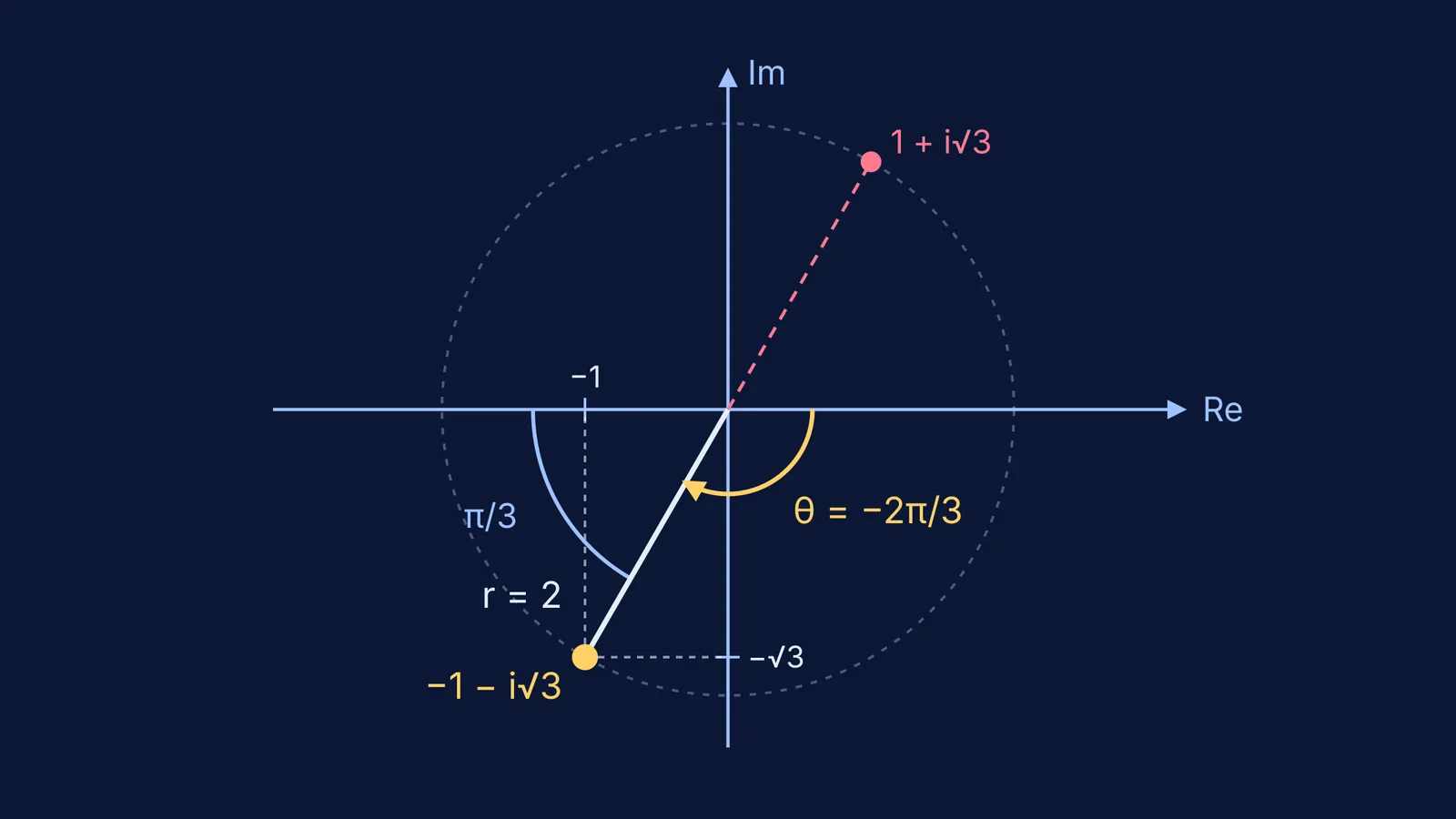
r = √((−1)² + (−√3)²) = √(1 + 3) = √4 = 2.
α = tan⁻¹|−√3 / −1| = tan⁻¹(√3) = π/3.
x = −1 and y = −√3 are both negative, so the point is in the third quadrant, below and to the left of the origin.
θ = −(π − π/3) = −2π/3.
So −1 − i√3 = 2(cos(−2π/3) + i sin(−2π/3)).
Now check it: cos(−2π/3) = −1/2 and sin(−2π/3) = −√3/2, so 2(−1/2 − i√3/2) = −1 − i√3. You get back the number you started with, so the angle is right.
Two other answers you may see:
θ = π/3 is wrong. It gives 2(1/2 + i√3/2) = 1 + i√3, the opposite point in the first quadrant.
θ = 4π/3 is a valid argument, but it is not the principal one because it lies outside (−π, π]. Subtract 2π to get −2π/3. If a question asks for "the argument" without saying principal, check which convention your book uses.
What are the common mistakes in modulus-argument form?
Using tan⁻¹(y/x) directly and skipping the quadrant step.
Writing r = −2 for a point in the third quadrant. The modulus is a distance, so it is never negative.
Giving 4π/3 or 5π/3 when the question asks for the principal argument.
Writing r(cos θ − i sin θ) when y is negative. Keep the plus sign, because the minus sign comes out of sin θ.
Mixing degrees and radians in one answer.
If the same wrong answer keeps coming back, the slip is usually in step 3 or step 4. The Fermi Problem Library has worked problems with a step-by-step solver that explains the reasoning rather than printing an answer, so you can see where the quadrant went wrong. If the gap comes earlier, at what an argument actually is, the Fermi Concept Library gives each mathematics concept its own lesson.
How can you practise until it is automatic?
Try these four before you look at the answers. Sketch each point first.
1 + i
−1 + i
√3 − i
−2i
Answers: (1) √2(cos π/4 + i sin π/4); (2) √2(cos 3π/4 + i sin 3π/4); (3) 2(cos(−π/6) + i sin(−π/6)); (4) 2(cos(−π/2) + i sin(−π/2)).
Once this feels routine, the next step is writing the same number in polar and Euler form. After that, using rotation in the complex plane shows why the argument matters in geometry questions. If you check your answers with an AI tool, here is how to check a principal argument by plotting the point.