

On this page
Ask a chatbot for the argument of −1 − i√3 and you may get π/3. That is tan⁻¹(√3), the answer you get if you divide y by x and forget where the point is. The fix takes a pencil and a quick sketch. Make the AI work quadrant by quadrant, then plot the point and see whether its angle could possibly be right.
What is the principal argument of a complex number?
The argument of z = x + iy is the counterclockwise angle from the positive real axis to the point (x, y) on the Argand plane, according to Wolfram MathWorld. The same source notes that this angle is often restricted to the range −π < θ ≤ π; that single value is the principal argument used in this post. MathWorld also notes that the inverse tangent used here takes into account the quadrant in which z lies.
That is where errors come from. The Python documentation for atan2 shows it with an example: atan(1) and atan2(1, 1) are both π/4, but atan2(−1, −1) is −3π/4, because atan2 knows the signs of both inputs. Plain tan⁻¹(y/x) only sees the ratio, so (1, √3) and (−1, −√3) look identical to it.
Why does AI get the argument of a complex number wrong?
Chatbots do not calculate the way a calculator does. In the GSM-Symbolic study by Iman Mirzadeh and colleagues, posted on arXiv in 2024, the performance of all models tested declined when only the numbers in a question were changed. Adding a single clause that seems relevant but plays no part in the solution caused drops of up to 65%. The authors hypothesise that the models replicate reasoning steps from their training data rather than reason logically.
Argument questions invite this kind of copying: in the first quadrant, tan⁻¹(y/x) happens to work, so a pattern copied from there breaks as soon as the signs change.
How do you make AI find the principal argument quadrant by quadrant?
Ask in steps, not for one line:
With three stated steps, you can see which one went wrong. For a point off the axes, the conversion is:
First quadrant (x > 0, y > 0): arg z = α
Second quadrant (x < 0, y > 0): arg z = π − α
Third quadrant (x < 0, y < 0): arg z = −(π − α)
Fourth quadrant (x > 0, y < 0): arg z = −α
On the axes the values are fixed: 0 (positive real), π (negative real), π/2 and −π/2 (positive and negative imaginary). The argument of 0 is undefined.
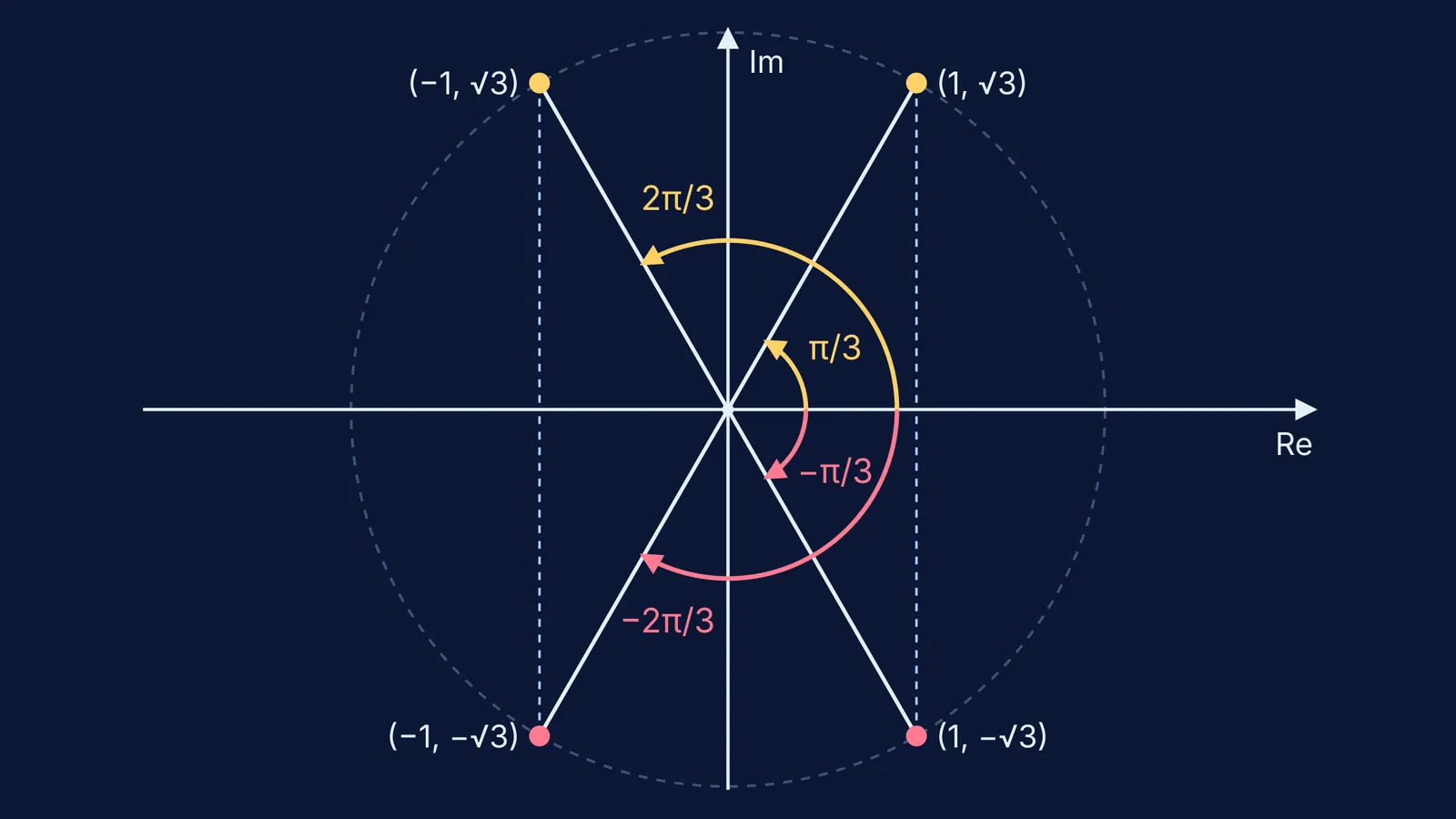
Here is a worked set, the four points in the diagram above. Each has modulus 2 and reference angle α = π/3:
1 + i√3: first quadrant, arg = π/3
−1 + i√3: second quadrant, arg = π − π/3 = 2π/3
−1 − i√3: third quadrant, arg = −(π − π/3) = −2π/3
1 − i√3: fourth quadrant, arg = −π/3
Two tempting wrong answers for the third point are π/3 (quadrant ignored) and 4π/3 (correct direction, but outside the principal range).
How do you check the AI's answer by plotting the point?
Before you read the AI's working, sketch two axes and mark the point. Then run these four checks:
Sign check. Read the signs of x and y and name the quadrant. If it differs from the AI's, stop there.
Range check. The answer must fall inside its quadrant's window: (0, π/2) for the first, (π/2, π) for the second, (−π, −π/2) for the third, (−π/2, 0) for the fourth. 4π/3 fails, because nothing above π is allowed.
Steepness check. If |y| > |x|, the point is steeper than the 45° line, so the reference angle α must exceed π/4. For −1 − i√3, |y| ≈ 1.73 beats |x| = 1, so α = π/3 fits.
Machine check (optional). In Python, math.atan2(y, x) gives the angle with the correct quadrant, and its result lies between −π and π (Python docs). Note the order: y comes first.
If the sign check keeps tripping you up, go back to which quadrant a point lies in and how to read the signs. Once the argument is right, you can write the number in polar and Euler form. For other answers, verify an AI maths answer by substituting it back.
If a sign slips somewhere inside a longer problem, the Fermi Problem Library has worked problems with a step-by-step solver that explains the reasoning rather than printing an answer. And Fermi's AI tutor teaches by writing on a board and drawing the figure, so the picture can come before the formula, which is the order this check needs.
Next time an AI hands you an angle, plot the point first, then decide whether to believe it.


