On this page
In short
Large Language Models often fail to catch their own logical mistakes when checking their work, according to a 2023 study by Google DeepMind and UIUC. The most reliable way to verify an AI's maths answer is to substitute the result back into the original problem.
Artificial intelligence can solve complex equations in seconds, but it has a known blind spot: it struggles to check its own work. If you ask a chatbot "Are you sure that's the right answer?", it will often invent a new error just to sound agreeable, or confidently repeat its original mistake.
A 2023 study by researchers from Google DeepMind and the University of Illinois at Urbana-Champaign found that large language models cannot yet self-correct reasoning. When asked to review their own maths logic, the models frequently changed correct answers into incorrect ones. They suffer from logical oversight, meaning they repeat the same reasoning flaw during the checking phase.
Because of this generation-verification gap, you cannot rely on an AI to spot its own hallucinations. Instead, the best way to verify an AI maths answer is to take matters into your own hands by using a fundamental mathematical habit: substituting the answer back into the original equation.
Why is substituting the answer back so effective?
Substitution, often called "plugging it back in", is the process of replacing the variable in the original equation with the numerical value you (or the AI) calculated. If the left side equals the right side, the answer is demonstrably correct.
This method completely bypasses the AI's flawed reasoning chain. You do not need to read through ten steps of generated algebra to find where the computer dropped a minus sign. You only need the original problem and the final answer.
How do you check an AI's algebra answer?
Let's say you take a photo of a linear equation and give it to an AI to solve.
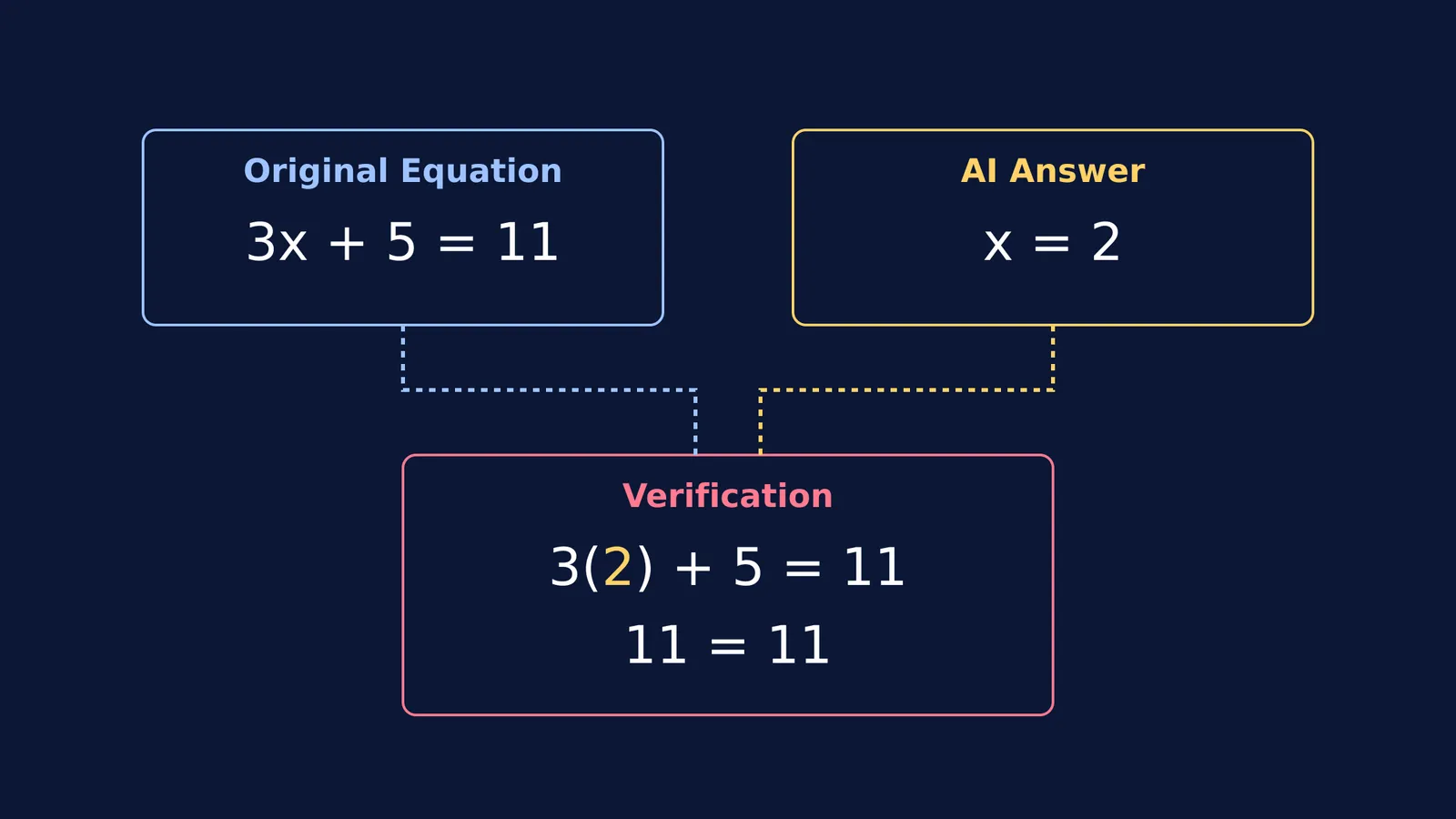
The original problem: Solve for x in 3x + 5 = 11
The AI gives you a long explanation and concludes that x = 2. To verify this without asking the AI, follow these three steps:
Write down the original equation: 3x + 5 = 11
Replace x with 2 (using parentheses): 3(2) + 5 = 11
Simplify the arithmetic: 6 + 5 = 11, which becomes 11 = 11.
Because 11 equals 11, the AI's answer is correct.
If the AI had hallucinated and told you x = 3, your check would look like this: 3(3) + 5 = 11 9 + 5 = 11 14 = 11
Since 14 does not equal 11, you instantly know the AI is wrong, and you can solve the problem yourself or ask for a fresh start. If you are testing different platforms to see which ones hallucinate the least, you can read more about how to evaluate an AI tutor with simple checks like this.
How can you verify a calculus or differential equation solution?
Substitution is not just for basic algebra; it is exactly how you verify solutions to differential equations in advanced mathematics.
Suppose you ask an AI to solve the differential equation dy/dx = 2x. The AI states the solution is y = x² + 5.
To verify it, plug the solution back into the original problem:
The original equation asks for the derivative of y with respect to x.
Differentiate the AI's answer: d/dx(x² + 5) = 2x.
Substitute this back into the original equation: 2x = 2x.
The two sides match, so the function is indeed a valid solution. This works for integrals too; if an AI integrates a function, you can differentiate the AI's result to see if you get the original function back.
When should you move from answer engines to tutors?
Verifying every answer can feel tedious if the AI makes frequent mistakes. Chatbots designed for general conversation often fail on complex numerical problems because they predict the next most likely word rather than actually computing the math.
If you want a tool that builds understanding rather than just printing an answer for you to check, you need a different kind of system. This is the main difference when looking at AI tutors vs answer chatbots.
Instead of typing out a final number, Fermi's AI tutor works alongside you. It builds a plan for the session, works out what you already know, and teaches through the problem step by step—checking your understanding as it goes, rather than leaving you to verify a hallucinated answer alone.