On this page
Multiply (1 + i) by itself eight times and you fill half a page with brackets. De Moivre's theorem does it in two lines, because in polar form a power only raises the length and multiplies the angle.
What does De Moivre's theorem say?
Wolfram MathWorld states De Moivre's identity as (cos θ + i sin θ)^n = cos nθ + i sin nθ, alongside its exponential form (e^(iθ))^n = e^(inθ). That form shows why the rule feels natural: exponents multiply. In exam work you use it for whole-number powers n.
Abraham de Moivre (1667–1754) was a French-born mathematician who worked in London, and according to his MacTutor biography, a version of the formula was published in 1722, with a closely related formula in a paper of 1707.
To use it on a number a + ib, first write it in polar form, z = r(cos θ + i sin θ), where r = √(a² + b²) is the modulus and θ is the argument. Then:
z^n = r^n (cos nθ + i sin nθ)
Raise the length to the power n and multiply the angle by n. If polar form feels rusty, our explainer on polar and Euler form of complex numbers walks through it, and why arguments add when you multiply complex numbers shows where the angle rule comes from.
How do you find (1 + i)^n with De Moivre's theorem?
Modulus: r = √(1² + 1²) = √2.
Argument: 1 + i sits in the first quadrant on the line y = x, so θ = π/4.
Apply the theorem: (1 + i)^n = (√2)^n (cos nπ/4 + i sin nπ/4) = 2^(n/2) (cos nπ/4 + i sin nπ/4).
Now put n = 8. The length becomes (√2)^8 = 16 and the angle becomes 8 × π/4 = 2π, a full turn:
(1 + i)^8 = 16 (cos 2π + i sin 2π) = 16 (1 + 0i) = 16
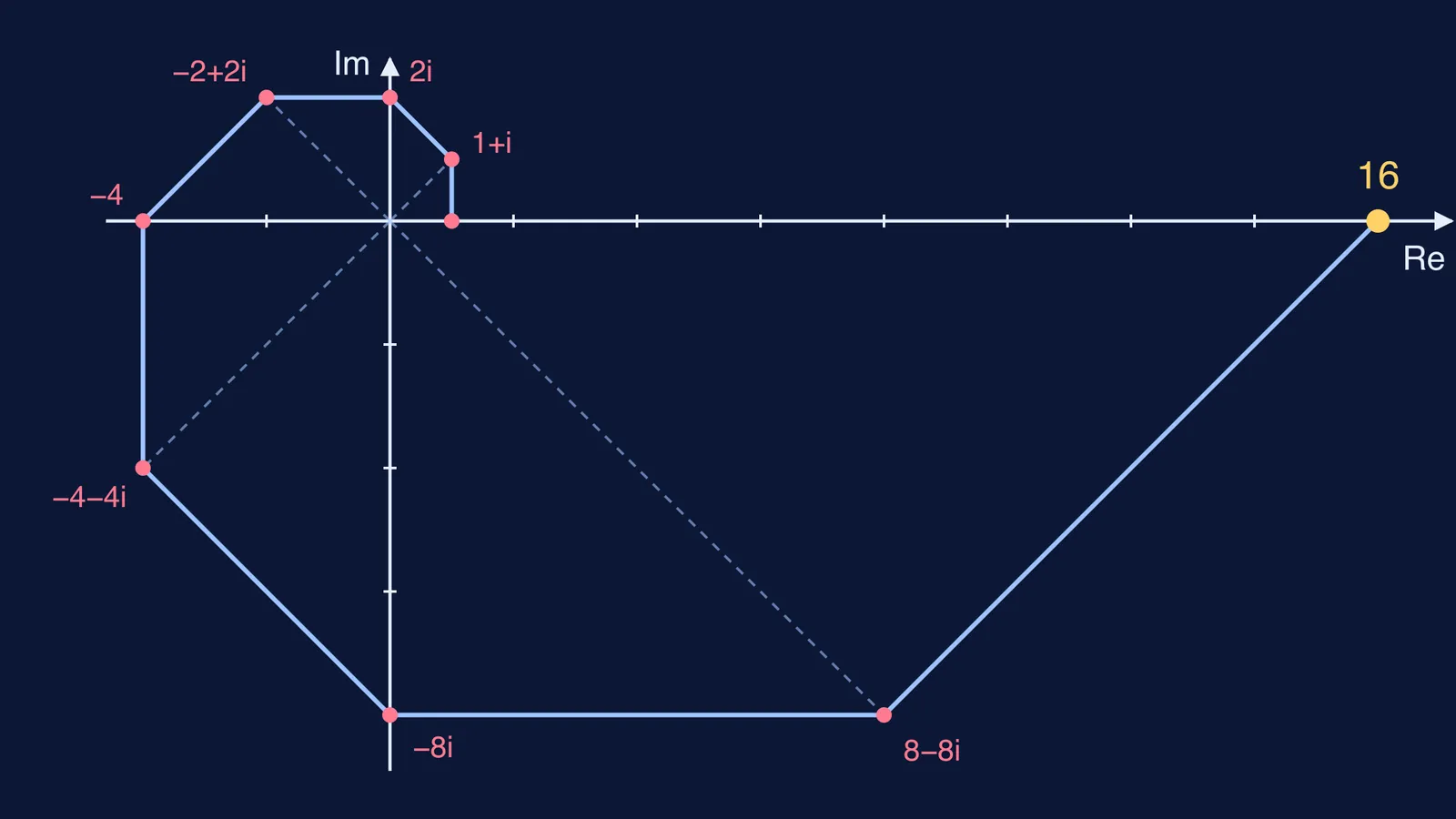
The diagram above plots every power up to n = 8. Each step turns 45° anticlockwise and stretches by √2:
n = 1: 1 + i
n = 2: 2i
n = 3: −2 + 2i
n = 4: −4
n = 5: −4 − 4i
n = 6: −8i
n = 7: 8 − 8i
n = 8: 16
When n is a multiple of 4, nπ/4 is a multiple of π, so (1 + i)^n is real. When n is 2 more than a multiple of 4, the angle points straight up or down, so the answer is purely imaginary. For example, (1 + i)^10 = 32 (cos 5π/2 + i sin 5π/2) = 32i.
If the i^4 step makes you pause, see our guide to simplifying powers of iota.
How do you work out (√3 + i)^6?
Modulus: r = √(3 + 1) = 2.
Argument: tan θ = 1/√3 and the point is in the first quadrant, so θ = π/6.
Apply the theorem: (√3 + i)^6 = 2^6 (cos 6π/6 + i sin 6π/6) = 64 (cos π + i sin π).
Evaluate: cos π = −1 and sin π = 0, so (√3 + i)^6 = −64.
Check it the long way: (√3 + i)^2 = 2(1 + √3 i), and (1 + √3 i)^3 = −8, so the total is 2³ × (−8) = −64.
Where do students lose marks with De Moivre's theorem?
Check these slips; most of them happen in the polar form, before the theorem is used:
Wrong quadrant for the argument. −1 + i has argument 3π/4, not −π/4; tan⁻¹(b/a) alone cannot tell them apart. Sketch the point first.
Forgetting r^n. Writing cos 8θ + i sin 8θ and dropping 16 turns (1 + i)^8 into 1.
Not reducing the angle. Take away whole turns of 2π before you evaluate cos and sin.
Mixing degrees and radians in the same line.
Sign errors with conjugates. 1 − i has argument −π/4, so its powers turn clockwise.
Can you try three practice powers?
Try these before reading the answers:
(1 − i)^6. Here r = √2 and θ = −π/4, so you get 8 (cos(−3π/2) + i sin(−3π/2)) = 8i.
(1 + √3 i)^5. Here r = 2 and θ = π/3, so you get 32 (cos 5π/3 + i sin 5π/3) = 16 − 16√3 i.
(−1 + i)^4. Here r = √2 and θ = 3π/4, so you get 4 (cos 3π + i sin 3π) = −4.
If modulus and argument are the weak spot, the Fermi Concept Library gives each mathematics concept its own lesson. If your answer differs from ours, the Fermi Problem Library has worked problems with a step-by-step solver that explains the reasoning rather than printing an answer, so you can find the exact line where your angle went wrong.