

On this page
Every power of iota lands on one of four values: 1, i, −1 or −i. Once you see why, a question like i²⁴³ or i⁻³⁵ becomes a one-line answer, and sums like i + i² + … + i¹⁰⁰ collapse to almost nothing. The one place that needs care is a square-root rule that quietly stops working when both numbers are negative.
What does i to the power n equal?
Start from the definition: i = √(−1), so i² = −1. The NCERT Class 11 Mathematics chapter on complex numbers builds the next powers from that one fact: i³ = i²·i = −i, and i⁴ = (i²)² = 1.
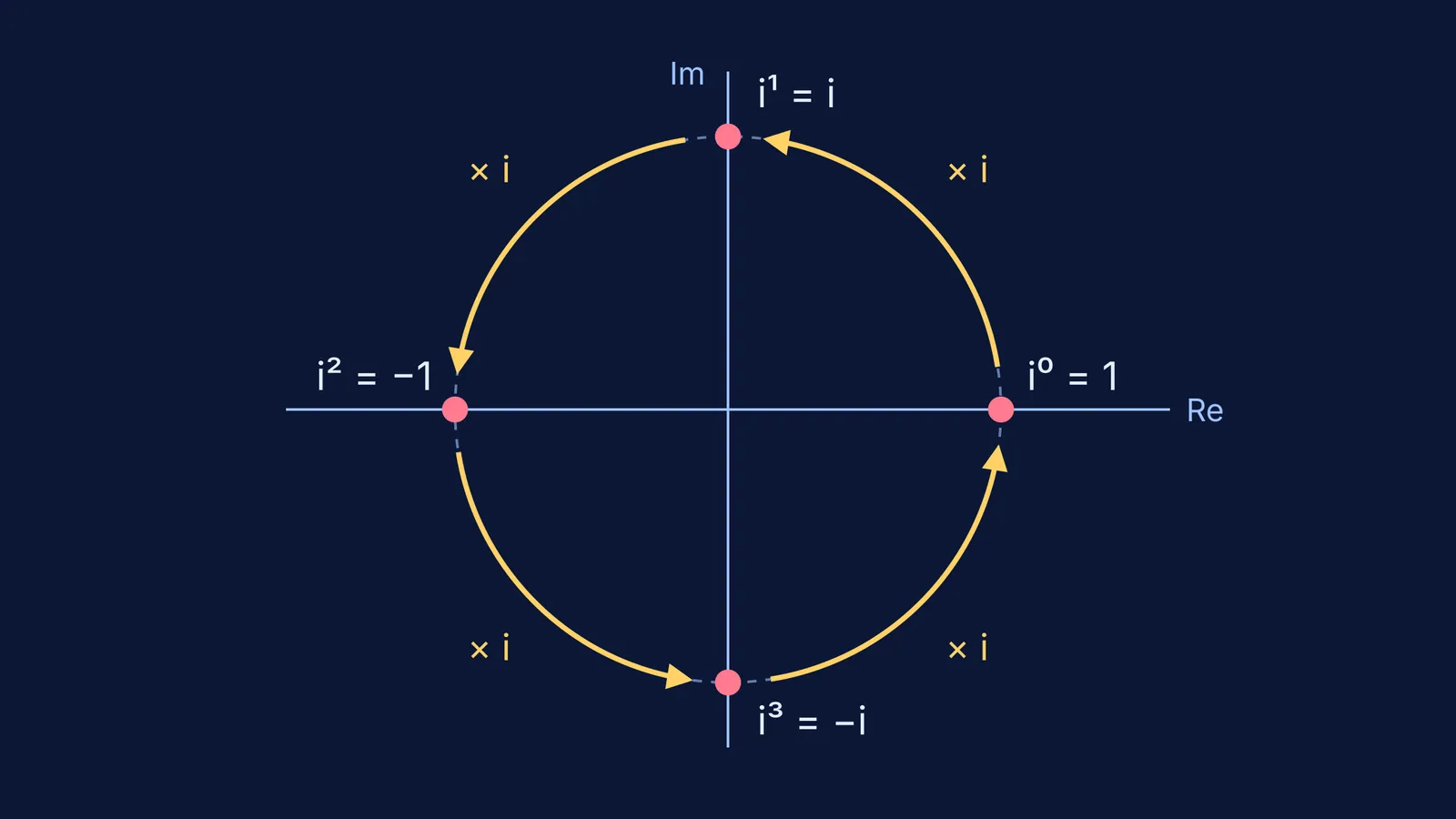
After i⁴ = 1, the pattern starts again, because i⁵ = i⁴·i = i. NCERT states the general rule: for any integer k, i⁴ᵏ = 1, i⁴ᵏ⁺¹ = i, i⁴ᵏ⁺² = −1 and i⁴ᵏ⁺³ = −i (NCERT, section 4.3.5).
Multiplying by i turns a point on the complex plane a quarter-turn anticlockwise, so four multiplications bring you back to where you started. Our post on why multiplying complex numbers adds their angles shows this rotation step by step.
How do you simplify a large power of i?
Divide the exponent by 4 and keep only the remainder.
Find r, the remainder when n is divided by 4.
Read off the answer: r = 0 gives 1, r = 1 gives i, r = 2 gives −1, r = 3 gives −i.
A shortcut for big exponents: 100 is a multiple of 4, so only the last two digits of n decide the remainder.
Worked example: simplify i²⁴³. The last two digits are 43, and 43 = 4 × 10 + 3, so r = 3 and i²⁴³ = −i.
Worked example: simplify i¹⁹⁹⁸ + i²⁰²⁶. The remainders are 98 → 2 and 26 → 2, so both terms equal −1 and the sum is −2.
How do you handle negative powers of iota?
NCERT works out the first four directly: i⁻¹ = −i, i⁻² = −1, i⁻³ = i and i⁻⁴ = 1 (NCERT, section 4.3.5). The trick behind i⁻¹ is to multiply top and bottom by i: 1/i = i/i² = i/(−1) = −i.
The cycle-of-four rule holds for negative k too, so you can either:
add a multiple of 4 to make the exponent positive, or
simplify the positive power and take its reciprocal.
Worked example: i⁻³⁵, which NCERT also solves. Add 36 (a multiple of 4) to get i¹ = i. Check it the other way: i³⁵ = −i (remainder 3), and 1/(−i) = i. Both routes agree.
What is the sum of consecutive powers of i?
Add one full cycle: 1 + i + (−1) + (−i) = 0. Any four consecutive powers of i add to zero, because they are iᵐ times (1 + i + i² + i³), and that bracket is 0.
So for a long sum, strip out complete blocks of four and keep only the leftover terms.
Worked example: i + i² + i³ + … + i¹⁰². That is 102 terms. The first 100 make 25 full blocks, which add to 0. The two left over are i¹⁰¹ = i and i¹⁰² = −1, so the sum is −1 + i.
Count terms carefully: i¹ to iⁿ has n terms, but i⁰ to iⁿ has n + 1.
Why does √(−a) × √(−b) give the wrong sign?
For positive real numbers, √a × √b = √(ab). NCERT notes that this still holds when one of a or b is negative, but not when both are (NCERT, section 4.3.6). The textbook shows why: if the rule held, i² = √(−1) × √(−1) = √1 = 1, which contradicts i² = −1.
The fix is a habit: convert every square root of a negative number to i form first, using √(−a) = √a · i for positive a, as NCERT does. Only then multiply.
Worked example: √(−4) × √(−9).
Wrong: √((−4)(−9)) = √36 = 6.
Right: (2i)(3i) = 6i² = −6.
The two answers differ only in sign, so a wrong method can still look like a sensible answer. Whenever two negative numbers sit under separate root signs, slow down.
Where to practise next
Try these on your own before checking: i⁵⁷, i⁻⁹⁸, i² + i³ + … + i⁴⁰, and √(−16) × √(−25). (Answers: i, −1, −i, and −20. For the sum, i¹ to i⁴⁰ is ten full blocks, so removing the i¹ term leaves −i.)
If you get stuck on why a step works, the Fermi Problem Library has worked problems with a step-by-step solver that explains the reasoning rather than printing an answer. For the ideas underneath, the Fermi Concept Library gives each concept its own lesson. Next, see how to factorise a² + b² using complex numbers.


