

On this page
Does an infinite sum like 1 + 1/4 + 1/9 + … add up to a finite number? For one family, the p-series, the answer is clean, and that family becomes the ruler you hold against most other positive series.
When does the series of 1 over n to the p converge?
For any real number p, the series Σ 1/nᵖ is called a p-series (OpenStax Calculus Volume 2, section 5.3).
The p-series converges if p > 1 and diverges if p ≤ 1 (OpenStax, section 5.3).
So Σ 1/n² and Σ 1/n^1.01 converge, while the harmonic series Σ 1/n and Σ 1/√n diverge. The boundary is sharp: p = 1 itself diverges. For p ≤ 0 the terms do not even shrink to 0, so the divergence test settles it.
Why does the integral test give the p-series rule?
The integral test says: if Σ aₙ has positive terms, f is continuous and decreasing, and f(n) = aₙ for every integer n ≥ N, then Σ aₙ and the integral of f from N to ∞ both converge or both diverge (OpenStax, section 5.3).
For p > 0, f(x) = 1/xᵖ is continuous, positive and decreasing on [1, ∞), so the test applies. For p ≠ 1, the integral of x^(−p) from 1 to b is (b^(1−p) − 1)/(1 − p).
If p > 1, b^(1−p) goes to 0, so the integral settles at 1/(p − 1) and the series converges.
If p < 1, b^(1−p) grows without limit, so both diverge.
If p = 1, the integral is ln b, which also grows without limit.
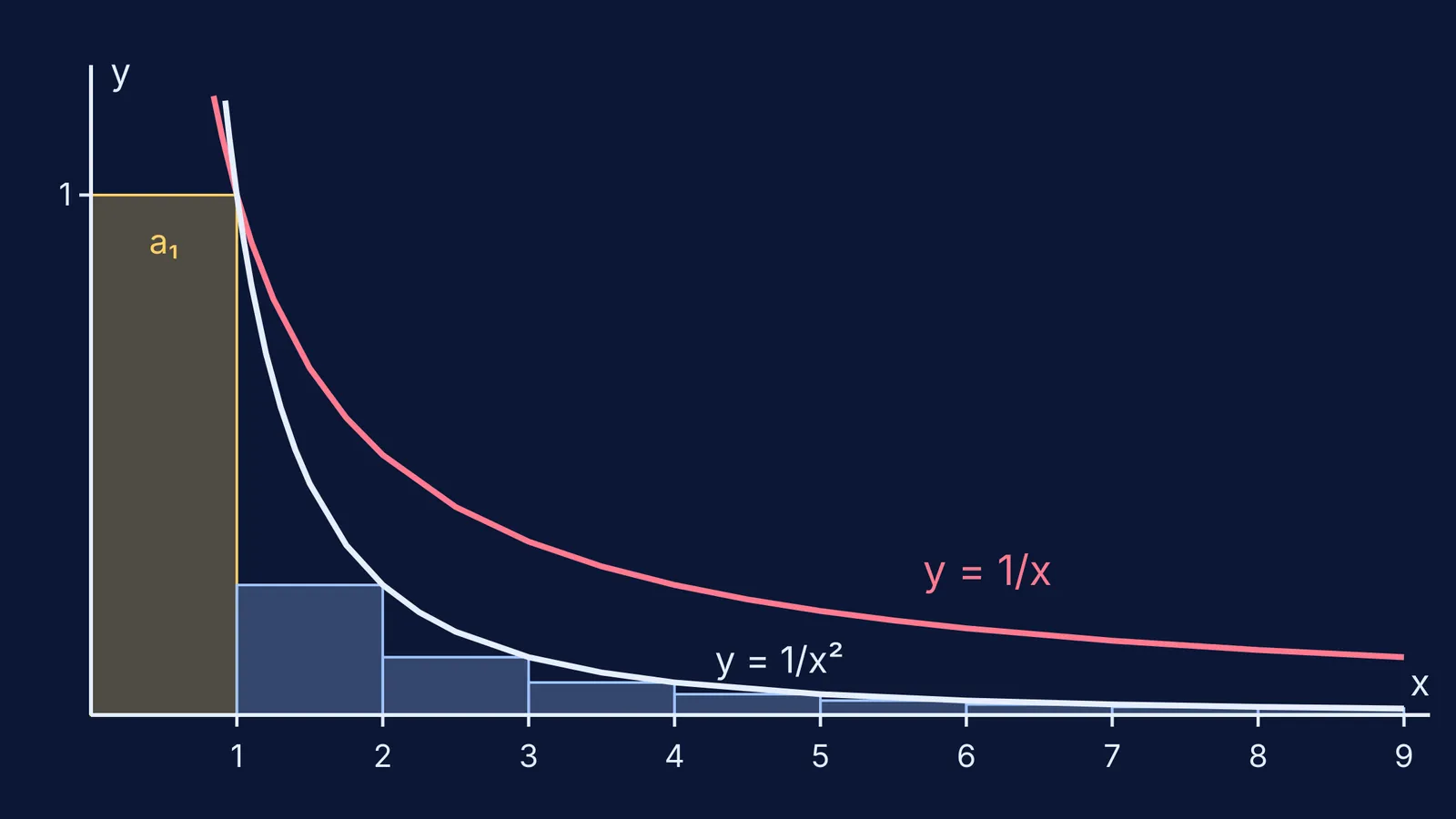
The picture above shows p = 2. Draw each term 1/n² as a bar of width 1 on [n − 1, n]. From n = 2 on, every bar sits under y = 1/x², whose area from 1 to ∞ is 1, so the whole sum stays below 2. Under y = 1/x the area never stops growing.
For the actual value, read how Euler found the exact sum of 1/n².
What are the comparison and limit comparison tests?
The comparison test has two halves (OpenStax, section 5.4):
If 0 ≤ aₙ ≤ bₙ from some point on and Σ bₙ converges, then Σ aₙ converges.
If aₙ ≥ bₙ ≥ 0 from some point on and Σ bₙ diverges, then Σ aₙ diverges.
The limit comparison test, for non-negative terms, looks at L = lim aₙ/bₙ. If L is finite and not 0, the two series both converge or both diverge. If L = 0 and Σ bₙ converges, Σ aₙ converges. If L = ∞ and Σ bₙ diverges, Σ aₙ diverges. Other combinations tell you nothing.
The skill is choosing bₙ: keep only the highest power of n on top and bottom.
Does Σ 1/(n² + n) converge?
Guess: for large n, n² + n behaves like n², so the terms behave like 1/n², a p-series with p = 2. Expect convergence.
Compare: n² + n > n², so 0 < 1/(n² + n) < 1/n². Your series is smaller than a convergent one, so it converges.
Check: split 1/(n(n + 1)) into 1/n − 1/(n + 1). The partial sum telescopes to 1 − 1/(N + 1), which tends to 1. The sum is exactly 1.
The telescoping step is the same partial-sum idea you meet in the Class 11 sequences and series formulas.
Does Σ 1/√(n + 1) converge?
Guess: √(n + 1) behaves like √n, so the terms behave like 1/n^(1/2), a p-series with p = 1/2. Expect divergence.
The trap: 1/√(n + 1) < 1/√n, and being smaller than a divergent series proves nothing.
Limit comparison: aₙ/bₙ = √n/√(n + 1) = 1/√(1 + 1/n), which tends to 1. Since L = 1 is finite and not 0, both series behave alike, and Σ 1/√(n + 1) diverges.
How do you test any positive series?
Check that the terms go to 0. If not, the series diverges.
Keep the highest powers of n on top and bottom to find the p-series it resembles.
Pick the direction: for p > 1, show your terms are smaller; for p ≤ 1, show they are bigger. If you cannot, take the limit of the ratio.
Write the conclusion with the test and the p-series named, for example "diverges by limit comparison with Σ 1/√n, p = 1/2".
If you keep reaching for a comparison that points the wrong way, the Fermi Problem Library has worked problems with a step-by-step solver that explains the reasoning rather than printing an answer. For the ideas underneath, improper integrals and limits, the Fermi Concept Library gives each concept its own lesson and its place in the map.
Now try the routine on Σ 1/(n³ + 1) and Σ n/(n² + 5).


