

On this page
Add up 1 − 1/2 + 1/3 − 1/4 + … term by term and the running total swings up and down, each swing smaller than the last, closing in on one number. Drop the minus signs and the same terms add up without limit. Three checks tell you which way a given series goes.
What is the alternating series test?
An alternating series is one whose signs flip at every term: b1 − b2 + b3 − b4 + …, with every b_n positive. The alternating series test says such a series converges if the sizes never increase (b_(n+1) ≤ b_n) and tend to zero (OpenStax Calculus Volume 2, Section 5.5, Theorem 5.13). The same section notes that the conditions only need to hold from some term onwards, so a few untidy terms at the start change nothing.
Many texts call it the Leibniz test, after Gottfried Leibniz, who discussed the criterion in his unpublished manuscript De quadratura arithmetica of 1676 (Wikipedia: Alternating series test).
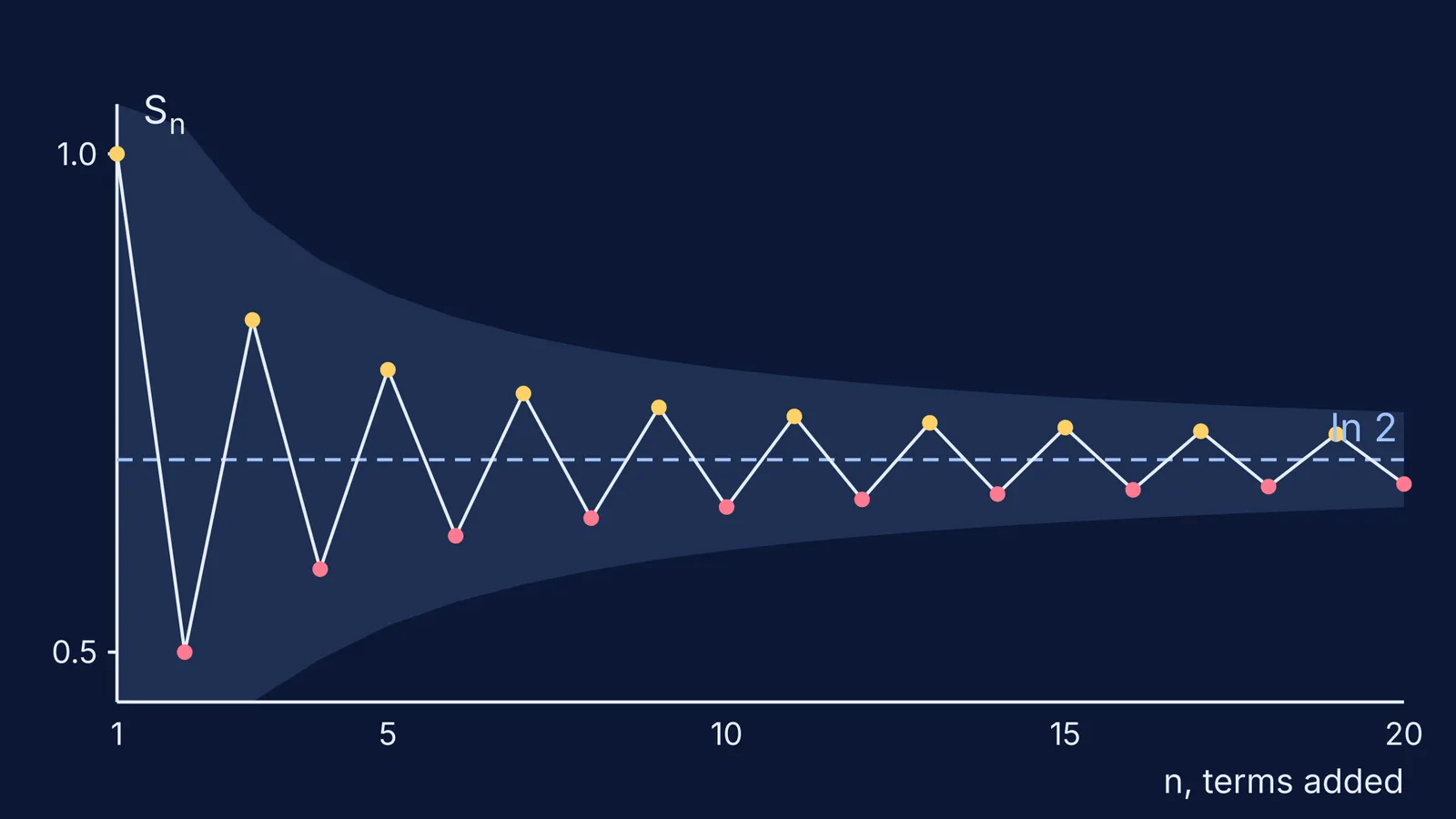
Why does it work? Each term overshoots by less than the last, so the partial sums are squeezed into a shrinking window that closes on one point.
When does an alternating series converge, and when does the test say nothing?
Run these checks in order:
Do the signs really alternate? Write the series as (−1)^(n+1) b_n with b_n > 0. A pattern like + + − − needs a different test.
Does b_n tend to 0? If not, stop: the series diverges, because no series can converge when its terms do not shrink to zero.
Does b_n decrease, at least eventually? Show b_(n+1) ≤ b_n directly, or write b_n = f(n) and check that f′(x) < 0 for large x.
If all three pass, the series converges. For example, the series with terms (−1)^n · n/(n+1) fails check 2, since n/(n+1) tends to 1, so it diverges.
How accurate is a partial sum of an alternating series?
If a series passes the test, stopping after N terms leaves an error no larger than b_(N+1), the first term you left out (OpenStax, Theorem 5.14).
Worked example 1. The alternating harmonic series 1 − 1/2 + 1/3 − … sums to ln 2, about 0.6931 (OpenStax, Section 5.5). After four terms, S4 = 1 − 1/2 + 1/3 − 1/4 = 7/12, about 0.5833. The bound promises an error of at most b5 = 1/5 = 0.2; the actual error is about 0.1098, well inside it. To guarantee an error below 0.01 you need 1/(N+1) ≤ 0.01, which means N = 99 terms. This series converges slowly.
Worked example 2. Estimate 1 − 1/2! + 1/3! − 1/4! + … to within 0.001. You need 1/(N+1)! ≤ 0.001, that is (N+1)! ≥ 1000. Since 6! = 720 and 7! = 5040, N = 6 terms are enough. Factorials grow fast, so this one converges quickly.
The true sum also lies between any two consecutive partial sums: S4 ≈ 0.5833 and S5 ≈ 0.7833 trap ln 2. If the first omitted term is positive, S_N is an underestimate.
What is the difference between conditional and absolute convergence?
A series converges absolutely if the series of its absolute values converges; it converges conditionally if the series itself converges but the series of absolute values diverges (OpenStax, Section 5.5).
1 − 1/2 + 1/3 − … is conditionally convergent: Leibniz says it converges, but 1 + 1/2 + 1/3 + … diverges.
1 − 1/4 + 1/9 − 1/16 + … is absolutely convergent, because 1 + 1/4 + 1/9 + … is a p-series with p = 2, which converges.
This matters. By the Riemann rearrangement theorem, the terms of a conditionally convergent series can be reordered to converge to any real number you choose, or to diverge (Wikipedia: Riemann series theorem). An absolutely convergent series has the same sum in every order (OpenStax, Section 5.5).
If terms like p-series or comparison test feel shaky, the Fermi Concept Library gives every concept in mathematics its own lesson and its place in the map, so you can fill the gap before coming back here.
How should you answer an alternating series question in an exam?
Use this four-step routine:
Make every sign positive and test that series first (comparison, p-series, ratio). If it converges, the answer is absolutely convergent.
If it diverges, run the three Leibniz checks. If they pass, the answer is conditionally convergent.
If b_n does not tend to 0, the answer is divergent.
For an estimate to within a stated error, solve b_(N+1) ≤ error for N, and quote the bound in your answer.
If you pick the right test but reach the wrong conclusion, work a few series in the Fermi Problem Library, whose step-by-step solver explains the reasoning rather than printing an answer.
Next time the signs start flipping, run the three checks before you reach for anything heavier.


