On this page
Green cardamom seed oil is mostly two molecules: α-terpinyl acetate, an ester, and 1,8-cineole (eucalyptol), a cyclic ether. Heat the oil with KOH and they part ways. The ester is saponified to an alcohol and potassium acetate. The ether passes through unchanged. That one experiment covers four exam ideas: ester against ether reactivity, the ester value, functional isomerism and counting stereocentres.
What is in cardamom seed oil?
Cardamom, Elettaria cardamomum, is native to India and Sri Lanka. A 2024 study in Plants ran one GC-MS analysis of a commercial cardamom seed oil bought in Thailand. The paper does not say where the cardamom was grown. It found 34 constituents making up 98.1% of the oil. The seven main ones, by peak area, were:
α-terpinyl acetate: 46.1%
1,8-cineole (eucalyptol): 31.2%
linalyl acetate: 4.7%
α-pinene: 4.7%
linalool: 2.5%
terpineol: 1.9%
nerolidol: 1.1%
Composition varies a lot from sample to sample. The same paper cites a survey of cardamom accessions with 1,8-cineole between 15.2% and 49.4%, and another oil with 34.3% cineole and only 23.3% α-terpinyl acetate. So the numbers below describe one oil, not every cardamom. Our post on why cardamom, saffron and vanilla cost so much covers how the spice is grown.
PubChem gives the structures. α-Terpinyl acetate is 2-(4-methylcyclohex-3-en-1-yl)propan-2-yl acetate, C₁₂H₂₀O₂, M = 196.29 g/mol. Linalyl acetate has the same formula. 1,8-Cineole is 1,3,3-trimethyl-2-oxabicyclo[2.2.2]octane, C₁₀H₁₈O.
Why does the ester react with KOH while cineole does not?
An ester has a C=O group. Its carbon is electron-poor, so hydroxide attacks it and forms a tetrahedral intermediate. The alkoxide then leaves, and the acid it leaves behind is at once turned into a carboxylate ion. That last step pulls the reaction to completion.
C₁₂H₂₀O₂ + KOH → C₁₀H₁₈O + CH₃COOK
For α-terpinyl acetate the alcohol is α-terpineol, 2-(4-methylcyclohex-3-en-1-yl)propan-2-ol. Linalyl acetate gives linalool in the same way. Check the balance: the left side has 12 C, 21 H, 3 O and 1 K, and so does the right.
Both esters are made from tertiary alcohols. The bulky groups near the ester oxygen crowd the carbonyl carbon, so expect them to saponify more slowly than a simple ester such as ethyl acetate. Read the example below as stoichiometry, not as a lab recipe.
An ether has no C=O for hydroxide to attack. To break a C–O bond, hydroxide would have to push out an alkoxide ion, which is a very poor leaving group. So cineole survives hot aqueous KOH. That does not make it inert. Ethers are split by hot concentrated HI, as our post on ether cleavage with HI shows, and strong acid can also open cineole's ring.
How do you calculate the ester value of cardamom oil?
The ester value is the number of milligrams of KOH needed to saponify the esters in 1 g of a sample. Each molecule of terpinyl or linalyl acetate has one ester group, so it uses one KOH. A fat is different: each triglyceride has three ester groups, as worked out in our post on saponification value and iodine value.
Worked example
Question. Using the oil above, and treating peak-area percentages as mass percentages, find the ester value, the mass of α-terpineol formed from 1 g of oil, and what happens to the cineole. Take M(KOH) = 56.11 g/mol.
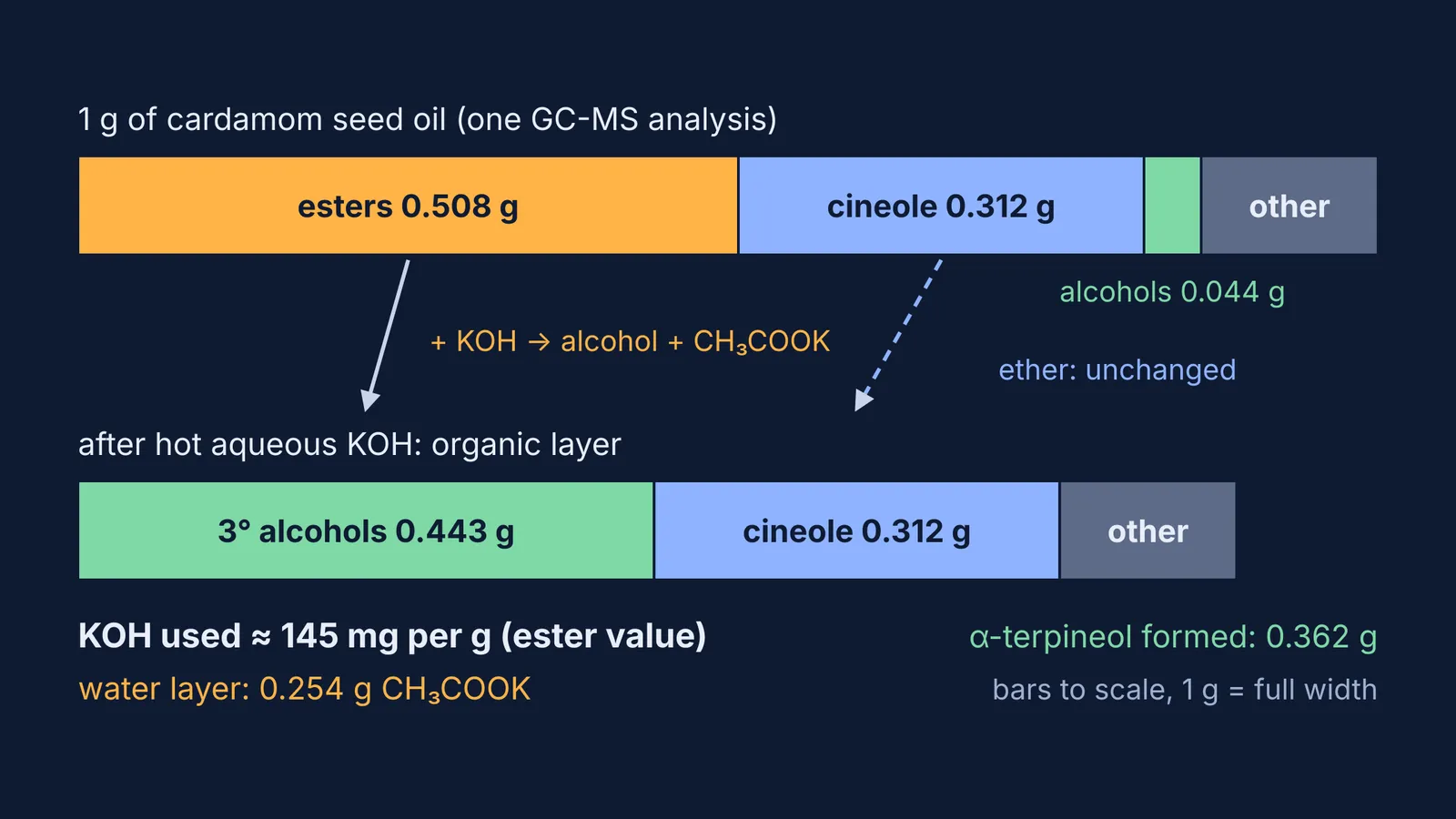
α-Terpinyl acetate in 1 g of oil = 0.461 g.
Moles = 0.461 ÷ 196.29 = 2.349 × 10⁻³ mol. It needs the same number of moles of KOH.
Mass of KOH = 2.349 × 10⁻³ × 56.11 = 0.1318 g = 131.8 mg. From α-terpinyl acetate alone, the ester value is about 132 mg KOH per g.
Linalyl acetate adds 0.047 ÷ 196.29 × 56.11 × 1000 = 13.4 mg.
Total: 131.8 + 13.4 = 145.2, so the ester value is about 145 mg KOH per g.
α-Terpineol formed (M = 154.25 g/mol) = 2.349 × 10⁻³ × 154.25 = 0.362 g. Linalyl acetate adds 0.037 g of linalool.
Potassium acetate formed = (0.508 ÷ 196.29) × 98.14 = 0.254 g. It stays in the water layer.
Cineole: all 0.312 g passes through unchanged.
You can write steps 2 to 5 as one shortcut: ester value = w × 56110 ÷ M, where w is the mass fraction of the ester and M its molar mass.
Two cautions. The paper's table lists only seven compounds (92.2%). The other 27 constituents (5.9%) and the 1.9% left unidentified could include esters, which would raise the value. And composition swings between samples: an oil with only 23.3% α-terpinyl acetate would get about 67 mg KOH per g from that ester. We did not find an official ester-value specification for cardamom oil, so do not treat 145 as a standard.
If you want more numericals like this with every step explained, the Fermi Problem Library has a step-by-step solver that explains the reasoning.
Why are cineole and α-terpineol functional isomers?
Both are C₁₀H₁₈O, with M = 154.25 g/mol. The degree of unsaturation is (2 × 10 + 2 − 18) ÷ 2 = 2 for each. They spend those two units differently.
1,8-Cineole: two rings and no C=C. The oxygen bridges two carbons, so it is an ether.
α-Terpineol: one ring and one C=C. The oxygen is in an OH group on a tertiary carbon, so it is an alcohol.
Same formula, different functional groups: that is functional isomerism. Three tests tell them apart.
Sodium metal. α-Terpineol gives hydrogen: 2C₁₀H₁₇OH + 2Na → 2C₁₀H₁₇ONa + H₂. Cineole has no O–H, so it gives no gas.
Lucas reagent. α-Terpineol, a tertiary alcohol, should turn it turbid at once, though a C₁₀ alcohol may not dissolve well in the reagent. Cineole shows no alcohol reaction.
Bromine. α-Terpineol's C=C decolourises bromine. Cineole has no C=C.
How many stereocentres do these molecules have?
α-Terpinyl acetate and α-terpineol: one each, at ring C1, the carbon carrying the side chain. Going round the ring one way, you meet the C=C after one CH₂. Going the other way, you pass two CH₂ groups first. The two ring paths differ, so C1 has four different groups.
Linalyl acetate: one, at C3, the same carbon that is the stereocentre in linalool.
1,8-Cineole: none. Each bridgehead joins three bridges: –O–C(CH₃)₂–, –CH₂CH₂– and a second –CH₂CH₂–. Two of the three are identical, so neither bridgehead carries four different groups. A mirror plane passes through both bridgeheads, the oxygen and the C(CH₃)₂ carbon, so the molecule is achiral and optically inactive.
If the link between structure and reactivity still feels loose, the Concept Library covers esters, ethers and isomerism one concept at a time.
Quick checklist
Cardamom seed oil in one analysis: 46.1% α-terpinyl acetate, 31.2% 1,8-cineole, 4.7% linalyl acetate.
Esters + KOH → alcohol + potassium acetate. Ethers do not react with aqueous KOH.
Ester value = mg KOH per g. One KOH per ester group: w × 56110 ÷ M.
This oil: about 132 mg KOH per g from α-terpinyl acetate, about 145 with linalyl acetate.
1 g of oil gives about 0.362 g of α-terpineol, and the cineole is left unchanged.
Cineole and α-terpineol are C₁₀H₁₈O functional isomers. Only the alcohol gives H₂ with Na.
Cineole has no stereocentre. α-Terpinyl acetate, α-terpineol and linalyl acetate have one each.